Measuring ROI From a CLM Platform Deployment
Track all four channels of CLM value to capture the full return on your investment.

Most organizations that deploy contract lifecycle management software measure the wrong thing, or more precisely, they measure one thing when the return actually arrives through four. The habit of justifying a CLM purchase on a single number, usually how much faster contracts get approved or how many headcount hours got saved, makes sense as a starting point but turns into a liability once the system is live. A business case built on one metric understates the real return to finance, gives legal weaker footing when asking other departments to adopt the new workflow, and leaves entire categories of leakage unwatched simply because nobody set up a way to see them. The cost of that blind spot is not abstract. Research by the Aberdeen Group puts the price of ineffective contract control and management at more than $153 billion a year, a number that runs across legal exposure, commercial losses, and operational waste all at once. No single metric can capture it. Organizations that track narrowly tend to govern narrowly too: they tighten whatever they measured and leave renewal leakage, compliance exposure, and productivity drag to run on unchecked beside it.
The four value dimensions that together define CLM ROI
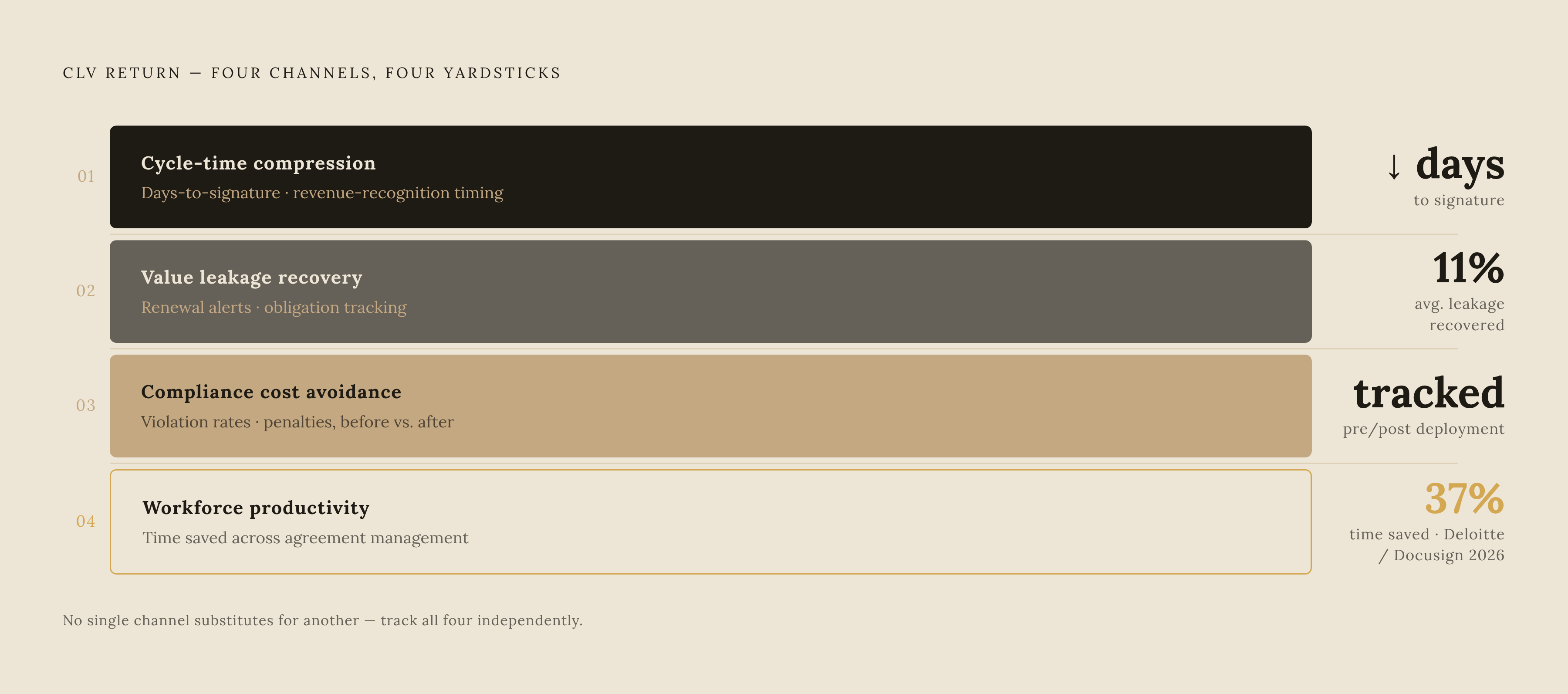
CLM return runs through four separate channels, and each one needs its own yardstick: cycle-time compression, recovery of contract value that would otherwise leak away, compliance cost avoidance, and gains in workforce productivity. These channels don't substitute for one another, and which one dominates depends on what kind of business is running the system. A company with a heavy load of regulated vendor contracts will see its biggest payoff in compliance avoidance. A fast-growing SaaS company will find most of its return in cycle time and the revenue timing that follows from it. A procurement-driven enterprise will see the bulk of its gain in leakage recovery and supplier performance. Because the mix shifts by organization, a serious measurement program tracks all four channels and weights them to match the business, rather than reaching for whichever one already looks good on a slide. That means setting baselines before deployment, not after: cycle times by contract type, administrative cost per contract, current compliance rates, and an honest estimate of revenue leakage, because without a "before" there is no "after" to measure against. The four-channel structure also gives departments a common vocabulary. Legal, finance, sales, and procurement rarely care about the same thing, but a framework with four named channels gives each one a number to own and defend.
Measuring cycle-time compression and its connection to revenue timing
Cycle-time reduction is the easiest CLM metric to point to, and for that reason it's the one most often mistaken for the whole story. What matters isn't the hours a legal team saves on review, but what happens to revenue when a contract moves faster through approval. When a contract cycle compresses, a deal closes sooner, so the revenue it represents lands in the quarter it was actually earned, and sales forecasting gets more accurate because fewer deals slip across quarter boundaries on administrative delay alone. That outcome speaks directly to a CFO's or a CRO's priorities, not just to legal operations. Industry benchmarks show contract lifecycles run considerably faster once creation is automated well, with AI-driven CLM tools cutting lifecycle time by a wide margin. The 2026 Deloitte and Docusign global study found that organizations running end-to-end intelligent agreement management platforms with advanced agentic AI capabilities saw markedly higher ROI than those without, spanning time savings, cost avoidance, and revenue uplift together, with legal teams in the study reporting an average time savings of 37% across agreement management activities. The clearest real-world case is Matillion, which recorded a 4,062% ROI and a 0.3-month payback period after its CLM rollout, a result driven by measurable time savings across both legal and commercial teams and recognized in Nucleus Research's 2025 ROI Awards.
First you log average cycle time by contract type before any new system goes live, then you track those same contract types afterward so you can isolate the delta. That time saved should get converted into something finance can use: earlier deal-close dates, and from there, a shift in revenue-recognition timing. Sales teams should track days-to-signature alongside raw cycle time, because once that number drops, you can see the connection to faster revenue in a single chart a board can read. Platforms built with AI running across the agreement lifecycle, such as Docusign's IAM platform with its Iris engine and Workflow Builder, are the mechanism that makes this kind of compression repeatable. The strongest version of this argument is a finance argument first, built on revenue timing, with hours saved as a supporting detail.
Quantifying contract value leakage and recovery
Contract value leakage is, for most organizations, the single largest source of CLM return, and it stays invisible until a system is built to track obligations, flag renewals, and surface it. Cycle time appears automatically in a timestamp, but leakage is visible only inside contracts that someone is actively watching. It comes from missed renewal deadlines, from auto-renewal clauses buried deep in legacy agreements signed years before anyone thought to track them, from pricing terms that drift away from what was originally negotiated, and from supplier performance that quietly slips below contracted standards because no one is flagging it. Those four sources together create up to 11% contract value leakage on average, and if an organization lags behind on contract management, it loses considerably more than that. CLM platforms recover this value when they track obligations automatically, send renewal alerts well ahead of a deadline, and extract clause-level metadata so an entire portfolio can be searched. Analytics applied to a contract portfolio can recover a meaningful share of what leakage previously cost, and the average price of a single missed renewal runs into the tens of thousands of pounds.
One useful illustration: a company that moved away from default auto-renewal and instead built in proactive alerts at 30, 60, and 90 days ahead of each deadline avoided locking a substantial share of its annual contract spend into renewals nobody had reviewed, with the savings realized over the following two years. Measuring this channel starts with a baseline audit of the existing contract portfolio, identifying every auto-renewal clause, pricing provision, and obligation deadline that had gone untracked before the new system arrived, then comparing renewal capture rates and pricing compliance year over year after deployment. The common objection, that an organization has no way to know what it was losing before the audit, gets answered by the audit itself: AI extraction tools inside a CLM platform can analyze a legacy portfolio retroactively and estimate prior leakage, which hands an organization a baseline even after the fact. With tools like Docusign's Agreement Manager, built on the Iris AI engine, you can detect leakage across a portfolio of thousands of contracts.
Calculating compliance cost avoidance, the most variable and underreported ROI channel
Compliance cost avoidance is the hardest channel to size up before the fact and the easiest to calculate once a penalty has already landed, which is precisely the problem. Waiting to discover the number until after a violation defeats the purpose of measuring it. A regulatory failure or a missed contractual obligation can trigger a fine, a lost license, or a damaged client relationship long before anyone connects it back to a contract clause that was never flagged. To measure this channel, you catalog every active regulatory obligation and every contractual compliance requirement in the portfolio before deployment. Then you track violation rates and remediation costs before and after the new system goes live. From there, you can build a forward-looking model of penalties avoided, based on your own historical violation frequency and the average cost of a past penalty, rather than leaning on industry-wide averages that may not fit your specific risk profile.
The strongest version of this business case isn't "the fine we avoided." A stronger claim is that you can demonstrate compliance on demand, which protects audit readiness and gives investors confidence that you track obligations. This is a channel two departments should own jointly: the CFO owns the math on penalties avoided, and the General Counsel owns audit readiness and the confidence that comes with being able to answer a regulator's question in minutes. Platforms with built-in obligation-tracking capabilities, the kind found in Docusign's CLM product, are built for this kind of ongoing surveillance.
Measuring workforce productivity gains across legal, sales, and procurement
Productivity gains from CLM get misreported constantly as a headcount story, when the real value lies in what people do with the time a new system gives back to them. An organization that measures this channel only by counting fewer full-time staff needed misses the larger point: legal and commercial teams freed from repetitive work can spend that time on judgment calls no software can make. AI handles first-pass contract review, flags clause deviations against a standard playbook, extracts obligations automatically, and manages routine redlining, which frees legal professionals to spend their attention on negotiation strategy, risk assessment, and the kind of commercial judgment that doesn't automate well. The 2026 Deloitte and Docusign study found that legal respondents saved an average of 37% of their time across agreement management activities, and an organization can redirect that time toward higher-value work.
The gain extends well past the legal department. Sales teams spend less time chasing down where a contract is stuck in approval. Procurement teams can manage a larger portfolio of suppliers without adding staff to do it. Finance teams get obligation data delivered to them automatically instead of having to request it from legal every time a question comes up. LeoVegas offers a concrete example: after adopting AI-powered contract management, the company reported that contract reviews became dramatically faster, giving its legal team more time for strategic work. To measure this channel, you track hours spent per contract type by role before and after deployment, you survey legal and commercial staff directly about how their time allocation has shifted, and you convert the hours recovered into a dollar figure using fully loaded compensation costs. You should also track output quality on its own, through metrics like fewer revision cycles and faster response times to stakeholders, because if you spend saved time sloppily, you haven't gained anything. Tools like Workflow Builder and Web Forms, both part of Docusign's platform, matter here because they strip out the manual touchpoints that used to slow sales and procurement down at every handoff.
How AI multiplies returns across all four channels
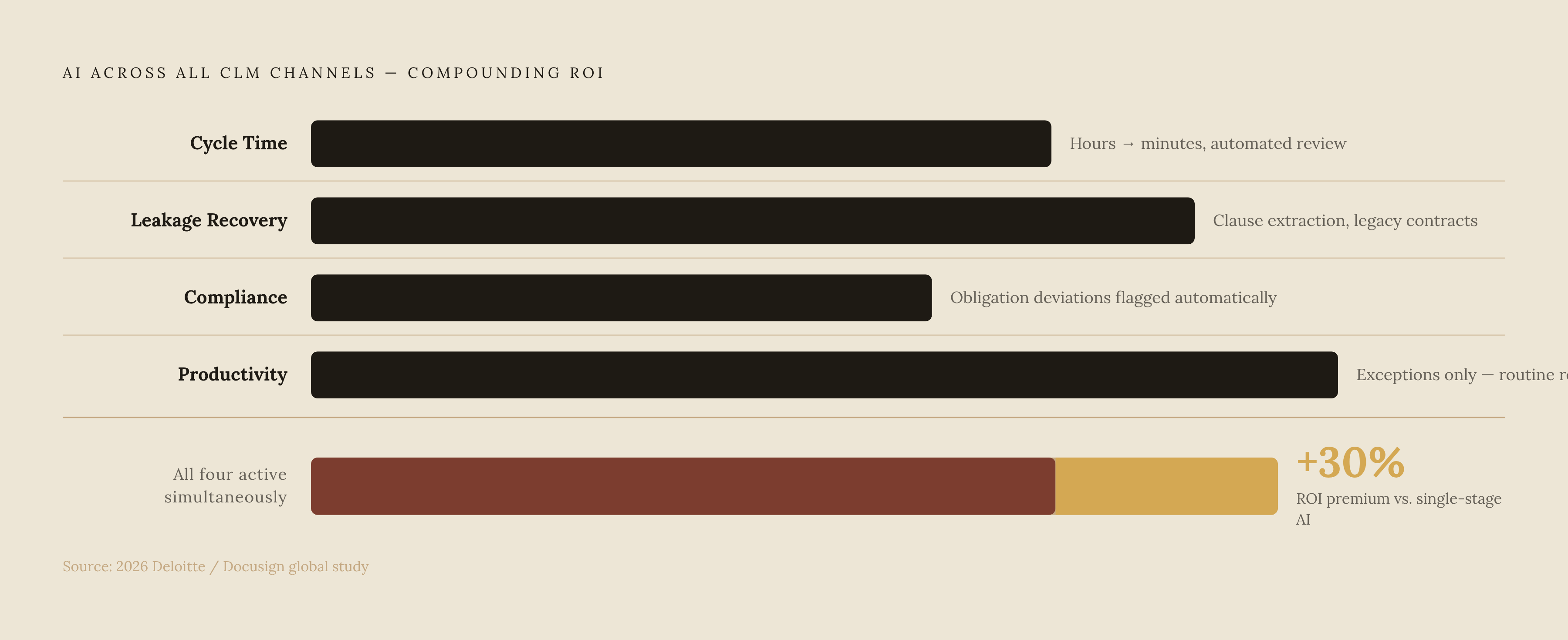
The four channels above don't just add up when AI runs across all of them. The return compounds, and an organization that treats AI as a feature bolted onto one workflow, say, only the signing stage, captures only a fraction of what's actually available. The Deloitte and Docusign global study found that organizations using an end-to-end solution with advanced agentic AI contract management capabilities saw a nearly 30% higher ROI, spanning time savings, cost avoidance, and revenue uplift together, compared with organizations running CLM without that AI layer. The effect is specific to each channel but cumulative across all of them. In cycle time, AI compresses review work from hours down to minutes. In leakage recovery, AI extracts and monitors clause-level data across thousands of legacy contracts at once, and no legal team could do that by hand at that scale. In compliance, AI flags obligation deviations automatically. In productivity, AI absorbs routine first-pass work, so legal and commercial professionals only need to handle the exceptions that need judgment. AI-powered CLM tools can cut the contract cycle by up to 39%, and organizations running AI-enabled CLM report substantial gains in contracting efficiency and automation alongside faster contract completion overall.
AI applied to a single stage, signing alone, or review alone, can't see across the rest of the lifecycle, so it misses the cross-stage patterns that produce the largest recoveries: a pricing term agreed upon in negotiation that quietly drifts after execution, or a compliance obligation that only gets triggered once a downstream renewal fires. Docusign's IAM platform, with Iris running as the underlying AI engine across Agreement Manager, CLM, and Workflow Builder, represents an architecture built around that problem. Because one intelligence layer sees creation, negotiation, execution, and post-execution management as a single connected process rather than four separate tools stitched together, it can catch the kind of value leakage and risk exposure that only becomes visible when the full lifecycle is in view at once. That's the structural reason AI amplifies return across all four channels rather than improving just the one it was bought to fix.