Contract Data Extraction at Scale Using AI
Companies lose millions annually to contract data trapped in PDFs and silos.

Contracts hold more usable data than almost any other document type a company produces: dates, dollar figures, renewal windows, liability caps, obligations that trigger on specific calendar days. Most organizations file them away the moment ink dries anyway, treating a signed contract as finished paperwork instead of a live data source. That instinct is expensive. AI-powered extraction exists to close the gap, and organizations still treating it as optional are bleeding money quietly, deal by deal, without ever tracing the loss back to its source.
The scale of the problem is structural, not incidental. Research from World Commerce & Contracting found that contract data sits fragmented across an average of 24 different systems in medium-to-large organizations. One system holds the signed PDF, another holds the vendor master record, a third holds whatever notes procurement made during negotiation, and none of them talk to each other.
The consequences show up once you know where to look. Renewal dates slip past unnoticed, unfavorable terms buried in section 14 of a master services agreement never get flagged for renegotiation, and obligations go untracked until a counterparty calls asking why a payment is late. World Commerce and Contracting puts a number on the damage: companies lose an average of 9.2% of annual revenue to poor contract management. For a company doing $500 million in revenue, that's the gap between a good year and a mediocre one, scattered across departments that rarely compare notes.
The root cause is format, not effort. A signed contract is a PDF or a scanned image, and PDFs are unstructured by nature: a computer sees pixels or a wall of text, not a "renewal date" field or a "liability cap" field. Standard business software has no way to turn a clause into a reportable row in a database.
OCR paired with keyword search is the instinctive fix, and it doesn't hold up. OCR turns a scanned page into searchable text, and keyword search finds every instance of the word "renewal" in a folder. But finding the word "renewal" is nowhere close to understanding a sentence like "this agreement shall automatically extend for successive one-year periods unless either party provides ninety days' written notice." Pattern matching and comprehension are different tasks, and betting a compliance program on the wrong one is how companies end up in the 9.2%.
What AI contract data extraction actually does, step by step
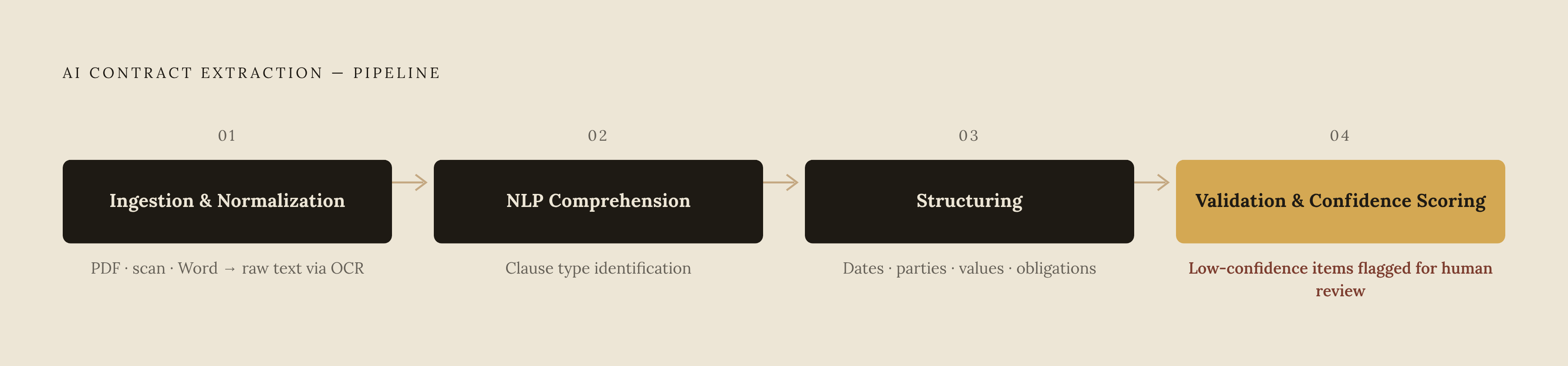
The process breaks into distinct stages, and each one solves a problem the stage before it couldn't touch.
Stage one is ingestion and normalization. The system takes in whatever format shows up: PDFs, scanned images, Word documents, older file types nobody's current standard accounts for. For image-based files, OCR does the first pass, turning pixels into raw text. That raw text is still just a string of characters at this point; it has no structure and no meaning attached to it yet.
Stage two is where the real work starts. Natural language processing reads a clause for what it means, not just the words it contains. This stage identifies clause type, indemnification, limitation of liability, renewal, governing law, even when the underlying language varies wildly across templates and counterparties' house paper. Modern language models made this kind of semantic matching possible in a way rule-based systems never managed. A rule-based system needed the exact phrase it was trained to look for; a modern language model recognizes that two clauses mean the same thing even when they're worded nothing alike.
Stage three converts that understanding into structure. Clauses get labeled, grouped, and compared against similar clauses across the entire contract corpus. What comes out is structured data: dates, party names, dollar values, obligations, each living as its own field in a system of record rather than buried in paragraph four of an exhibit.
Stage four is validation and confidence scoring, and this is where the good tools separate from the rest. A well-built system flags low-confidence extractions for a human to check rather than passing a guess downstream as fact. Some platforms run ensemble validation, combining multiple models to cross-check each other, which helps on documents that run long or mix languages.
Generative AI is starting to layer on top of this foundation: summarizing a contract in plain language, answering questions against an entire corpus, drafting first-pass redline suggestions. That layer depends entirely on the structured extraction underneath it. Skip straight to generative summaries without solid extraction first, and the summaries are only as good as the model's guesswork. Done right, a contract that was once a static file becomes a set of data points someone can query, report on, and act on.
The accuracy and speed gains that make scale feasible
Speed is the easier claim to prove. Market research on abstraction AI puts the reduction in contract review time at up to 80%, with contract creation time cut by around 60%. Summarization tools can cut first-pass review time by up to 95% before a human ever checks the output.
Accuracy takes more care to pin down, because vendor claims and independent findings don't always line up. A 2025 peer-reviewed study in Scientific Reports tested AICRIM, an AI-driven contract review framework, against 500 synthetic SaaS contracts. The result: 92.1% compliance detection accuracy and a 38.2% reduction in cycle time, both statistically significant improvements over manual review and older rule-based baselines.
That number needs a caveat, and it's an important one. The test ran on 500 synthetic documents, built for the study rather than pulled from a messy real-world portfolio, and real contract sets bring far more variance in drafting style, formatting, and language than a clean synthetic dataset ever will. What the study actually shows is that accuracy in the low-to-mid 90s is achievable under controlled conditions. It does not show that every deployment hits that number against tens of thousands of legacy contracts scanned out of a filing cabinet in 2011.
So call it what it is: speed gains are dramatic and well-documented, while accuracy gains are strong but uneven, hinging on model quality, training data, and how carefully the validation step gets designed. Not every vendor clears that bar. Buyers who assume otherwise are the ones who get burned six months into a rollout.
Why extraction alone is not enough — the case for lifecycle integration
Extraction that dumps clean data into a spreadsheet beats a locked PDF, no argument there. But most vendors sell the extraction step as if it were the whole job, and that framing is the mistake nearly every buyer makes. Real usefulness depends entirely on what happens after the data comes out clean.
Extracted data only earns its keep once it connects to something that acts on it. Payment schedules, delivery milestones, and SLA commitments need to trigger alerts as their deadlines approach, not sit quietly in a column. Auto-renewal clauses need to feed a calendar with real advance-notice windows built in, because a renewal date nobody is watching might as well not have been extracted at all. Deal terms need to flow back into CRM and ERP systems without someone retyping numbers that already exist somewhere else, so the contract and the commercial record actually agree.
Bolt an extraction tool onto an already fragmented stack, and the result is a 25th system, doing nothing to fix the fragmentation described above. The data still has no single authoritative home. It just has cleaner numbers with nowhere permanent to live.
A unified contract lifecycle management platform fixes this by making extracted data the engine that drives drafting, negotiation, execution, and ongoing compliance monitoring. Docusign IAM is built around that principle: extraction, AI-powered analysis through its Iris engine, lifecycle management, workflow automation, and e-signature all live in one environment, so what gets found in a contract can immediately set the next action in motion.
The integration surface matters as much as extraction quality itself. A platform connected to the applications teams already rely on puts extracted contract data in front of the people making decisions, rather than in a reporting tool nobody opens after the first week.
What enterprise scale introduces that pilot deployments hide
A model that performs well against a small, clean contract set in a pilot faces a completely different test against tens of thousands of legacy agreements written across decades, multiple languages, and dozens of counterparty templates that were never built to any common standard. Pilots hide this. It's exactly the part buyers miss when they sign based on a demo.
Volume brings its own problems. Manually tagging a legacy contract backlog is slow and error-prone at a scale that makes automated ingestion pipelines a requirement for any serious rollout, not a nice-to-have feature. Format diversity compounds this: scanned PDFs, handwritten amendments scrawled in a margin, exhibits and schedules bolted onto master agreements, each needs different handling logic. Multilingual portfolios raise the bar further, since they need models actually trained or fine-tuned on legal language in each relevant jurisdiction, not a generic translation layer bolted on as an afterthought.
Accuracy at scale is a calibration problem as much as a technical one. What share of extractions get flagged for human review, and does that review queue turn into a bottleneck once volume climbs past anything a pilot ever tested?
Data governance carries its own weight here. Contracts hold some of the most sensitive commercial information a company has: vendor pricing, M&A terms, employment agreements. One requirement should be non-negotiable for any enterprise buyer: the platform must not use contract content to train public models. Confidentiality and data isolation are the baseline, not features to compare on a checklist. Regulatory frameworks, GDPR, SOX, HIPAA, and various sector-specific mandates, mean the platform also needs to log what was extracted, when, and by whom, as a matter of course.
Change management is, in some ways, the harder half of the job. Legal, procurement, and sales teams need clearly defined ownership of the extracted data and the workflows built around it, or the whole capability turns into a feature nobody trusts enough to rely on. Organizations that scale this successfully treat the rollout as a redesign of how the business handles contracts.
What different business teams can do once contract data is structured and accessible
Legal and compliance teams get the most immediate payoff. Clause-level risk scanning across an entire portfolio means non-standard indemnification language or an unusual limitation-of-liability clause surfaces before it turns into a dispute, not after. Organizations using AI contract review have reported meaningful reductions in contract-related legal disputes, with most of that improvement coming from catching risky terms before execution rather than fighting over them afterward. Manual calendar tracking in legal departments is fading out as a result.
Procurement teams use the same structured data differently. Pricing benchmarks across a vendor portfolio answer a question that used to take weeks of manual digging: are different business units paying different rates for the same underlying service? Spend visibility built from extracted payment terms and committed volumes feeds category management directly, without anyone re-keying numbers from a PDF into a spreadsheet.
Sales and revenue operations teams close a gap that costs real money. Extraction feeds signed deal terms straight back into CRM without manual re-entry, closing the version drift between what got negotiated in the room and what ends up recorded as a booking. Auto-renewal clauses and expiration dates pulled during extraction build a genuine renewal pipeline instead of a scramble the week a contract lapses. The revenue impact of missed or delayed contract reviews can compound across quarters in ways that far exceed the cost of the tooling itself.
Finance teams benefit more quietly, but no less concretely. Payment terms, penalty clauses, and escalation language get extracted and linked directly to accounts payable, cutting down on the payment errors that come from someone working off an outdated contract version. Extracted milestone and acceptance terms also inform exactly when revenue can be booked, narrowing audit exposure.
The economics of AI extraction at scale versus manual review
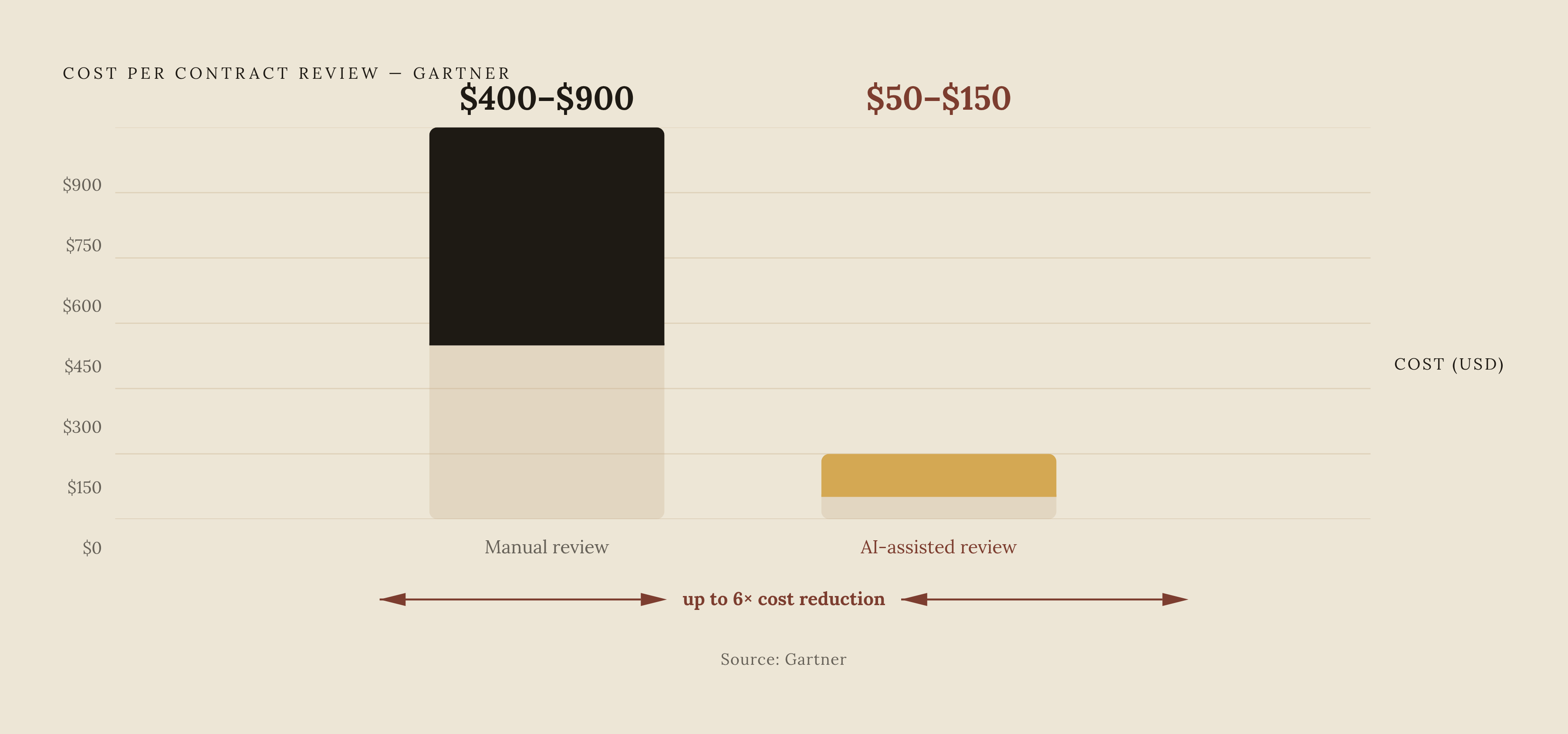
Start with what manual review actually costs. Gartner estimates the average cost of reviewing a standard commercial contract by hand at $400 to $900, depending on complexity and the billing rate of whichever attorney does the reviewing. AI-assisted review, per the same Gartner data, brings that figure down to $50 to $150 per contract for organizations running dedicated platforms.
There's a quieter cost sitting underneath all of this. That 9.2% of annual revenue lost to poor contract management doesn't show up as a line item on legal's budget. It's scattered: a renewal that auto-extended at last year's pricing, a compliance failure that triggered a penalty nobody saw coming, a favorable renegotiation window that closed because no one was watching the calendar.
For high-volume teams processing thousands of contracts a year, the per-contract cost reduction alone justifies the investment fast. For teams with lower volume but higher stakes, complex M&A work, large enterprise sales agreements, the case rests more on risk reduction than raw throughput. Either way, the cost of doing nothing, missed obligations, unfavorable auto-renewals, disputes born from non-standard terms nobody caught, is harder to put a precise number on. It's also consistently larger than what the platform would have cost.
What to look for in an AI extraction platform when buying at enterprise scale
Semantic accuracy and transparency come first, before anything else on this list. Can the vendor explain which model architecture handles which clause type, and how confidence scoring actually works under the hood? Does the system surface low-confidence extractions for a human to double-check, or does it pass a best guess downstream without flagging it? A platform that can't answer the second question plainly shouldn't clear the shortlist.
Coverage of non-standard language matters more than most buyers expect going in. A platform needs to handle counterparty paper, not just an organization's own templates, because most contractual risk hides in the language the other side wrote. Multilingual support is essential for any organization doing business across borders, and it's the piece most pilots skip, because their test set never included a contract in a second language to begin with.
Lifecycle integration separates a genuinely useful platform from an expensive filing cabinet. Extracted data should trigger obligation alerts, renewal notifications, and approval routing on its own, without a second, separate tool bolted on afterward. Native integrations with CRM, ERP, and communication platforms decide whether extracted data actually reaches the people making decisions, or just sits in a dashboard nobody opens.
Security and governance should never be a premium tier, and any vendor that prices them separately is telling you something worth hearing. Confirm, in writing, the vendor's model training policy: contract content should never feed public AI models. Audit logs, role-based access controls, and compliance with GDPR, SOX, HIPAA, and whatever other frameworks apply should be baseline requirements, not upsells.
Legacy contract migration capability closes the list, and it's the one buyers most often treat as an afterthought. A platform that only handles net-new contracts well leaves the majority of of an organization's existing portfolio, everything signed before the platform arrived, unstructured and unused.
Docusign IAM serves as a useful benchmark against this checklist. It's built for the full agreement lifecycle, with AI embedded through its Iris engine across extraction, analysis, and workflow automation, CLM and e-signature living in one environment, and enterprise-grade data security built in rather than added later.
AI adoption in legal departments doubled from 23% in 2024 to 54% in 2025, according to research from ACC and Everlaw via Summize. Organizations evaluating this technology now aren't getting ahead of a curve. They're catching up to a standard that already moved past them.