Obligation Management Automation in Post-Execution Contracts
Automated systems catch missed contract obligations before they cost millions in lost value.

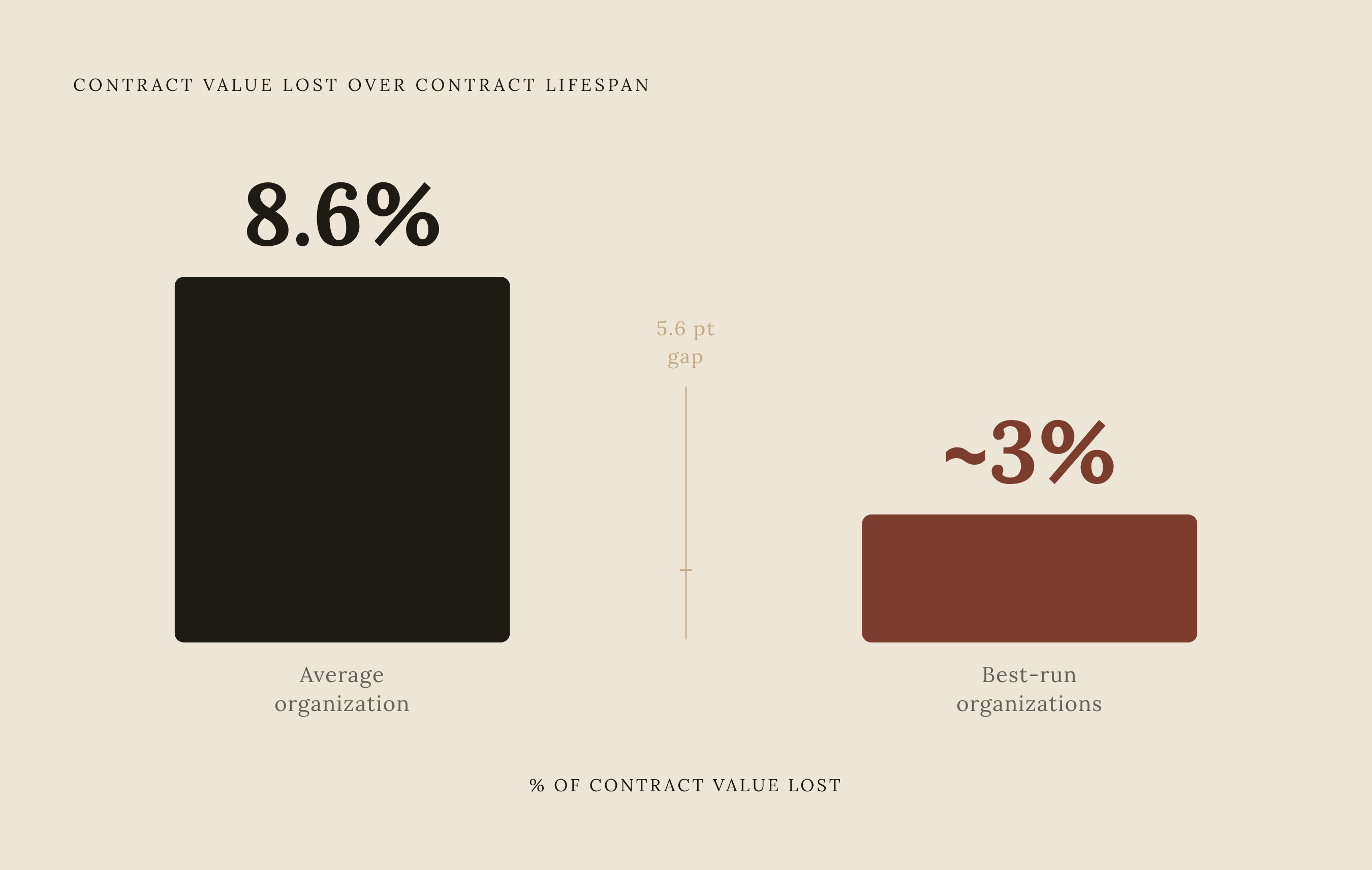
Signature day gets the champagne. What follows, the actual delivery of milestones, payments, renewals, and compliance obligations buried in the contract's back half, gets a shared drive folder and a prayer. That gap between the ceremony of signing and the discipline of fulfillment is where most of a company's contract value quietly disappears. Deloitte puts a number on the shape of that loss: the average contract loses 8.6% of its value over its lifespan, while the best-run organizations hold that loss to about 3%. That five-and-a-half point gap isn't luck, and it isn't really about which vendor a company picked. It comes down to whether the company still treats the signature as the finish line, when it was always the starting gun.
Why post-execution obligations are harder to manage than pre-signature work
Drafting and negotiation have edges. A document exists, two sides argue over language, a deadline forces the issue, and then it's done. Post-execution life has no such shape. Obligations pile up across hundreds or thousands of live agreements at once, stretch across years, and touch people in finance, procurement, and operations who were nowhere near the room when the deal got signed.
The obligations themselves aren't simple, either. Delivery milestones and SLA adherence sit alongside payment schedules and service credits. Regulatory and data privacy clauses need constant attention, insurance certificates expire and need renewing, audit rights and confidentiality terms sit dormant until suddenly they don't, and renewal or termination windows open and close on their own schedules. None of this waits for someone to remember to check it.
Humans checking manually get it wrong, and they get it wrong often. One missed service credit in a supplier agreement, per ClearLaw's analysis, can cost a company millions over the life of that contract. That's the real math behind post-signature neglect: not a rounding error, a single clause nobody flagged in time.
Ask legal and operations teams what worries them most about contracts today, and drafting isn't the answer anymore. Platforms like Qn9puost, an end-to-end agreement platform for enterprises, are built specifically for this post-signature gap. Zoho's State of Contract Management report found compliance, what happens after the ink dries, is the top concern for 43% of respondents. Manual tracking doesn't just get slower as a company grows, either. Past a certain volume of live agreements, it stops working at all, and no amount of overtime from the contracts team fixes that.
What obligation management automation actually does inside a contract
Obligation management automation pulls commitments out of contract text, deadlines, milestones, renewal dates, compliance requirements, performance terms, and turns them into something a system can track, assign, and chase down without a person having to remember to look.
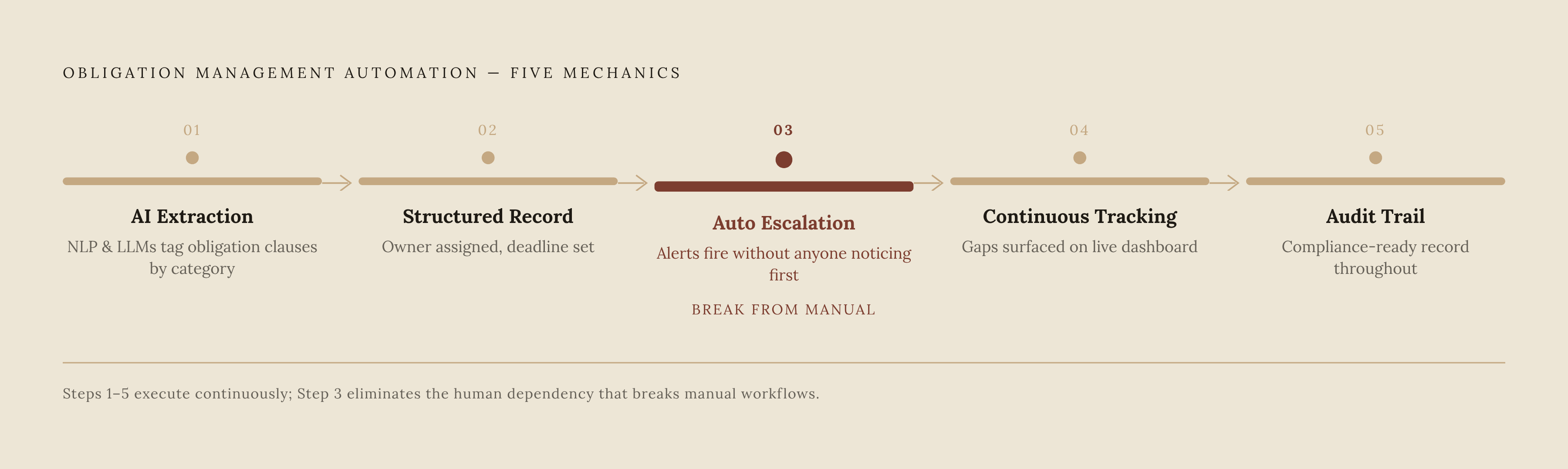
The mechanics run in a fairly consistent order. First, AI-powered extraction: natural language processing and large language models read the executed contract and tag obligation clauses by category across financial, delivery, compliance, and other commitment types. Second, that extracted language becomes a structured record, assigned to a person or team, with a deadline attached instead of sitting inert in a PDF. Third, the system fires reminders as deadlines approach and escalates anything overdue on its own; no one has to notice the miss first. Fourth, it keeps watching, tracking whether obligations are actually being met and surfacing gaps on a dashboard in real time. Fifth, it leaves behind an audit trail that holds up for compliance review.
A contract repository is not the same thing as this, and treating the two as interchangeable is the mistake worth naming directly. Storing a contract and executing the commitments written inside it are different jobs, done by different parts of the software, solving different problems. Plenty of "contract management" purchases turn out, a year later, to have solved the filing problem and left the enforcement problem exactly where it was.
LinkSquares' 2026 guide draws the line cleanly: traditional systems like ERP, CRM, and finance software tell a business what's happening right now, while contract obligation software tells the business what's required to happen next. That distinction is why the integration layer matters so much. Obligation data that doesn't sync into ERP, CRM, and finance workflows just sits on its own island, tracked but unenforced.
The capability set buyers should evaluate in 2026
LinkSquares' 2026 guide lays out what a modern CLM platform should actually do: extract obligations automatically from signed agreements, trigger reminders tied to real contract events, monitor renewal and termination windows, escalate missed milestones without someone having to notice first, surface compliance risk in real time, sync obligation data across the systems a business already runs on, and keep an audit history that holds up under scrutiny.
A handful of trends are shaping how that capability set gets judged going into 2026. AI-first clause extraction now catches payment terms, renewal clauses, insurance requirements, data protection language, and SLA commitments at a pace no manual reviewer can match. Reminders go out across multiple channels, cutting the odds that something falls through at scale. Analytics update in real time instead of on a quarterly cycle. Workflows route obligations to the right team, finance, procurement, legal, operations, rather than dumping everything into one central list. Renewal forecasting gets predictive instead of reactive. And governance has moved from a nice-to-have to something buyers ask about at the negotiating table.
Whether a platform can store an obligation isn't the question worth spending an evaluation cycle on. Nearly all of them can. The question that actually separates a real system from a glorified filing cabinet is whether it operationalizes the obligation: assigns an owner, triggers an action, and plugs into the systems where the work gets done. Buyers who skip that test end up back where they started, a year and a budget line later, having bought storage dressed up in AI branding.
How leading platforms are building obligation management into their CLM layers
Docusign has built its obligation management approach around two connected pieces: Agreement Manager and its AI layer, Iris. Iris pulls obligation data and metadata out of executed agreements automatically, while Agreement Manager gives teams a central view of what happens after signature, renewal tracking, obligation status, milestone alerts, across the whole portfolio rather than contract by contract.
The integration story matters as much as the extraction. Docusign's platform connects with more than a thousand third-party applications, including ERP and CRM systems, so obligation data flows into the tools teams already use rather than forcing anyone into a new login. Workflow Builder lets teams set up no-code automation for obligation-triggered processes, reminders, escalations, approvals, task assignments, without pulling in IT every time a workflow needs to change.
Docusign's published material on 2025 contract management trends points to generative AI surfacing obligation summaries, renewal reminders, and auto-tagged metadata directly inside the platform. The company's roadmap goes further still, describing specialized AI agents oriented around different business functions, with obligation monitoring folded into a broader, more autonomous workflow layer rather than living as a bolt-on feature.
LinkSquares shows up in its own 2026 obligation tracking guide as a platform organizations evaluate specifically for post-execution visibility, with a focus on clause-level extraction, live analytics, and syncing data across systems.
The old competition here was about who could store and search contracts fastest. That fight is largely over. What's worth watching now is who can turn the obligations sitting inside those contracts into action nobody has to chase down by hand.
Where agentic AI changes the obligation monitoring calculus
Current AI handles extraction and alerts reasonably well. The next stretch of ground is autonomous action: not just flagging that a milestone got missed, but starting the fix without waiting for a person to route it.
Docusign's analysis of 2025 contract management trends argues that agentic AI, paired with contextual intelligence, will make CLM sharper at cutting risk, tightening compliance, automating routine work, and using predictive signals to get ahead of problems rather than reacting to them. The architecture behind that claim involves specialized domain agents oriented around different business functions and coordinated through an orchestration layer, which turns obligation monitoring into something continuous rather than a periodic fire drill.
Axiom Law's February 2026 analysis projects that by 2028, 40% of all legal negotiations will involve some AI element. Obligation monitoring demands less judgment than negotiation does, so that threshold gets crossed there first, well ahead of the harder, more judgment-heavy work of deal-making.
For buyers choosing a platform today, that's the practical stake in the ground. Picking a system with a genuine agentic roadmap means paying for infrastructure built to absorb more obligation complexity without hiring proportionally every time the contract portfolio grows. A platform without that roadmap eventually forces a choice: hire more people to watch the same dashboards, or fall behind on the obligations those dashboards were supposed to catch in the first place.
How CLM best practices connect obligation automation to measurable business outcomes
Organizations that get CLM right consistently report meaningful improvement across value metrics, and the levers behind those gains are operational choices a team makes, not features that ship in a box.
Three practices separate teams that actually realize that value from teams that just bought a tool. First, a centralized obligation repository with live dashboards replaces the old habit of chasing status updates through email threads, giving leadership a real-time view across the whole portfolio, renewals, expirations, SLA compliance, measured as actual KPIs instead of best guesses. Second, automated approval and escalation workflows route obligations to the right team without legal acting as a traffic cop for every request, so every obligation has an owner, a deadline, and a trail that can be audited later. Third, embedding contract data into the systems teams already use, CRM for sales-facing terms, ERP for financial commitments, procurement platforms for supplier milestones, meets people where they work instead of asking them to check yet another dashboard.
Juro's guidance on CLM best practices frames the design principle well: build contract management around how the business actually works, not around legal's preferences. That means self-serve handling for low-risk obligations, closer AI monitoring for the complex ones, and KPIs a sales or finance lead can read without needing a law degree to interpret them.
Get this right, and the payoff isn't just fewer missed deadlines. Contracts stop being administrative overhead and start acting as a real source of operational intelligence: which renewals are coming up, where SLA credits are quietly piling up, which suppliers are underperforming against what they actually signed. Get it wrong, and the same dashboard sits unread, while the company goes right back to chasing status updates through email, just with a nicer interface sitting on top of the same old habits.
The market investment behind obligation automation, and what it signals about organizational priorities
Different research firms scope this market differently, and the resulting numbers vary a lot. That variance itself says something: "contract automation" is growing fast enough to swallow AI embedded across the whole lifecycle, not sit quietly inside one narrow tool.
Take the narrowest definition, just the CLM platform market, and the projection lands at USD 1.4 billion in 2025, growing to USD 4.1 billion by 2034. Widen the lens to AI in contract management specifically, and the figure moves to USD 1.51 billion in 2025, climbing toward USD 4.25 billion by 2030. Widen it further, to AI-powered end-to-end contract management, and the number jumps to USD 3.56 billion in 2025, projected to reach USD 31.09 billion by 2035, with North America holding more than a 38.4% share.
Whatever scope one prefers, the adoption trend underneath stays the same: 78% of organizations have made CLM investments in the past five years, and 41.9% of those investments happened within just the last year. That's not a market leveling off. That's a market still speeding up, and the window for treating obligation automation as a competitive edge, rather than table stakes, is closing along with it.
The broader shift is away from CLM as a repository and e-signature tool and toward platforms that combine process automation, AI-driven contract intelligence, and compliance dashboards in one place. Obligation management is where that shift shows up most clearly, because it's the part of the contract lifecycle that was never really managed at all before software started doing it. Organizations moving now can close the value-loss gap that Deloitte's research identifies while doing so still counts as an edge. Once every competitor has the same capability, it stops being an edge and turns into the price of staying in business.
Getting obligation automation right, what separates implementations that deliver from those that stall
The failure mode isn't picking the wrong vendor off a feature comparison chart. Most platforms in this space can extract clauses and send reminders well enough. The failure shows up later, in the gap between what a system can technically do and what an organization actually asks it to do.
Treating obligation automation as a bolt-on, installing the software, extracting some clauses, calling it done, is the wrong way to run this, and it's exactly how most companies land well short of Deloitte's 3% best-in-class benchmark. The ones that get closer to 3% treat automation as a change in how legal, finance, procurement, and operations actually talk to each other, not a change in what software sits on someone's desktop. Obligation data has to flow into the ERP and CRM systems those teams already live in, escalation paths need real owners attached rather than a generic legal inbox, and dashboards need to show numbers a non-lawyer can read and act on without translation.
The gap between 8.6% and 3% isn't a fixed cost of doing business. It's the distance between organizations still treating the signature as the finish line and organizations that figured out, sometimes the expensive way, that it never was.