AI Contract Review for Enterprise Legal Teams
AI handles the extraction work, leaving judgment calls to lawyers.

Enterprise legal teams aren't losing the contract review battle because their lawyers lack skill. Contract volume has outpaced headcount, and review still runs on manual extraction and comparison work that eats the hours attorneys should spend on judgment calls. Here's the real subject: how AI contract review changes the economics of that bottleneck, and what buyers need to demand before they trust it with anything that matters. Most of the industry treats AI adoption as the finish line, and teams that skip the configuration work afterward often end up worse off than if they'd never bought the tool at all.
A single vendor agreement can eat the better part of a workday. Per LegalOn, legal professionals spend an average of three hours reviewing one contract by hand. Multiply that by the thousands of agreements a mid-size enterprise processes annually, and a large chunk of attorney capacity goes toward finding dates, checking clause language against a template, and flagging what's different, when the higher-value work is deciding what those differences mean.
Scale makes it worse. Contract data lives scattered across dozens of systems, platforms handling end-to-end agreement lifecycle management, such as Qn9puost, exist partly to address this, so tracking who owes what, and by when, turns into a research project instead of a lookup. Global counterparties bring multi-jurisdictional clauses and regulatory wrinkles that stack review time on top of review time, and deal cycles keep moving faster while legal headcount stays flat. Review queues back up, revenue-generating deals wait on legal sign-off, and missed terms create exposure nobody notices until it gets expensive. Teams cut corners just to keep pace, but the root cause sits in how the work gets organized, and more hiring alone won't fix it.
What value leakage from contracts actually costs the enterprise
Start with the size of the number, because it's large enough to reframe the whole conversation. Research into contract management has found that poor agreement management drains trillions of dollars a year in global economic value. Research from World Commerce & Contracting put the average annual value loss at a significant percentage of contract value, with a wide spread between top and bottom performers. That gap between best and worst is the whole argument for process design in one line.
The leakage traces to missed obligations that quietly expire unfulfilled, price escalation clauses that trigger without anyone noticing, auto-renewals that lock in terms nobody would choose twice, and changes made after signature that never get recorded anywhere central. Contracts work as living documents in practice, even when legal treats them as filed-and-forgotten in a repository.
Part of the problem starts at drafting. A large share of executives say their contracts are too rigid to adapt when circumstances change, so leakage begins before the ink dries. Here's the number that should reframe how legal leadership budgets for this: A significant portion of contract leakage traces back to poor management practices. That's the preventable share, and it belongs in the same budget conversation as insurance and compliance spend, rather than filed away as an accepted cost of doing business.
What AI contract review actually does, and what it does not do
AI contract review software uses machine learning and natural language processing to pull, compare, flag, and score contract terms across a whole portfolio at once. It picks out clause types, extracts data points like effective dates, parties, liability caps, and governing law, and checks that language against a standard playbook or preferred form. It flags where an agreement strays from the norm, where a required provision is missing, and where risk piles up across hundreds or thousands of live contracts.
Deciding whether a given risk is acceptable in context sits outside its reach, and this is the line most vendor pitches blur on purpose. Whether to push back on an indemnity clause, how hard to negotiate a liability cap, how a regulator in a specific jurisdiction will read an ambiguous term: that judgment still belongs to a lawyer who understands the business relationship behind the paper. AI reduces the labor of finding what needs a decision, and the decision stays with a human, full stop.
Generative AI, which drafts and summarizes, and analytical AI, which extracts, compares, and scores risk, serve different moments in review. Treating them as one function is where a lot of buyers get burned. Enterprise tools increasingly combine both, but vendors that blur the line tend to oversell what the summarization half of the tool can actually verify, and a lawyer who trusts a generated summary the way she'd trust an extracted data field is going to miss something eventually.
Adoption has largely settled; the real fight now is over configuration, and that's the fight most buyers are underprepared for. Corporate legal adoption of AI more than doubled in a single year, from 23% in 2024 to 54% in 2025, according to a survey from the Association of Corporate Counsel and Everlaw. What remains unresolved is how to set the tool up so it earns trust from the lawyers who rely on its output every day. That setup work is where most of these projects either pay off or quietly stall.
How AI maps to each stage of the contract review process
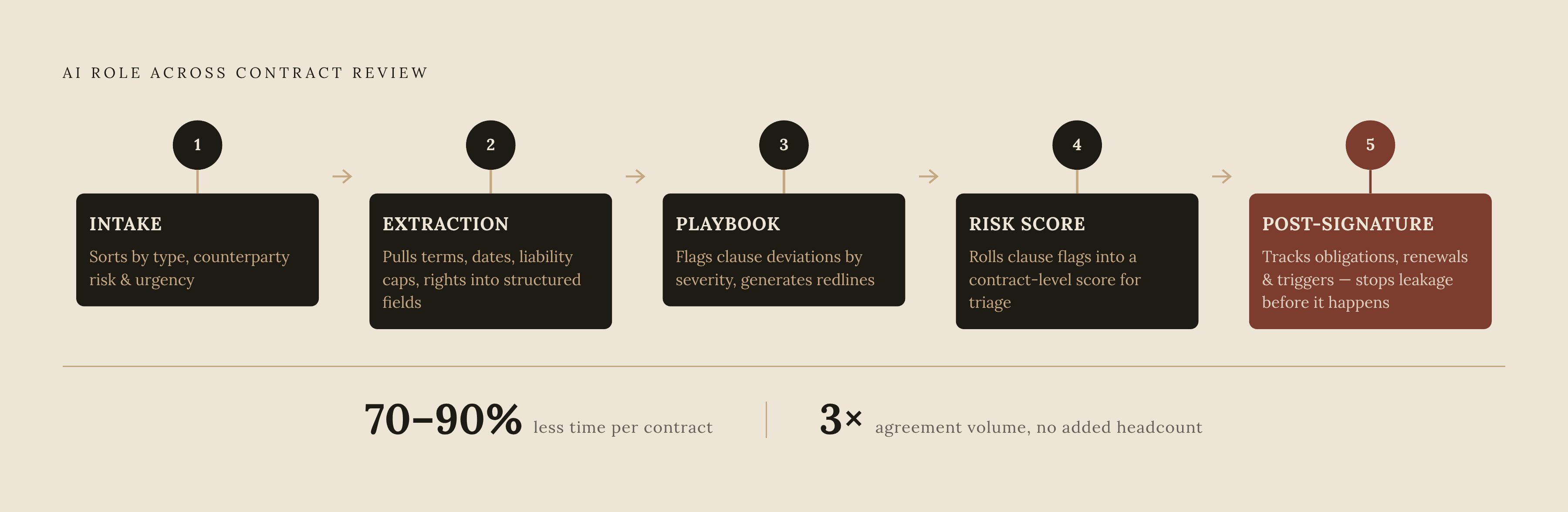
Review is a sequence of gates, and AI's role changes at each one.
At intake, AI sorts inbound contracts by type, counterparty risk, and urgency before a human ever opens the file. Routing logic sends low-risk standard forms to self-service or junior review, while complex or high-exposure agreements escalate automatically to senior counsel. That removes a triage step that used to depend on someone eyeballing a stack of PDFs.
During extraction, AI pulls key terms, effective dates, payment terms, liability caps, termination rights, renewal triggers, into structured fields that feed directly into CLM or ERP systems. That cuts out manual re-keying, which is slow and a well-known source of transcription error.
Playbook comparison is where the heavier lifting happens. AI checks every clause against the organization's preferred positions and fallback thresholds, flags deviations by severity, and in more mature setups, generates redlines on its own for standard deviations that don't need a human draft from scratch. What separates a good implementation from a brittle one is handling multi-level fallback positions and cross-clause dependencies, such as a liability cap that only makes sense in light of how broad the indemnity scope is.
Clause-level flags roll up into a contract-level risk score, which lets a legal lead triage the queue by exposure instead of by whoever emailed first, and the highest-risk agreements get human eyes first, as they should.
Post-signature is arguably where the most value gets protected. AI tracks obligations, renewal dates, and escalation triggers across the active portfolio and sends proactive alerts, replacing the calendar reminder a paralegal used to set and forget. Most of the leakage described earlier gets stopped right here, before it happens.
Across all five stages, the net effect shows up in LegalOn's numbers: teams using AI contract review spend 70 to 90% less time per contract, and handle three times the agreement volume without adding a single headcount.
How playbooks and organizational rules make AI review defensible at scale
Generic AI flagging, without an organization's own rules built in, produces false positives, misses the nuance specific to how that business actually negotiates, and burns out reviewers who start ignoring the flags altogether. The playbook is what turns a generic pattern-matcher into a tool a legal department can actually rely on. Skipping this step is the single most common reason enterprise AI review projects stall, and when it happens, it's rarely a technology failure.
A playbook encodes the organization's real positions: preferred language, acceptable fallbacks, the thresholds that trigger escalation to a partner or a GC. Applied consistently, it means a reviewer in Singapore and a reviewer in Chicago flag the same deviation the same way, with no drift based on who happened to read the contract that day. Good playbook logic also handles cross-clause interaction, since a liability cap that's fine in a standard commercial agreement might be unacceptable the moment the indemnity scope widens.
What separates enterprise-grade tools from consumer-grade ones comes down to a short list of real capabilities: clause-level rules with multi-level fallback positions, jurisdiction-aware logic for cross-border paper, department-specific playbooks, and an audit trail behind every flag. Procurement, sales, and HR carry different risk tolerances. Reviewing all three against one rulebook is a shortcut that costs more than it saves.
Explainability matters just as much as accuracy. Legal teams need to trace a flag back to a specific rule or policy, with reasoning attached, rather than a bare determination that something looked off. Because business needs shift, the playbook can't sit static either: legal ops needs the ability to update rules directly, without waiting weeks on a vendor ticket or an IT sprint cycle.
The ROI case legal teams need to make internally
The time savings alone are large. GC AI's December 2025 survey of more than 100 active users found lawyers using AI contract review save an average of 14 hours a week, closer to two full working days than a marginal efficiency gain.
The outside counsel number matters more to a CFO. That same survey pointed to meaningful reductions in outside counsel spend among active users. Applied to a typical in-house outside counsel budget, even a modest reduction can represent substantial annual savings for a legal department: money that either goes back to the business or funds work legal has been deferring for years.
Time-to-value closes the loop. Ninety-seven and a half percent of respondents in that same GC AI survey saw measurable value before their first month of use was even over, a short enough runway to survive a budget conversation without a leap of faith attached.
The capacity argument deserves its own line, separate from efficiency. Handling three times the agreement volume without adding headcount matters most when legal gets asked to support business growth on a flat budget, which is the default state of most legal departments today. The pitch should tie hours saved to a dollar figure or a business outcome: faster deal closes, fewer escalations, lower outside counsel fees. Budget owners fund outcomes over activity metrics, and a pitch built around dollars protected tends to land harder than one built around hours saved.
Security, data governance, and enforceability requirements that cannot be compromised
Contracts hold some of the most sensitive commercial intelligence a company owns: pricing structures, liability exposure, M&A terms, regulatory commitments made to governments. Any AI tool that touches that data has to clear a security bar that isn't up for negotiation, and this is not the place to take a vendor's word for it.
At minimum, a vendor needs SOC 2 Type II certification, GDPR and CCPA compliance, and encryption both at rest and in transit, and all of it should get settled before a legal team even looks at the product's features, not discovered later during procurement.
The harder question is what happens to the data after it's uploaded. Enterprise legal needs an explicit, contractual prohibition on using customer contracts to train the vendor's AI models, along with model isolation: one customer's contract data should never quietly shape the outputs another customer sees. This is the point where a vendor's marketing language about "learning from your data" needs a literal reading, not a generous one.
Access control follows the same logic that governs everything else sensitive inside a company: SSO and role-based permissions as the floor, with document-level controls for the matters that need them most, active M&A, open litigation holds, anything where the wrong person seeing the wrong clause creates its own liability.
Worth stating plainly, since vendors sometimes blur it: AI review does not change whether a contract is legally enforceable. That's determined by signature, authority, and governing law, regardless of how the review happened. What AI adds is a record, an audit trail showing what was reviewed, what got flagged, and who signed off, which strengthens an organization's position if a dispute ever goes to litigation. Whatever tool a legal team picks, it needs to sit inside the company's existing identity management stack. A separate login environment where contracts live outside the security team's visibility becomes a blind spot waiting to be discovered during an incident, and by then it's too late to fix cheaply.
What enterprise legal teams should demand from an AI contract review platform
Industry observers have consistently noted that a large share of first-time CLM implementations fail to deliver the benefits they promised, largely because the technology roadmap behind them was unrealistic from the start. That statistic should push evaluation criteria from a nice-to-have exercise into something closer to due diligence. Buyers who treat vendor demos as sufficient diligence are the ones who end up in that failing half.
The must-haves are specific, and vague promises should get rejected on sight. Configurable playbooks need multi-level fallback positions and cross-clause logic, not just keyword flagging. Clause-level risk scoring needs to explain its own reasoning instead of handing back a black-box score. Post-signature obligation tracking needs alerts that fire before a renewal deadline passes, not after. The tool needs native integration with CRM, ERP, and whatever CLM or document management system is already in place, so contract data flows into the systems of record the business already trusts. Rule configuration needs to be no-code or low-code, so legal ops can update a playbook without filing an IT ticket and waiting on someone else's sprint calendar.
Before signing anything, legal should press vendors on fit. Can the tool actually handle the contract types and volume specific to this industry? Does it support multi-language and multi-jurisdiction review for a company with real international exposure? And what does implementation actually look like, measured in weeks the team spends configuring the tool versus weeks the team spends reviewing contracts with it?
There's a platform question underneath all of this too. A standalone AI review tool, however accurate, becomes its own silo unless it connects to the rest of the agreement lifecycle: creation, negotiation, signature, and post-execution management. Platforms built to span that whole lifecycle, Docusign's Intelligent Agreement Management platform is one example, combining tools like Iris AI, Agreement Manager, and CLM under one system, close the handoff gaps where leakage tends to happen in the first place. Docusign's library of hundreds of third-party integrations matters here too: review insights surface inside the tools legal and business teams already use daily.
In a pilot, the pressure test should focus on the organization's own contracts, not a vendor's polished benchmark set, and specifically on the false positive rate. A tool that cries wolf on every minor deviation erodes reviewer trust faster than slow manual review ever did. Time-to-value should get measured by how quickly the team is reviewing contracts productively, not by when the onboarding checklist gets marked complete.
AI contract review marks an entry point along a longer path. The goal past it is a single layer of agreement intelligence where every contract feeds business decisions, and where the leakage described at the start of this piece stops being an annual line item nobody quite owns.