CLM Implementation Failure Causes and Prevention
Nearly half of CLM implementations fail because organizations skip process redesign.
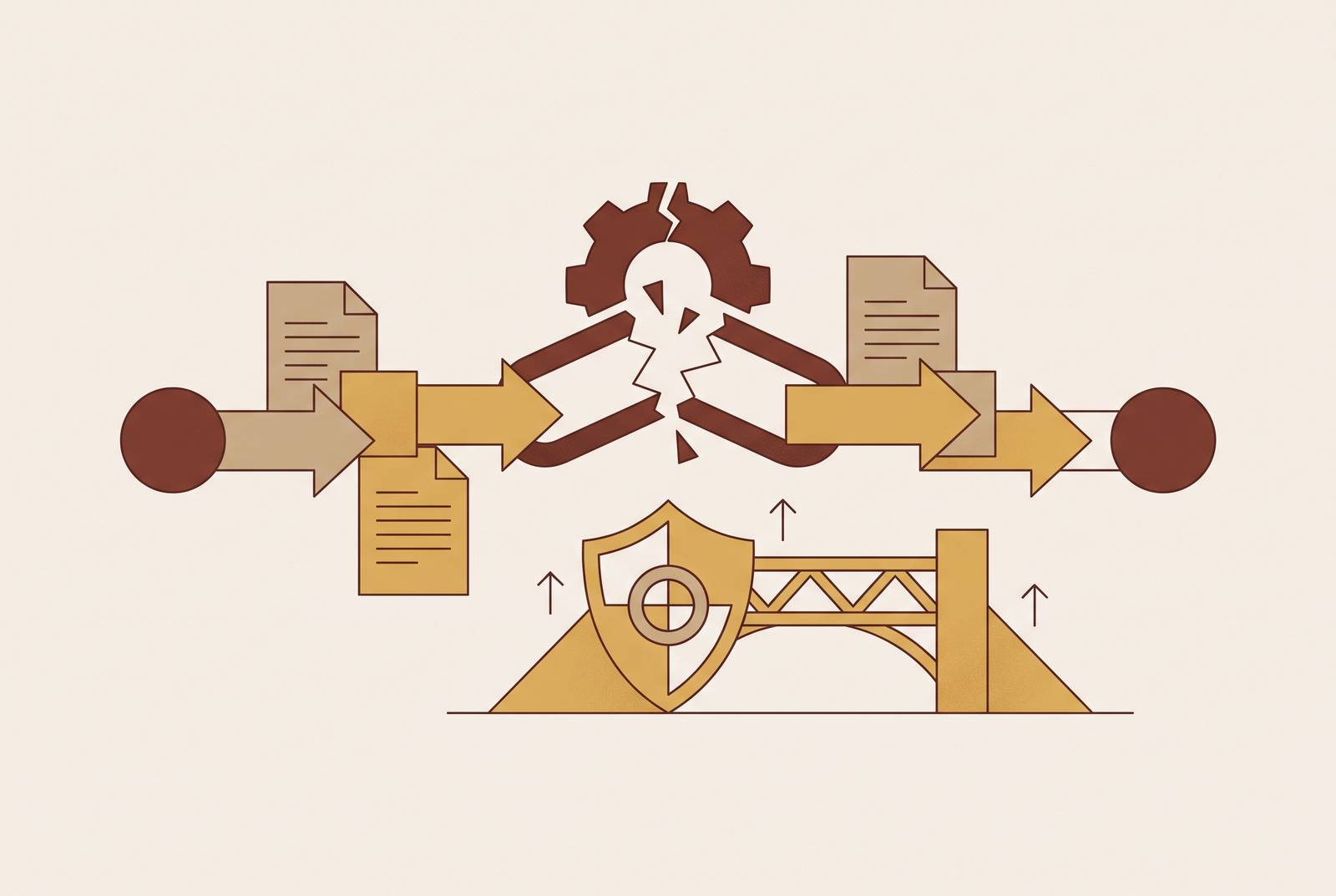
The contract lifecycle management market is growing fast, and it is failing its buyers at almost the same pace. Gartner reports that nearly half of all CLM implementations fail to deliver the benefits they were bought to deliver, and that figure hasn't moved much even as the software itself has gotten more capable. MGI Research's 2025 CLM Buyer's Guide, which looked across 35 leading vendors, found that more than two-fifths of organizations rip out their first CLM system within three years. That's a substantial cost, not a minor discrepancy. That's sunk licensing cost, a legal and sales team that just relearned a workflow for nothing, and a procurement org back where it started, except now more skeptical of the next pitch.
The market these organizations are shopping in isn't small or immature, either. Future Market Insights has the CLM sector growing at a 12% compound annual rate, which means the vendor landscape keeps getting more crowded, more expensive, and, apparently, no easier to get right. Meanwhile the demand side keeps tightening: CLOC's State of the Industry survey found that most legal departments expect contract volume to keep climbing while headcount stays flat. Put those two facts together and a failed CLM rollout stops looking like a one-time write-off. It becomes a compounding liability, because the volume problem that motivated the purchase in the first place doesn't pause while the organization figures out what went wrong.
What's notable isn't the failure rate itself so much as the language in the post-mortems. Nobody writing these reviews says the platform couldn't do what it promised. The recurring verdicts are things like "adoption rates were too low," "data quality didn't meet expectations," "sales went back to the old method." Read enough of these and a pattern appears that has nothing to do with software architecture. It points somewhere else entirely, toward the organization that bought the tool rather than the tool itself.
The organizational failures that cause implementations to collapse
Strip away the vendor-specific noise and four mistakes appear repeatedly, all of them made before go-live, none of them fixable by better software after the fact.
The first is digitizing chaos instead of redesigning the process that produces it. The most common trap in a CLM rollout is mapping the existing, messy workflow onto the new system exactly as it stands today. If a contract currently passes through seven people before anyone signs it, the software doesn't shorten that path, it just makes it visible, searchable, and permanent. Legartis's 2026 guide calls this out directly: organizations that skip process design before picking a system end up digitizing their own chaos, with a nicer interface wrapped around the same underlying dysfunction. Whatfix's 2025 implementation research lands on the identical point from a different angle, arguing that contract transformation has to start with systems thinking, not with a software purchase.
When legal builds a system around its own review and approval workflows and only later asks sales to adopt it, sales doesn't adopt it. Sales goes back to email, phone calls, and self-drafted documents, because those are the tools it already trusts. This isn't a discipline problem or a training gap. Legal and sales run on structurally different incentives: sales gets measured on closed deals, and every day a contract sits in review shows up in a pipeline report somewhere, while legal is built around risk control and is almost never measured on speed. Legartis frames this correctly: CLM software can't resolve that tension, but it can structure it, and the friction only ends once someone decides upfront which contracts actually need legal eyes and which don't.
The third mistake is building governance as a brake instead of a filter. The bottleneck doesn't go away in this setup. It just moves inside the new system and gets assigned a ticket number.
The fourth is change management occurring after the go-live date instead of before it. A platform delivers exactly nothing if the people expected to use it every day don't understand why it's worth the switch, and if the new system is slower than the old workaround, people will pick the workaround every single time. This isn't unique to contracting software. Broader change management research cited in Whatfix found that up to 70% of change initiatives fail due to poor focus on people and processes rather than technology. The Foth Companies case, where General Counsel Susan Davis and Contracts Manager Carrie Voskuil walked through their own CLM journey in a Summize webinar, makes the same point from the inside: what determined the outcome wasn't which platform they picked, it was how much preparation and ownership existed on the user side before the switch happened.
Three amplifying forces that make organizational problems worse in the current environment
Beyond the structural mistakes, three forces specific to the current CLM market are amplifying the failure rate by pulling procurement decisions away from organizational readiness and toward technology enthusiasm.
Elevate Law, writing in July 2026, named the first one the GenAI Mirage. Legal teams under pressure from the C-suite to "do something" with AI are now prioritizing AI-led features in vendor selection, which means platforms get bought on the strength of a demo, some buzzwords, and clause-extraction capability, rather than on whether the workflow actually fits the organization. A global sales team pushing hundreds of contracts a month doesn't stall because the AI failed to pull the right clause out of a document. It stalls because approvals take five days and travel through a chain of email threads that nobody's redesigned in years. As GenAI tools become common and easy to buy, organizations are discovering they don't actually know how contracts move through their own business. The AI purchase didn't create that ignorance. It just exposed it.
The second force is the feature checklist replacing any real assessment of architectural fit. Buyers compare vendors by counting checked boxes on a feature matrix, skipping the harder question: does a platform's underlying architecture match their actual contract profile. Elevate Law's research is specific about the mismatch: a platform built for mid-market speed can buckle under enterprise volume, and a heavyweight enterprise tool built for complexity can grind a faster-moving smaller company to a halt. Feature count tells a buyer almost nothing about either failure mode, and without that architectural alignment, adoption suffers no matter how long the checklist runs.
The third is what might be called the workflow isolation trap. Contracts don't live in a vacuum, they touch ERP, CRM, and procurement systems at nearly every stage, and a CLM platform that operates as its own island pushes users straight back into old habits: saving drafts locally, managing redlines over email, working around the very system meant to centralize that work. Elevate Law, citing MGI Research, names poor integration as one of the primary culprits behind CLM failure, and Malbek's research makes the mechanism explicit: without real connections to upstream systems like CRM and ERP, and downstream systems like finance and compliance platforms, even a technically advanced CLM still ends up creating its own data silo.
Two smaller amplifiers ride alongside these three. First-generation CLM platforms were sold on configurability, but in practice "configuration" often meant custom code, and plenty of organizations are still untangling that vendor dependency years later. A 2026 ThinkFree analysis found that if formatting breaks or the interface feels awkward when AI output hits the editor screen, users immediately leave for external tools. One General Counsel quoted in that research said legal staff were spending more time resolving problems a year after CLM implementation than they had before it, with the worst bottlenecks concentrated in redlining, internal escalation, and negotiation rounds.
What value leakage and risk exposure cost organizations running broken contract processes
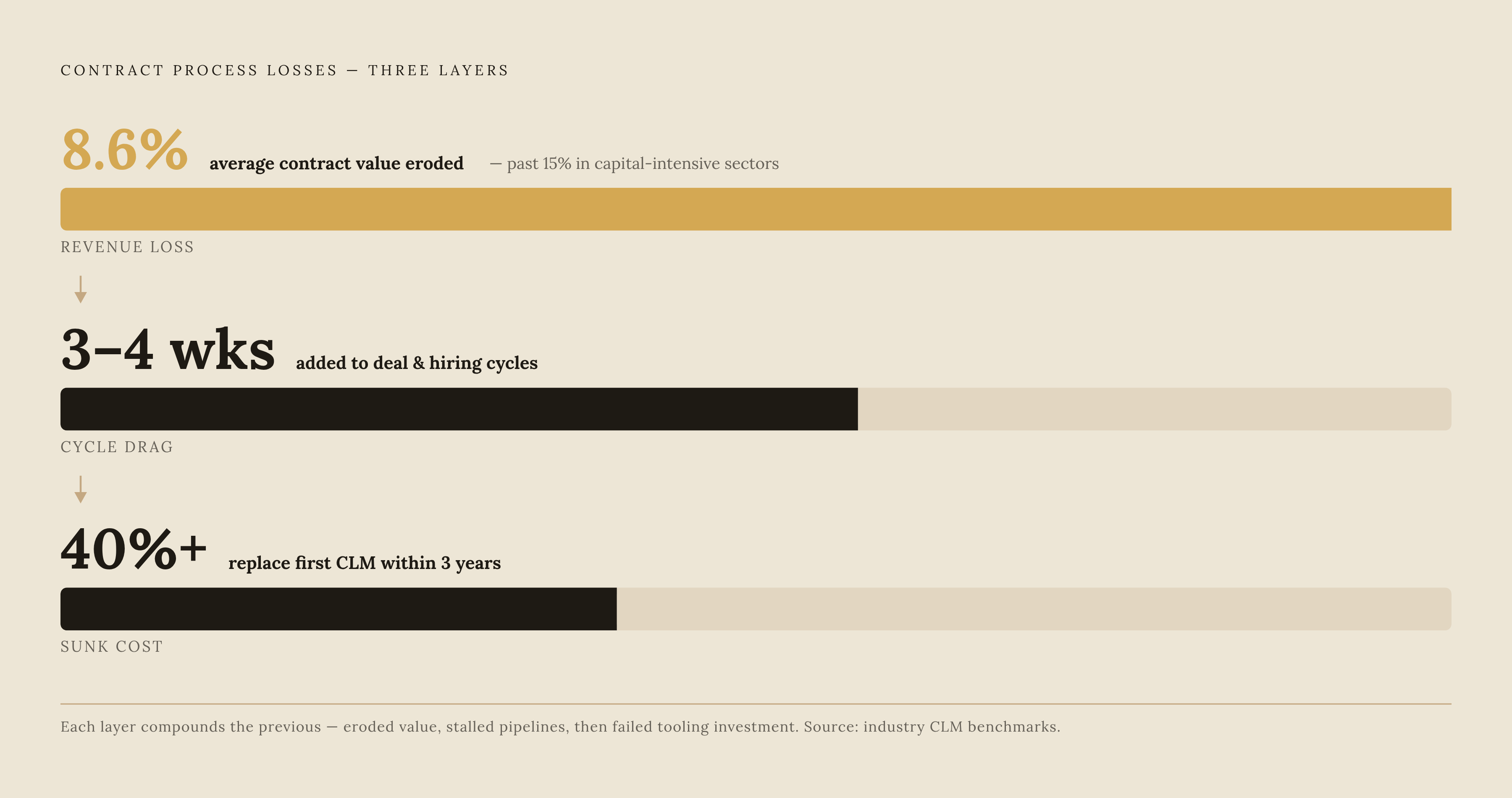
They appear in quarterly numbers, and the clearest one is contract value erosion. Research across a large sample of organizations, cited in Whatfix, found an average value erosion of 8.6% when contracting processes are fragmented, a figure that climbs past fifteen percent in capital-intensive sectors where contract terms carry more weight per deal.
Then there's the delay itself. Aline's research found that inefficient contract workflows commonly add three to four weeks to deal and hiring cycles at many companies, and that delay never appears as a line item in the CLM budget. It appears in the sales cycle instead, quietly, where almost nobody thinks to trace it back to the contracting process. Compounding that is a visibility problem: a large majority of organizations, per Aline, don't have full visibility into their own contractual obligations, which raises the odds of missed deadlines, unwanted auto-renewals, and revenue simply leaking out the side of the business.
Regulatory exposure adds another layer, and it's getting heavier rather than lighter. CobbleStone Software's 2026 analysis points to an expanding regulatory environment across privacy law, AI governance, ESG reporting, and cross-border data rules, and manual contract processes create exactly the blind spots that expanding regulation punishes: inconsistent language across agreements, missed obligations, and no real audit trail for how approvals happened. None of this happens in isolation from staffing. When contract volume rises and legal headcount doesn't, every one of these inefficiencies multiplies rather than simply adding up, which is why a failed CLM implementation isn't a one-time loss so much as a recurring cost that scales right alongside the business.
The upside case, though, is just as concrete. The 2025 Forrester Wave CLM Report, cited in Sirion's research, found that organizations running integrated digital contract management close deals substantially faster than those without it. One enterprise integration case involving Workato and Sirion produced significant annual savings from nothing more than better visibility into supplier terms. The technology clearly can deliver. The organizations that get there are the ones that fix what's broken internally before they ever sign a vendor contract.
What to resolve inside the organization before selecting or re-implementing a CLM platform
The most consequential decisions in a CLM initiative happen before a single vendor demo, and organizations that skip this internal work are, in effect, shopping for a solution to a problem they've never actually written down.
Start with a contract inventory, not a market scan. Before comparing platforms, an organization needs to know what it actually handles, by type, by volume, by complexity, because a standard NDA with a routine partner has nothing in common with a framework agreement anchored to a key account, and the whole CLM design should follow from that distinction rather than precede it. Legartis's research points to something counterintuitive here: this inventory usually shows that a larger share of contract types can be automated than legal teams instinctively assume, which reshapes the whole scope of the project before a vendor is even in the room.
Next, map how contracts actually move today, not how the process documentation claims they move. Who starts the contract, in what format, which approvals are genuinely required versus quietly skipped in practice, and where the time actually disappears. Legartis is blunt about this step: it's uncomfortable, because it usually reveals just how far daily reality has drifted from the process someone wrote down years ago, and it remains the single most important step before any system gets designed. Whatfix's research backs this up from the technology side, noting that this kind of mapping surfaces hidden inefficiencies and risks that no software purchase, on its own, can fix.
With that map in hand, build a baseline of standardization before automating anything. That means templates, clause libraries, and negotiation playbooks that hold consistent across contract types. Skip this step and automation doesn't clean up the mess, it just runs the same inconsistency faster and at greater scale. Elevate Law's research states that organizations without a solid process foundation shouldn't expect automation to manufacture order out of disorder.
Then comes the governance question of which contracts require legal review, which don't, who owns each stage of the lifecycle, and what the approval matrix looks like end to end. Legartis's framework treats this as the real agreement that makes a CLM platform viable, not the software license sitting on top of it. Last, before deployment, metrics need to be locked in against shared outcomes: time-to-sign, approval lag, contract risk score, automation rate, all defined by Whatfix as the KPIs worth tracking. Without a documented "before" picture, there's no accountability baseline once the system goes live, and leadership's gut feeling fills the vacuum where actual measurement should be.
How to build the cross-functional change program that makes adoption stick
The technical rollout is the smallest part of any CLM initiative. The change management work that runs before, during, and after go-live is what actually decides whether the platform earns its keep or turns into an expensive line item nobody opens anymore.
That work has to start before go-live, not after the first wave of resistance occurs. Legal wants risk control and clean version history. Procurement needs its own separate approval path. Finance won't touch anything without ERP integration. Sales expects to see contract status from inside the tools it already lives in every day. Each function needs something different from the same platform, and a CLM built exclusively around legal's preferences gets abandoned by everyone else within a few months. ThinkFree's research states that a CLM that isn't designed from the start as shared, collaborative infrastructure eventually shrinks down to a tool that only the legal team bothers to open.
Whatfix's research points to the fix: align legal, sales, finance, and procurement goals early, build shared templates and a common approval matrix, and settle on one consistent risk framework across departments. Done well, that alignment increases deal velocity and strengthens governance at the same time, rather than trading one for the other.
Sequencing matters as much as the alignment itself. Before implementation, lay out the why, the what, and the how of the change, and get real stakeholder commitment locked in, not just sign-off in a meeting nobody remembers. During implementation, build momentum through visible quick wins and catch friction early with regular check-ins rather than waiting for a quarterly review to surface problems. After go-live, keep it alive through active feedback channels and continued measurement against the baseline set before the project started.
That's the pattern running through every section of this analysis. The software has matured. The failure rate hasn't moved because the organizational work that causes it, largely, still hasn't been done. The Foth Companies.
Sources
- CLM Implementation 2026: After AI Drafts the Contract
- How to Achieve Successful CLM Implementation and Drive Business Value (2025 Guide) - Whatfix
- CLM Implementation Challenges: Why 40% of Enterprise Deployments Fail - Elevate
- Implementing Contract Management Software: A 2026 CLM Guide for Legal and Sales
- Why CLM Implementations Fail and How to Get it Right | Summize
- 11 Contract Lifecycle Management Best Practices for 2026