Electronic Signatures in Healthcare Consent and HIPAA Compliance
Organizations must treat e-signatures as PHI and implement multi-factor authentication accordingly.

Electronic signatures are legal in healthcare. HIPAA leaves the choice of technology to make them so up to the organization. The actual rule is easier to state than to satisfy: any e-signature method that produces a legally binding contract under the state or federal law governing that transaction clears HIPAA's own bar. Two federal statutes carry the legal weight here. The ESIGN Act says electronic signatures and records hold up in court as long as both parties agreed to transact electronically and the record stays accessible later, and UETA, now adopted in 49 states, treats an electronic signature as the functional equal of a wet one.
That near-universal adoption still leaves a gap to check before rollout. A handful of states run their own equivalent statutes instead of UETA itself, so a hospital system signing patients across state lines has to confirm which law governs each signer and each document type. Assuming federal coverage settles the matter everywhere is exactly the mistake that trips people up.
What gets missed often enough to cause real trouble is that once a patient's signature is tied to their health information, that signature becomes PHI in its own right. It does not sit outside the record as some administrative footnote. It carries the same protection obligations as the diagnosis, the chart note, or the lab result sitting next to it on the page.
The specific HIPAA Security Rule requirements that any e-signature implementation must satisfy
HIPAA will not name a technology, so the Security Rule's administrative, physical, and technical safeguards become the actual rulebook for anyone building or buying an e-signature system that touches ePHI. Four things have to hold at once.
Signer authentication has to bind a specific identity to the specific act of signing. Document integrity depends on cryptographic hashes and tamper-evident seals applied at the moment of signature, so any later edit leaves a trace that can be caught. Audit trails need to be immutable and complete: who signed, what exactly was signed, when, from where, and by what authentication method, all sitting in a log that cannot be quietly edited afterward. Access controls and retention round out the list: role-based access to ePHI, encryption both in transit and at rest, managed key rotation, and retention periods set in advance rather than improvised later.
Non-repudiation underlies all four. Regulators wanted a signer who could not credibly claim later that they never signed anything. Modern platforms get there by layering cryptographic hashes, trusted timestamps, a text record of signer identity, and procedural evidence like training records and internal policy.
The bar is about to rise. Any organization treating its current safeguards as a ceiling rather than a floor is building on ground that is already shifting under it. A proposed update to the Security Rule would erase the old line between "required" and "addressable" safeguards, so what used to be optional becomes mandatory across the board. Multi-factor authentication and encryption for data at rest and in transit would stop being best practice and become the floor. Business associates would face a 24-hour window to notify covered entities when they activate a contingency plan, though the broader 60-day breach notification rule stays as it is.
Signer authentication in depth: tiering identity verification to the risk level of each document
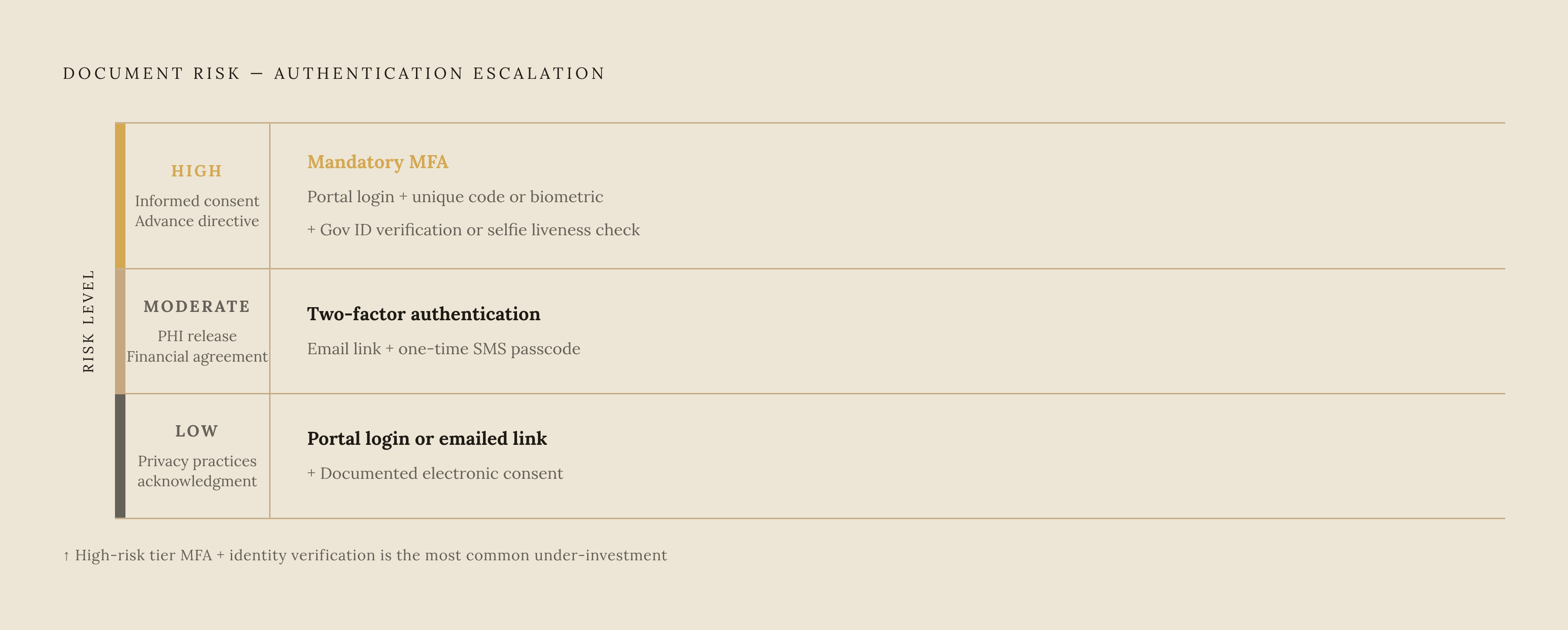
Authentication is not a switch you flip on or off. HIPAA-aligned practice treats it as a dial that turns up in proportion to how sensitive the document actually is. A three-tier model captures how that plays out in practice.
Low-risk paperwork, an acknowledgment of receiving the Notice of Privacy Practices being the clearest example, can often get by with a portal login or an emailed link, paired with documented consent to transact electronically. Moderate-risk documents call for more: a PHI release authorization or a financial agreement benefits from two-factor authentication, an email link combined with a one-time SMS passcode. High-risk documents, informed consent ahead of a major procedure or an advance directive, deserve the strongest tier available: mandatory multi-factor authentication pairing portal login with a unique code or a biometric check, and for the most sensitive workflows, government ID verification or a selfie liveness check layered on top.
The choice of MFA technology carries its own trade-offs, and this is where a lot of organizations get complacent. Authenticator apps generating time-based one-time passwords strike a reasonable balance between security and everyday usability. SMS and voice codes remain common, but they carry real exposure to SIM-swap fraud, so they belong alongside other controls rather than standing as the only factor protecting a signature. Treating an SMS code as sufficient on its own, for a high-risk document, looks fine right up until a fraud case forces someone to explain that choice in front of a judge.
Authentication at login is not the same thing as authentication at the moment of signing, and treating the two as interchangeable is a common design mistake. Re-confirming identity right before the signature is captured, on the final version of the document content, is what actually supports a non-repudiation claim later. A signer who logged in an hour earlier and then walked away from the screen is a scenario no login-only system can rule out.
What a HIPAA-ready audit trail must capture
Regulators heading into 2026 expect audit records to cover the whole lifecycle of a contract or consent form: who accessed the document, what got changed, when approvals landed, and how ongoing compliance obligations are being tracked. A defensible audit trail breaks down into six dimensions.
Who covers authenticated user identity, tied to a unique user ID rather than a shared login. The document itself is covered by its version, a cryptographic hash of its state before and after signing, and the exact consent language the signer saw. When means timestamps drawn from a trusted, synchronized source, with timezone and sequence recorded so events cannot be reordered later. Where captures IP address, device fingerprint, and geolocation where collecting that makes sense. How records the authentication method used, whether it succeeded or failed, and whether step-up MFA triggered along the way. Why documents the stated purpose behind the action, naming it as treatment consent, a HIPAA authorization, or a PHI disclosure.
None of that matters if the log can be edited after the fact. The records need to sit in an append-only repository, chained together with cryptographic hashes so tampering with any single entry breaks the chain and becomes visible, and replicated across separate fault domains with drift monitoring watching for inconsistency between copies.
Litigation and regulatory inspection add one more requirement that is easy to skip: the audit package has to be searchable, exportable, and readable by a human being, without needing the vendor's own proprietary software to open it. An export that only renders correctly inside one company's tool becomes a liability the day that vendor relationship ends or the software loses support, and that day tends to arrive with no warning.
Business Associate Agreements: requirements, contents, and vendor vetting
The trigger here is straightforward, even though organizations sometimes miss it. If an e-signature vendor creates, receives, maintains, or transmits ePHI on a covered entity's behalf, and that includes simply storing signed documents on its servers, the vendor counts as a Business Associate, and a BAA has to be in place before any ePHI reaches that vendor. Storage alone is enough to trigger the requirement. No processing or analysis is needed.
The BAA itself does not need a wet signature. HHS's Office for Civil Rights has said that digital signing of electronic BAAs is acceptable, as long as the resulting contract is legally binding under whatever state or other law applies. The agreement governing e-signature use can itself be executed electronically.
A sound BAA needs specific provisions, not boilerplate. It has to require the vendor to flow the same ePHI protections down to any subcontractors it uses, rather than leaving that chain unaddressed. It has to give the covered entity a right to audit the vendor or obtain attestations about its security posture. It has to spell out what happens at termination, secure return or certified destruction of ePHI, and proper data sanitization once the relationship ends. And it has to align breach notification obligations with HIPAA's own 60-day window, while requiring expedited reporting to HHS for any incident touching 500 or more individuals.
Vetting a vendor before signing anything means going past the sales pitch, and this is where most procurement processes fall short. Ask for penetration test results and third-party audit reports, with SOC 2 Type II or ISO 27001 as the standard references. Confirm the encryption standards and key management practices actually in use. Trace the subprocessor chain all the way down, since one weak link anywhere in that chain undermines every protection built on top of it. And if the platform offers AI-assisted contract drafting, test it directly: run scenarios across different vendor types, cloud providers, medical device manufacturers, consulting firms, and check whether the AI-generated HIPAA clauses, indemnification language, and breach notification terms actually hold up. Required BAA provisions must be specified, detailing what business associate agreements must contain when they are required and how vendors should be vetted.
Healthcare documents that routinely require HIPAA-compliant e-signatures
The list of documents touching HIPAA e-signature requirements runs longer than most people expect, and it spans well past the intake desk. Patient consent and authorization paperwork sits at the center: acknowledgment of receiving the Notice of Privacy Practices, consent forms where a patient has a genuine chance to agree or object, authorizations for uses or disclosures of PHI that would otherwise be impermissible, revocations of consent submitted by a patient or an authorized third party, and remote authorizations executed by personal representatives or medical powers of attorney.
Telehealth has added its own layer. Patients need documented consent before a telehealth visit can proceed, identity verification typically happens before the consultation starts, and remote pre-operative consent forms need to spell out procedural risk in writing, all of it captured electronically in most current workflows.
Clinical research carries its own dense stack of forms: investigational new drug applications, statement of investigator forms, financial interest and arrangement disclosures, and informed consent documents for trial participants, each one carrying its own signature and retention requirements.
The administrative side just picked up new weight, and it deserves more attention than it is getting. A CMS final rule issued March 24, 2026, sets a HIPAA standard specifically for electronic signatures used in health care claims attachments transactions https://www.covingtondigitalhealth.com/2026/04/cms-finalizes-hipaa-standard-for-electronic-signatures-in-health-care-claims-attachments-transactions/. The rule does not force anyone to use e-signatures, it standardizes the format when they do, and covered entities have until May 26, 2028, to comply https://www.covingtondigitalhealth.com/2026/04/cms-finalizes-hipaa-standard-for-electronic-signatures-in-health-care-claims-attachments-transactions/. Two years might sound generous, but claims-processing systems tend to be old, tightly coupled, and slow to touch, so the runway is shorter than the calendar suggests.
Cross-border complexity: where HIPAA and GDPR overlap for healthcare organizations serving EU patients
GDPR reaches outside the EU's own borders. Any US-based healthcare provider offering services to individuals in the EU has to satisfy HIPAA and GDPR at the same time, and that includes the e-signature workflow itself. Under GDPR Article 9, health data counts as a special category, carrying protections that go beyond what applies to ordinary personal data.
Four GDPR obligations reach directly into how an e-signature system has to be built. A documented lawful basis for processing, usually vital interests, public health grounds, or explicit consent, has to be established before any ePHI moves through the signing platform. Data minimization means collecting only what the specific signing purpose actually needs, resisting the temptation to pull in extra health data just because a form field happens to exist for it. Transparency requires a privacy notice explaining how signature data gets processed, stored, transferred, and for how long it is kept. Data subject rights mean patients can access, correct, delete, or port their own signature data on request, which places real demands on how the platform's retention architecture gets designed from the start.
None of these four obligations map cleanly onto HIPAA's own framework. A platform built only to HIPAA's specifications, then patched afterward for GDPR, tends to show the seams, particularly around erasure requests, since HIPAA's retention mandates and GDPR's right-to-erasure provisions can pull in genuinely opposite directions. Treating this as a paperwork exercise rather than an architecture decision made before the first line of code gets written is the mistake that costs the most: organizations that do it end up rebuilding the retention layer twice.
How AI is beginning to change contract review and compliance monitoring in healthcare settings
Adoption here is still early, and the numbers reflect that. Deloitte's US Health Care Outlook Survey found that 49% of surveyed organizations are still experimenting with generative and agentic AI, while 18% have not adopted these tools in any form https://www.signnow.com/blog/hipaa-electronic-e-signature-solutions/. That puts healthcare well behind the curve on practical contract lifecycle management, even as the underlying vendor tools keep getting better.
Before signature, AI tools flag risky or missing clauses, deviations from an organization's legal playbook, and non-standard indemnification or breach notification language. After execution, AI-powered categorization sorts signed agreements, surfacing renewal dates, compliance obligations, and policy-change impacts across large contract portfolios.
The caution belongs right alongside the promise, and it deserves more weight than most pitch decks give it. AI-generated clause language still needs the same scrutiny a human-drafted clause would get, tested against real scenarios rather than trusted because the output sounds smooth. A tool that drafts confidently is not the same as a tool that drafts correctly, and in a regulatory environment where a single missing breach notification clause carries real financial exposure, that gap is the whole ballgame. HIPAA penalties range from $100 to $50,000 per incident, with an annual maximum of $1.5 million per violation category, and willful neglect is at the top of that scale https://www.signnow.com/blog/hipaa-electronic-e-signature-solutions/ https://signquick.app/blog/e-signatures-in-healthcare-hipaa-compliance-guide. GDPR sets its own ceiling at up to €20 million or 4% of global revenue https://yousign.com/blog/healthcare-e-signature-compliance-hipaa-gdpr-medical-records https://youtrust.com/blog/healthcare-e-signature-compliance-hipaa-gdpr-medical-records. Criminal penalties for intentional HIPAA violations can run up to 10 years in prison https://signquick.app/blog/e-signatures-in-healthcare-hipaa-compliance-guide. The CAQH Index 2023 puts administrative complexity at approximately $400 billion of total national healthcare expenditures in the US https://www.signnow.com/blog/hipaa-electronic-e-signature-solutions/. The CAQH Index 2023 finds administrative complexity responsible for about 10% of total national healthcare expenditures in the US https://www.signnow.com/blog/hipaa-electronic-e-signature-solutions/. The Journal of Medical Internet Research (JMIR) found that 61.3% of Americans accessed patient portals over the last 12 months https://www.signnow.com/blog/hipaa-electronic-e-signature-solutions/. The Journal of Medical Internet Research (JMIR) found that 89.9% of patient portal users use them to view test results https://www.signnow.com/blog/hipaa-electronic-e-signature-solutions/. Yousign.com reports that healthcare data breaches exposed over 276 million patient records in 2024 https://yousign.com/blog/healthcare-e-signature-compliance-hipaa-gdpr-medical-records. Healthcare data breaches exposed over 276 million patient records in 2024, according to Healthcare E-Signatures: Compliance Made Simple https://youtrust.com/blog/healthcare-e-signature-compliance-hipaa-gdpr-medical-records. HIPAA maximum penalties are up to $1.5M per violation category per year, according to Healthcare E-Signatures: Compliance Made Simple https://youtrust.com/blog/healthcare-e-signature-compliance-hipaa-gdpr-medical-records. Under HIPAA Breach Notification Obligations, organizations must report unauthorized PHI access affecting 500+ individuals within 60 days, according to Healthcare E-Signatures: Compliance Made Simple https://youtrust.com/blog/healthcare-e-signature-compliance-hipaa-gdpr-medical-resources. There are 18 HIPAA identifiers that constitute protected health information, according to E-Signatures in Healthcare: HIPAA https://signquick.app/blog/e-signatures-in-healthcare-hipaa-compliance-guide.