AI Bias and Accuracy Risks in Automated Contract Analysis
Fast AI contract review relocates errors into channels where they're harder to catch.

The AI contract analysis market hit $3.32 billion in 2025 and GII Research projects $4.30 billion by 2026, growing at a 29.6% annual clip. That money is moving toward automating the full agreement lifecycle, not just faster first-pass review. Speed doesn't eliminate agreement risk. It relocates it, pushing errors that used to get caught in slow manual review into quieter, more trusted channels where they're harder to catch once they've reached a downstream system. That relocation, not the speed itself, is the story enterprise legal departments haven't fully priced in.
Industry analyses have estimated poor agreement management destroys trillions in global economic value every year. World Commerce and Contracting puts the average business's loss at 9.2% of annual revenue. Large enterprises and Fortune 500 companies have moved quickly to build AI-assisted contract review into standard workflow. Adoption is the current operating condition, not a future scenario. It's the operating condition for most large legal departments, and that makes the conditions under which AI fails, along with the safeguards that catch those failures, an immediate operational question rather than an academic one.
Where AI contract analysis performs well, and where confidence in those numbers should be tempered
The gains on standard contract types hold up under scrutiny. Loio's data shows AI can review a standard NDA in 26 seconds at 94% accuracy, against 92 minutes for a human lawyer on the same document. A 212x speed improvement isn't a rounding error; it works because NDAs are structurally repetitive, and the clause categories, the language patterns, and the variables that shift from one NDA to the next are narrow and well mapped by any model trained on enough of them.
The trouble starts the moment you leave that narrow lane. Accuracy on standard fields sits above 90% for common contract types, but it drops sharply once you hit novel clauses, multi-party structures, or anything jurisdiction-specific. A simulation study published in Scientific Reports (the AICRIM research) found a 27% to 32% reduction in contract errors and compliance detection accuracy of 92.1%. Those numbers come from simulation, not live deployment, so treat them as upper-bound estimates until someone validates them against real contract portfolios, not as evidence of current field performance.
The enterprise data tells a similar story with the same asterisk attached. LexCheck's 2024 benchmarks found AI tools hit 94% to 97% accuracy on standard clause identification, while experienced lawyers averaged around 80% on the same task. That comparison holds only for standardized commercial paper, and it says nothing about the edge cases: the unusual indemnity language, the jurisdiction quirks, where a wrong answer actually costs money. Clean training corpora and familiar contract types are the conditions that produce the headline figures. Most enterprise contract portfolios don't live in those conditions, and that gap is where bias and failure modes start.
How training data bias shapes what AI sees and misses in contract language
Training data bias in a contract AI system means something specific: a model trained mostly on one jurisdiction, one industry, or one contract type underperforms, predictably and repeatedly, on anything that doesn't resemble what it learned from. Gowling WLG's 2026 analysis names the mechanism: unrepresentative training data limits a model's ability to generalize, and noisy data produces inaccurate outcomes downstream. A model trained heavily on US commercial paper misreads how civil-law jurisdictions frame force majeure or indemnity clauses, the same way someone who's only ever read US contracts would stumble over a civil-law drafting convention they've never encountered.
Niche industries carry the risk in reverse. Healthcare, government, and life sciences contracts run on regulatory language that most general-purpose models never see at meaningful scale during training. Third-party paper is another blind spot: a model tuned on a company's own templates performs worse the moment it hits a counterparty's drafting conventions, because the patterns it learned to spot simply aren't there.
Amendments create a subtler version of the same failure. ContractSafe's 2026 AI Contract Data Accuracy Guide notes that field-level accuracy can look strong on the original agreement while contextual accuracy quietly fails, because the model never registers that Amendment #1 now controls a term the base agreement originally set. The standard buyers should hold vendors to is clear: training data has to be lawfully sourced, licensed for the use case, and representative of it, free of the biases that would undercut it. An enterprise evaluating a contract AI vendor needs to ask about training corpus composition directly, not settle for the headline accuracy number. A tool that's 94% accurate on NDAs says nothing about how it handles the regulatory language buried in a life sciences supply agreement.
Training data bias creates the blind spot. What happens next is where the damage compounds: users start trusting that blind spot completely.
Automation bias: why users trust AI contract outputs more than the accuracy warrants
Automation bias isn't unique to contracts. Research published in an arxiv preprint describes it as the tendency for users to accept a system's output without independent verification, especially when the reasoning behind that output stays opaque. Contract review already carried an error problem before AI showed up. Research into manual review finds it runs an error rate between 15% and 25%. Stacking a generic AI tool on top of that without real oversight causes the failures to compound instead of canceling out: missed clauses, unenforceable language, and deal-specific terms that go missing.
The scale of misplaced trust is measurable outside legal work too. In 2024, research found that 38% of business executives reported making a wrong decision based on a hallucinated AI output. That figure isn't legal-specific, but the consequences in a contract, a missed obligation, an unnoticed auto-renewal, a term that turns out to be unenforceable, map directly onto agreement value.
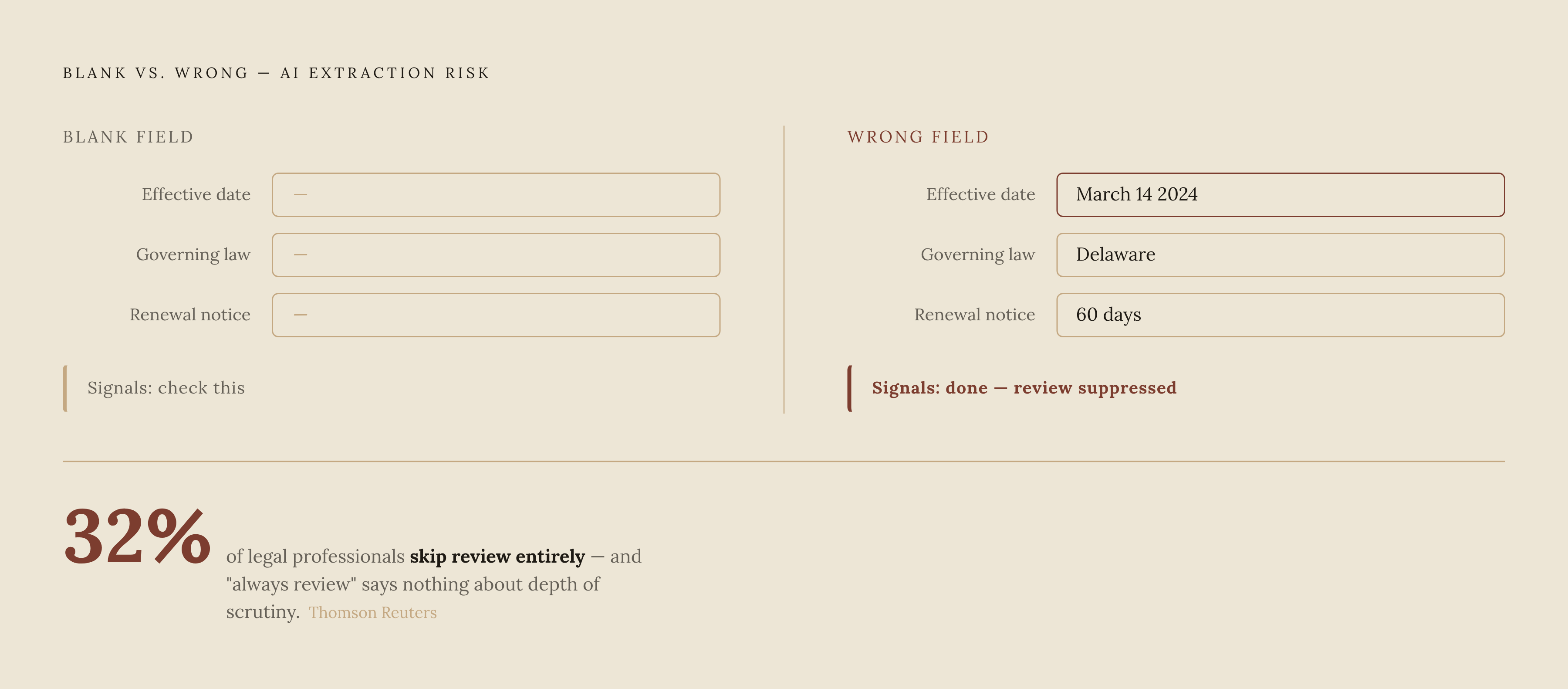
ContractSafe's accuracy guide names the asymmetry that makes this dangerous. A blank metadata field tells a reviewing team to go check something. A filled field, even a wrong one, signals the system already did the checking. Wrong data is more dangerous than missing data because it looks finished. Thomson Reuters' survey found 68% of legal professionals say they always review AI contract output before acting on it, which leaves 32% who don't. Even "always review" as a stated policy doesn't say what level of scrutiny gets applied to which field, and that gap is the one that matters operationally.
The real exposure doesn't come from complicated, high-stakes contracts getting careless treatment. It comes from the opposite: high-volume, low-complexity contracts that feel too routine to warrant close attention are exactly where rubber-stamp review happens. Auto-renewal clauses, payment terms, notice periods: they hide in the contracts nobody thinks to scrutinize.
AI hallucinations in contract and legal work: named incidents and systemic risk
Hallucination in legal AI stopped being theoretical a while back. Legal analytics tracking by LexisNexis and Bloomberg Law has identified more than 700 court cases involving AI-generated hallucinations or fabricated content. The ABA TechReport found 79% of lawyers already use AI tools in some capacity. Adoption has outpaced the safeguards meant to catch its failures, and courts are starting to notice.
Even the tools built specifically for legal work carry meaningful hallucination rates. A preregistered empirical evaluation published in the Journal of Empirical Legal Studies found that purpose-built legal research tools, LexisNexis's Lexis+ AI and Thomson Reuters's Westlaw AI-Assisted Research and Ask Practical Law AI among them, hallucinate somewhere between 17% and 33% of the time, after vendor-side optimization specifically for legal use cases. General-purpose large language models fare worse. Stanford's CodeX Center found in 2025 studies that these models fabricate case citations in roughly 30% to 45% of legal research responses, with the rate climbing as the legal issue gets more obscure or novel.
Two named incidents show what this looks like in practice. In May 2025, the Mississippi-based law firm Butler Snow faced judicial scrutiny after submitting court filings in a lawsuit containing fabricated citations generated by an AI chatbot. U.S. District Judge Manasco in Alabama flagged the firm's "lapse in diligence and judgment" after fabricated case references appeared in the filings. The firm apologized and sanctions were subsequently issued.
The second incident involved a music publisher's case against Anthropic PBC, where an expert declaration cited a fictitious article title with inaccurate authors, generated by an AI tool. The underlying article did exist and was eventually located through a plain Google search, but the fabricated citation details cast doubt on the entire submission. The court struck part of the expert declaration and noted that a standing order on filing accuracy had not been followed.
The finding that should worry practitioners most cuts against the assumption that newer models are safer. A model's release date is not a proxy for its reliability, and anyone treating it that way is making a bet the data doesn't support.
Translate this into contract terms, and hallucination doesn't produce a fake court citation. It produces fabricated clause language, an invented governing law reference, an incorrect SLA term, or an obligation attributed to the wrong party, and all of it looks like valid extracted data right up until it causes a real business consequence.
The regulatory environment that is making AI bias and accuracy a compliance obligation, not just a quality concern
Regulators stopped treating AI accuracy as a vendor quality issue a while back. The EU AI Act's phased rollout made that shift concrete: as of August 2025, obligations for general-purpose AI model providers took effect. EU Commission guidance states that providers placing general-purpose models on the market from August 2, 2025 onward must publish a sufficiently detailed summary of their training content, and downstream enterprise users carry the burden of confirming their systems don't fall into a prohibited category.
The bias obligations reach past an enterprise's own fine-tuning work. TechAhead's guide on AI bias audits notes that the EU AI Act's bias requirements extend to foundation model providers themselves. Stanford HAI's 2026 AI Index found 36% of organizations already cite ISO/IEC 42001 as an influence on their responsible AI practice, and that certification is turning into a procurement prerequisite, with bias documentation sitting at the center of the evidence a vendor has to produce.
US federal procurement moved the same direction. OMB Memoranda M-25-21 and M-25-22, issued in April 2025, require covered agencies to address data ownership and intellectual property rights in AI procurement contracts, bar vendors from training publicly or commercially available AI algorithms on non-public government data without agency consent, and mandate documentation supporting transparency and explainability. Those requirements apply to contracts awarded or renewed after October 1, 2025.
Governance controls that used to be a vendor's selling point, bias monitoring, audit trails, encryption, explainability documentation, are turning into contractual requirements instead. Due diligence on the AI procurement contract now matters as much as due diligence on the tool itself. MiroMind's analysis finds that the most serious risks in AI procurement rarely come down to whether the model works. They come down to how data, IP, liability, bias, safety, and lifecycle governance get allocated between customer and vendor in the contract language itself.
Metadata fields and contract structures that demand human review in AI extraction
Two kinds of accuracy get conflated constantly, and they shouldn't be. ContractSafe's 2026 guide draws the line: field-level accuracy asks whether the AI pulled the right value from a given document. Contextual accuracy asks whether the AI knows which document, in a chain of amendments, actually controls right now. A tool can score well on the first and fail completely on the second.
Some fields fail more predictably than others, and renewal terms sit at the top of that list. They're logic-dependent, often conditional, frequently altered by amendments buried later in the file, and a wrong value here can trigger an unwanted auto-renewal or quietly close a renegotiation window. Counterparty names fail through normalization problems: the same legal entity ends up recorded under several slightly different names, which corrupts portfolio reporting and makes vendor relationship tracking unreliable. Carved-out clauses, the exceptions and limitations tucked into definitions sections, often get treated by the model as standard boilerplate instead of the exception they actually are.
Amendment chains create a failure mode that's easy to miss. The AI might read each document in a chain correctly on its own terms, yet still miss that Amendment #3 superseded a term from the base agreement. No individual extraction gets flagged as wrong. The governing term is wrong anyway, and the extraction process does not flag that error. Jurisdiction-specific regulatory language, GDPR data processing addenda, HIPAA business associate terms, state-specific governing law clauses, belongs in the same risk category, precisely because training data for these categories tends to be thin.
Not every field carries equal weight, and treating them as if they do wastes review capacity where it isn't needed. ContractSafe's framework separates fields that trigger downstream action, renewals, payments, compliance alerts, from purely descriptive fields that don't. Risk classification should decide what gets reviewed first.
The consequences of getting this wrong don't stay contained. Once contract data flows into a CRM, an ERP, or a procurement system, a bad party name or an incorrect payment term replicates across every system it touches, and reporting built on that data turns into fiction. Once it's spread that far, tracing the error back to its origin gets close to impossible. High-risk fields need human validation before they trigger an alert, a payment, a renewal, or a downstream report, not after. That rule is simple to state and easy to skip.
Building a human-in-the-loop validation process that works in practice, not just on paper
The architecture ContractSafe recommends is straightforward, even if it takes discipline to run consistently. AI extracts the fields. The system routes anything high-risk for review. The right person, not just whoever's available, validates or corrects it. Only then does the data become the version of record used for alerts, reports, and every downstream system that depends on it.
Whether a review loop catches errors depends on who actually sits in it. Thomson Reuters' CLM guidance is direct on this point: attorneys stay central to final clause approval, negotiation strategy, and compliance interpretation. Human-in-the-loop review is a tiered process, matched to how much risk a given clause actually carries, applied differently to each extracted field. It's a tiered process, matched to how much risk a given clause actually carries.
Explainability isn't optional here, it's the foundation everything else depends on. Thomson Reuters states that accountability requires an organization to actually understand and explain what the AI produced, demonstrate fairness in how it assessed risk, and trace how the system arrived at a given answer. A model that can't be explained creates a governance failure on its own. Its opacity is a governance failure on its own, regardless of whether the output happens to be right.
The next layer of complexity is already arriving. The 2026 CLM landscape is shifting toward what's being called agentic CLM, where AI doesn't just extract and flag but takes partially autonomous action, executing routine steps and escalating only the decisions that need human judgment. PwC's AI Agent Survey found 66% of respondents using agentic AI reported measurable productivity gains. That's a real result, but exception-driven systems only work if the escalation criteria are precise and the audit trail is complete. Missing either one means agentic CLM doesn't reduce automation bias. It scales it.
Sources
- AI Contract Review Automation Statistics 2026: Adoption, Time Savings, and Cost Data
- AI Contract Data Accuracy: Validation, Oversight, and Risk
- AI‑driven framework for contract risk automation and compliance in oracle CPQ | Scientific Reports
- AI Bias Audit: Tools, Methods & Reporting Standards 2026
- AI Assistance for Human Review of Default Judgments
- giiresearch.com
- briefcatch.com
- miromind.ai