Electronic Signature Audit Trails and Court Admissibility
Audit trails, not signatures themselves, determine whether e-signatures hold up in court.
Most organizations treat "we use e-signatures" and "our signatures hold up in court" as the same claim, but those are different claims. What a court evaluates when a signature is challenged is not the mark on the page but the evidentiary chain behind it, and that chain either exists in defensible form or it does not.
Why Courts Evaluate the Audit Trail
A signature typed into a document or dragged in as an image is, on its own, just a string of characters or a picture. Nothing about the mark itself tells a court who made it, when, on what device, after what steps were taken to confirm identity, or whether the document looked the same the moment before it was signed as it did the moment after. What answers those questions is the record built around the signature: a tamper-evident log of events that a court can examine independent of anyone's memory or say-so.
Docusign's own admissibility analysis shows how this plays out in practice. In IO Moonwalkers, Inc. v. Bank of America, the court found that the electronic trail of events, the send, receipt, signature, and review steps logged by the Docusign system, carried more weight than a sworn statement about whether a paper document had been mailed. The signature mark did not win that argument. The trail did.
Wet signatures make the contrast obvious. Proving a handwritten signature is genuine usually means bringing in a handwriting expert or a witness who saw the signing happen, both of which cost money, take time, and depend on human memory holding up under cross-examination. A properly built audit trail swaps all of that for machine-generated records that courts have grown increasingly comfortable relying on, because the evidence doesn't depend on anyone remembering anything correctly years later. The rest of this piece works through what that record needs to contain, what the law requires of it, and where it breaks down even when built well.
The legal framework that defines what counts as sufficient evidence
Three bodies of law set the bar an audit trail has to clear. The federal ESIGN Act, the Uniform Electronic Transactions Act (adopted by 49 states), and the Federal Rules of Evidence each take a different route to the same destination: the audit trail is the mechanism that proves the signature means what it claims to mean.
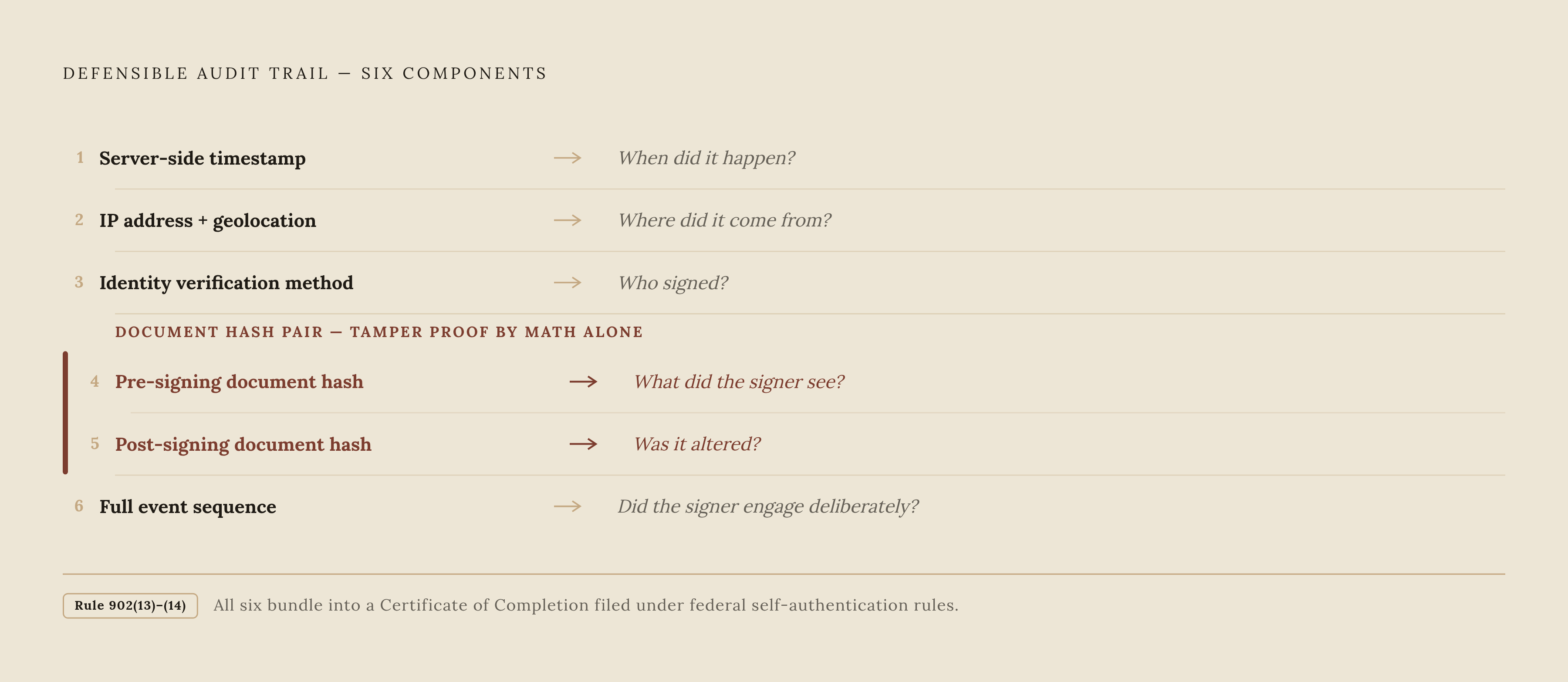
ESIGN and UETA both say an electronic signature can carry the same legal weight as ink on paper, but neither law hands that weight over automatically. Both statutes require that the signature be traceable to a specific person and that the record it lives in hasn't been altered, and the audit trail is what has to prove both of those things. Courts apply four tests fairly consistently when a signature is challenged under either law: did the signer take a clear, affirmative action showing intent to sign; did the parties agree to do business electronically in the first place; can the signature be tied reliably to the individual; and was the record left untouched after signing. A trail that cannot answer all four questions leaves the signature exposed, no matter how official the document looks.
Federal Rule of Evidence 901 sets the general bar for authenticating any piece of evidence, but 902(13) and 902(14) let a properly certified electronic record authenticate itself. That status changes who has to do the work in a dispute: instead of the party producing the document having to prove it's genuine from the ground up, the burden flips, and the party challenging it has to come forward with a reason to doubt it. That shift only happens, though, if the underlying audit trail is solid enough to support it.
One compliance trap catches organizations that otherwise do everything right on the signing side. The ESIGN Act requires that a recipient specifically consent to receiving records electronically before a business can stop sending the paper version, and a contract sent to someone who never opted into electronic delivery can violate the Act even when the signature platform itself worked exactly as designed. The signature can be flawless and the transaction can still be exposed, because the problem sits upstream of the signing event.
Organizations operating outside the U.S. face a parallel structure. The EU's eIDAS regulation sets up tiers of electronic signature, and even the lowest tier, the "simple electronic signature," requires adequate evidence of how the signing happened before it will be admitted. An audit trail is exactly the kind of evidence that requirement calls for.
What a defensible audit trail captures
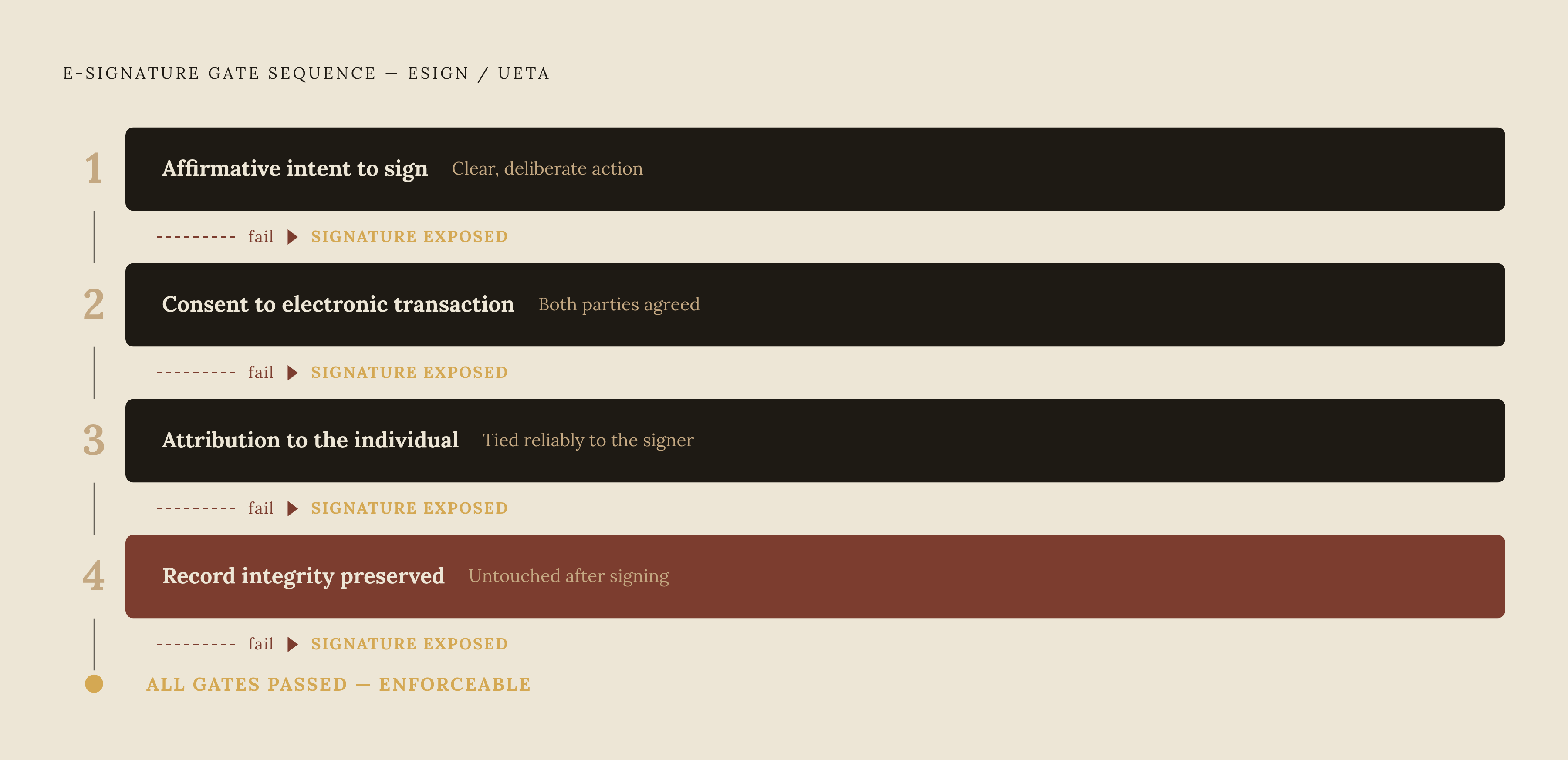
A defensible audit trail is a cryptographic chain of custody, not a list of timestamped actions sitting in an application database, and each piece of it exists because it answers a specific question a court will ask when a signature gets challenged.
Start with the timestamp. The record needs to show when each step in the signing process happened, and that timestamp has to come from the server rather than the signer's own device, because a device clock can be changed by the person using it before they sign. A server-side timestamp synchronized to a public time source cannot be adjusted by the signer, which is what makes it useful as evidence of when something actually occurred rather than when someone wanted it to look like it occurred. This single data point satisfies the "when" half of the attribution requirement under UETA and under Rule 901.
Next is the source IP address and the geolocation tied to it. This establishes where the signing action came from, and courts have treated IP capture as a standard part of the authentication chain, building on the analysis set out in Lorraine v. Markel American Insurance, 241 F.R.D. 534 (D. Md. 2007), which remains the foundational federal opinion on authenticating electronically stored information generally. IP address on its own doesn't identify a person with certainty, since VPNs, office networks, and carrier-level address sharing all complicate the picture. A geolocation that flatly contradicts where a signer swears they were at the time, though, becomes a strong piece of corroborating evidence, even if it isn't treated as proof by itself.
The audit trail also has to record which method confirmed the signer's identity. A link sent to an email address is the floor, the minimum level of verification most platforms use by default. Stronger options exist: a code sent by text message, knowledge-based authentication pulled from public records, or a government-issued ID uploaded and checked. The method chosen directly affects how much weight a court gives the resulting signature, and for high-value contracts, adding SMS or knowledge-based verification measurably strengthens the case that the right person signed.
The most technically involved piece of the trail is the document hash, captured once before signing and again after. A hash is a short fixed-length string generated from the exact contents of a file, and even a single changed character produces a completely different hash. Capturing the hash at both points means that if anyone alters the document later, even in some small way, the hash computed on the altered file will not match either value on record, and that mismatch is enough to prove tampering occurred without needing anyone to testify about what happened. This is the mechanism that satisfies the record-integrity requirement running through both UETA and the case law: the proof lives in the math.
Alongside the hash sits the full event sequence: when the document was sent, opened, viewed, signed, or declined. This sequence is what lets a court conclude the signer engaged with the document deliberately rather than clicking through something they never saw, and intent to sign is the pillar most frequently fought over in e-signature disputes. Docusign's own audit trail logs a complete automated history of every view, print, send, sign, and decline action with timestamps attached to each one, and it was exactly this kind of granular, step-by-step record that persuaded the court in Barwick v. Geico to accept the electronic signature as valid.
All of these signals eventually get bundled into a single artifact: a Certificate of Completion, a downloadable file combining every piece of metadata into one document a records custodian can certify. This certificate serves as the formal evidentiary record that gets submitted for certification under Rule 902(13)–(14).
Where that evidence lives matters as much as what it contains. Audit logs need to sit in append-only storage, ideally kept separate from the application database that runs the signing platform itself. If someone compromises the application layer and the audit log sits in the same place, that attacker could rewrite history after the fact, and smaller vendors fail on exactly this point more often than on any single data field they forgot to capture.
How the metadata-as-evidence doctrine shifts the burden of proof
A well-built audit trail doesn't just help a document get admitted into evidence. It changes who has to prove what, turning what could have been a swearing contest between two parties into a documented record that the side challenging it has to affirmatively tear down.
Lorraine v. Markel American Insurance, 241 F.R.D. 534 (D. Md. 2007), set out the analytical groundwork here, walking through how computer-generated records like metadata can sit outside the hearsay rule entirely, since there's no human declarant making a statement, only a machine recording an event. The court in that case ultimately found that neither side had actually submitted properly authenticated evidence, so the ruling didn't resolve the underlying dispute. What it left behind was the framework later courts use, and that framework supports the idea that a well-structured audit trail can authenticate a signature without anyone from the signing platform or the signer personally testifying.
Rule 902(13) and 902(14) turn that framework into something concrete. A Certificate of Completion paired with a declaration from the records custodian generally lets the record qualify as self-authenticating, so the party producing it doesn't have to build a case for its authenticity from zero. The opposing side has to raise the challenge instead, and that's a meaningfully different starting position in litigation.
2025 case law shows this doctrine being applied in practice. Garcia v. Pacific Sunwear Stores, Byler v. Mastec Services Co. (2025 U.S. Dist. LEXIS 120135, C.D. Cal.), and Maddox v. Indochino Apparel (US), Inc. (2025 Ohio App. LEXIS 2165) are named among the seminal e-signature decisions of the year, and together they point in the same direction: courts keep widening their acceptance of audit-trail evidence as the standard by which signatures get authenticated. In Barwick v. Geico, it was the step-by-step sequence log that persuaded the court to accept the document as valid. In IO Moonwalkers, the electronic record of sending, receipt, signature, and review outperformed a sworn statement about whether paper had been mailed.
The most common objection a signer raises is simple denial: a claim that they never signed the document. A complete audit trail closes that door, because the signer then has to explain, with some plausible alternative story, why their IP address, their device fingerprint, their email-linked authentication token, and the full sequence of logged events all line up with the claimed signing event. For legal teams preparing for a dispute before it happens, the operational lesson is straightforward: the strength of that trail is decided long before any complaint gets filed, at the moment the signing platform and its configuration get chosen.
Audit trail exclusions and platform gaps that void enforceability
A signature used somewhere the law will not allow electronic execution cannot be rescued by a technically flawless audit trail, and separately, plenty of platforms fail to build adequate trails.
Certain categories of document stay excluded from electronic execution no matter how good the supporting evidence is. Negotiable instruments, court filings that local rules require to carry a wet signature, notices terminating utility service or initiating foreclosure, notices tied to transporting hazardous materials, and certain testamentary documents all fall outside what UETA and ESIGN permit. A bankruptcy court in the Eastern District of California sustained objections to electronically signed written direct testimony declarations for exactly this reason: Local Rules 9017-1 and 9004-1(c) require a manually created wet signature for sworn written testimony, and none of the available exceptions applied. The audit trail behind those declarations was never the issue; the type of document was.
The more common failure occurs at the platform level rather than in the statute. Timestamps pulled from the signer's own device instead of a server, audit logs stored in the same database as the signing application where an attacker could alter them, no hash captured before signing so there's no way to prove what the signer actually saw, and no record of which identity verification method was used, these gaps appear constantly in litigation and are almost entirely preventable. A construction firm that faced a challenge to one of its signed contracts found this out directly: it could not produce an adequate audit trail, and opposing counsel successfully argued the signature failed to meet ESIGN and UETA requirements. The signature itself was there, but the evidence chain behind it was missing.
A newer failure mode is emerging out of AI-assisted contract drafting. When a contract is drafted with AI assistance and then edited by a person before it goes out for signature, the audit trail has to document which version of the document the signer actually reviewed and signed. As AI drafting tools spread further into contract workflows, this version-tracking problem is likely to become one of the more frequent gaps raised in future disputes over what a signer actually agreed to.