Electronic Signature Legal Validity by Country
Enforceability hinges on signature tier, not market share or platform.

Electronic signature law is a stack of overlapping frameworks, including one country's statutes, a regional rulebook like eIDAS, and a long list of country-specific carve-outs. The gap between them is where enforceable contracts turn into expensive paper. Cross-border contract disputes cost businesses an estimated $4.2 billion a year, and a growing slice of that traces back to signatures that never met the legal bar in the jurisdiction where someone tried to enforce them.
Adoption numbers mislead people here: market share tells you nothing about enforceability. North America holds roughly 31% of the global digital signature market's revenue in 2025 according to MarketsandMarkets, but a judge or arbitrator doesn't care about market share. The only question that matters is whether that specific signature, on that specific document, in that specific jurisdiction, clears the legal bar set there. Two contracts can look identical on a screen and get opposite outcomes depending on where they land, and most legal teams don't find that out until a counterparty stops paying and lawyers start arguing about what actually happened at signing.
The stakes build quietly, too. One rejected contract stalls a deal for a few weeks while lawyers scramble to re-execute it. A pattern of contracts that don't meet local rules wears down a revenue pipeline in a way that stays hidden until a dispute forces the issue. What follows is a jurisdiction-by-jurisdiction map of what actually holds up, and why.
How most legal systems organize electronic signatures into tiers that determine everything
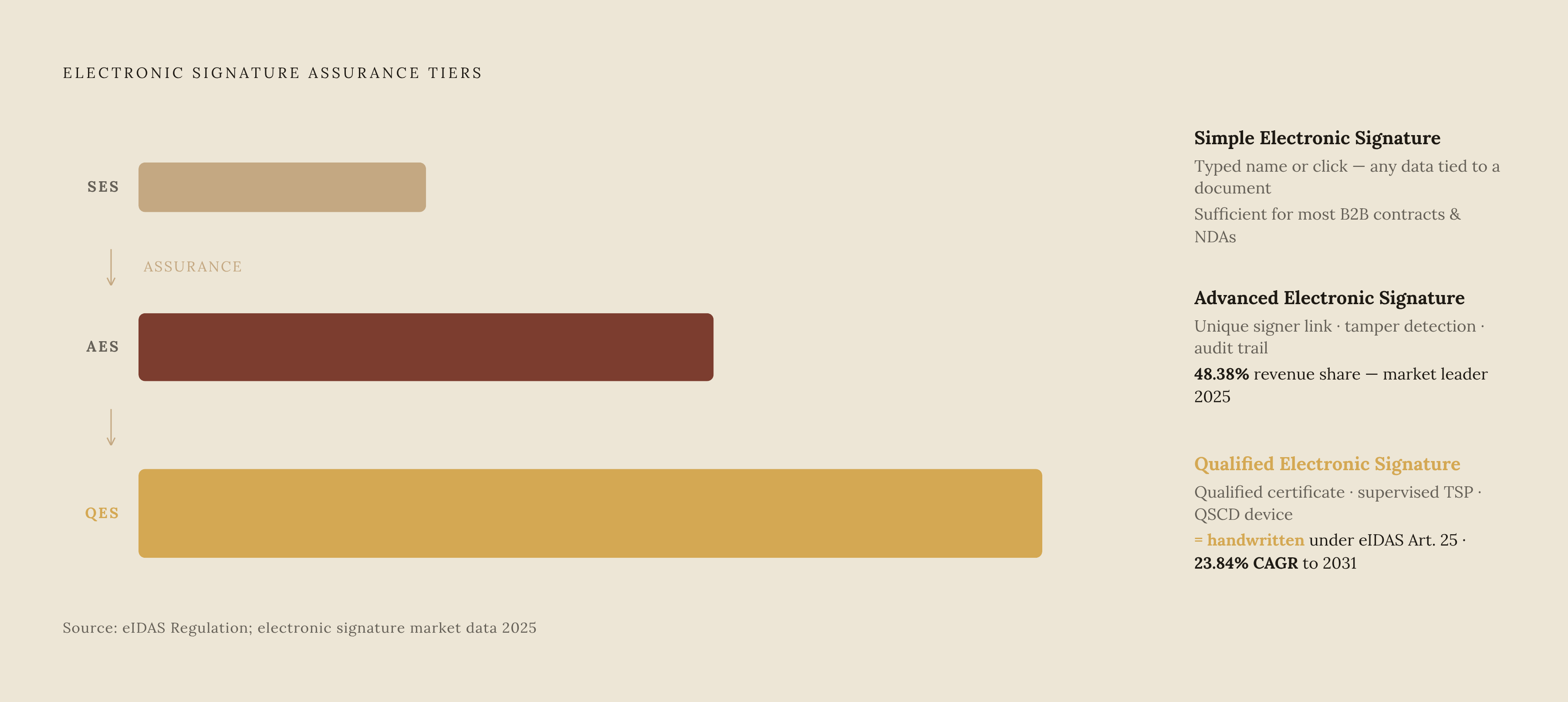
Most legal systems, whether loose or strict on paper, sort electronic signatures into three tiers. Getting the tier wrong is the single most common way a signed contract turns into an unsigned one in the eyes of a court, more common than outright fraud.
A Simple Electronic Signature (SES) is the loosest category: any electronic data tied to a document and used to sign it. A typed name, a scanned signature image, a click on an "I agree" box. Most legal systems won't throw out an SES just because it's electronic, but it carries the least weight as evidence. For everyday B2B contracts, NDAs, and service agreements between two private parties, SES is usually enough, and reaching for anything stronger is often money wasted.
An Advanced Electronic Signature (AES) raises the bar. It has to tie uniquely to the person signing, identify them specifically, get created using something only that person controls, and link to the document in a way that flags any later change. In practice, that means built-in tamper detection and an audit trail running from the first click. AES led the market by signature type in 2025, with a 48.38% revenue share.
A Qualified Electronic Signature (QES) sits above both. It needs a qualified certificate from a supervised trust service provider, plus a qualified signature creation device (a hardware token, say, or a vetted remote-signing platform tied to verified identity). Under eIDAS Article 25, QES is the only tier the EU treats as fully equal to a handwritten signature across all member states. It's also the fastest-growing segment, tracking a 23.84% compound annual growth rate through 2031.
Two philosophies decide how countries assign these tiers to real transactions, and picking the wrong mental model is where most cross-border legal teams go wrong. Permissive, technology-neutral systems, common in common-law jurisdictions, let courts focus on intent and consent: no format gets mandated, and any tier can work if authenticity holds up. Prescriptive systems, common in several other major economies, write the tier into the statute itself, so the law spells out which tier a given document type needs, and higher-assurance signatures become mandatory for a long list of high-stakes transactions.
Most legal ops teams miss that the platform matters far less than what it produces. A company can run every contract through the same e-signature tool worldwide and still fail enforceability in a dozen countries, because the tier that tool defaults to isn't the tier local law demands. A few categories fall outside e-signature entirely almost everywhere: wills, notarial deeds, certain real-property transfers, specific employment-termination documents. That exclusion pattern appears repeatedly in nearly every jurisdiction below.
The United States: permissive by design, but sector overlays add real complexity
The ESIGN Act, passed at the federal level in 2000, and the Uniform Electronic Transactions Act (UETA), adopted state by state, together set a simple rule: a signature doesn't lose legal force just because it's electronic. No format is required. What matters is whether the signer intended to sign, whether both sides agreed to do business electronically, and whether there's a record, timestamped and tamper-evident, that captures the transaction.
That third piece, the audit trail, is where most disputes actually get decided. Courts rarely argue about whether a click counts as a signature. They argue about whether the retained record proves who clicked and when, and a platform that can't produce a clean log loses that argument no matter how the contract itself reads.
State-level quirks change which rules apply. New York never adopted UETA; it runs on its own Electronic Signatures and Records Act (ESRA), making it the only state operating outside the UETA framework. Arizona, Nevada, and Tennessee went the other direction and updated their statutes to explicitly cover blockchain-based signatures and smart contract terms; Arizona's version is in Revised Statute § 44-7061.
Then there are the sector overlays, and this is where a lot of legal teams get caught flat-footed. In FDA-regulated industries, 21 CFR Part 11 sets specific rules for electronic records and signatures, but only when a company uses electronic systems to create, maintain, or submit records that FDA predicate rules require. It doesn't blanket every record at every pharma or life sciences company automatically, but where it applies, a standard SES workflow won't cut it. Financial services, healthcare, and government contracting each carry their own extra layers on top of the federal baseline.
The United States gets treated as the easy jurisdiction, and for routine commercial work, it is. But that reputation is what trips up teams in regulated industries. A pharma company running its 21 CFR Part 11 records through a generic e-signature workflow built for NDAs is not doing the same job twice, it's doing the wrong job once. Treating a validated clinical record like a standard confidentiality agreement is how careful legal teams end up with a technically defective record and don't find out until an FDA audit.
The European Union: eIDAS sets a three-tier standard across 27 member states, with eIDAS 2.0 raising the bar further
Regulation (EU) No 910/2014, known as eIDAS, has governed electronic signatures across the bloc since July 2016. The European Digital Identity Regulation, eIDAS 2.0, amended it in 2024 and took effect on May 20, 2024, pushing the framework further with stronger cryptographic standards, better cross-border recognition between member states, a European Digital Identity Wallet for storing qualified credentials, and upgraded tools for secure remote qualified signing.
Article 25 sets the core principle: no electronic signature can be denied legal effect purely for being electronic. But only QES carries automatic equivalence to a handwritten signature across the entire EU, and that one distinction drives most cross-border contract strategy in Europe. A qualified signature issued by a trust service provider in one member state gets recognized in all the others, and a signatory outside the region can get a qualified certificate from any qualified trust service provider inside that framework.
What eIDAS explicitly doesn't touch matters just as much. Wills still need a wet signature in most member states. Notarial deeds are typically excluded. Certain real-property transactions fall under member-state law rather than the regulation, and employment-termination contexts vary country to country but get carved out often enough to check before assuming otherwise.
Legal ops teams love to standardize globally, and eIDAS punishes that instinct directly. Picking one signature setup and applying it everywhere across the EU does not work, because the tier required depends on the document type, and the exclusions are at the member-state level, not centrally in Brussels. A contract template that clears the bar in one member state might need a stronger signature wrapper in another for the exact same transaction type. North America still leads the overall digital signature market by revenue, with a 38.00% share in 2025, but Europe's structured demand for QES is a major driver of that segment's growth worldwide.
The United Kingdom after Brexit: pragmatic framework with two firm exceptions
The UK kept the core principles of eIDAS after Brexit, now operating as "UK eIDAS" under the Electronic Identification and Trust Services for Electronic Transactions (Amendment etc.) (EU Exit) Regulations 2019, layered on top of the older Electronic Communications Act 2000. UK courts go further than most in what they'll accept: typed names, scanned signature images, even tick-box consent have all been treated as valid.
For the bulk of commercial contracts, this is about as permissive as it gets. QES isn't required, but it helps for higher-risk transactions where extra evidentiary weight matters. Absent a specific statutory carve-out, English law treats a standard e-signature as valid, full stop.
Two carve-outs stand firm, though, and no amount of clever contract drafting gets around them. Wills are one. The Law Commission's final report concluded that electronic wills would need new primary legislation, and that legislation hasn't passed. Wills still run on the Wills Act 1837: wet signature, physical witnesses, no digital substitute.
Land is the other. HM Land Registry only accepts electronic signatures for registrable dispositions under its own specific scheme, either a witnessed electronic signature process or a Qualified Electronic Signature, which removes the witness requirement. A generic SES or AES simply doesn't clear the bar for land registration, no matter how good the audit trail looks.
For teams running cross-border deals, the UK's default settings make routine commercial paperwork easy. Real estate and succession work call for a distinctly different signing process, and treating them like a standard confidentiality agreement is a fast way to get a registration rejected.
Canada, Australia, and New Zealand: technology-neutral but not identical
All three countries run technology-neutral frameworks, but technology-neutral doesn't mean identical, and the differences become visible in what courts actually look for when a signature gets challenged.
Canada splits authority between the federal Personal Information Protection and Electronic Documents Act (PIPEDA), which governs designated federal law provisions, and the provinces, most of which have adopted the Uniform Electronic Commerce Act (UECA) or a close variant. Electronic signatures generally stand equal to paper for business transactions, and the legal test centers on whether the signature can be linked to the person who signed and whether the integrity of the document can be verified. Canadian courts have gone further than most jurisdictions in reading intent broadly. Canadian courts have read intent broadly, a reminder that in a genuinely technology-neutral system, format matters far less than whether intent and consent can be shown.
Australia works under the Electronic Transactions Act 1999. Courts there ask three things: can the signer be identified, is the signing method reliable, and did the recipient clearly consent to the process? In practice, platforms that capture reliable identifying information and preserve the document's integrity at the point of signing generally satisfy the federal standard without much argument.
New Zealand operates within a broadly comparable regional tradition, and the shared principle across all three countries is that audit-trail quality and demonstrated intent drive enforceability more than signature format.
That principle: audit-trail quality beats signature format every time. A platform that captures IP address, timestamp, and a hash of the signed document clears the evidentiary bar in each country, whether the signature itself is a typed name or a biometric capture.
China, India, Japan, and Singapore: Asia-Pacific's prescriptive and semi-prescriptive regimes
Asia-Pacific is where the gap between permissive and prescriptive regimes gets sharpest, and where getting the identity-verification layer wrong does the most damage.
China's framework runs on the Electronic Signature Law, revised in 2019, and the PRC Civil Code, whose Article 469, effective January 1, 2021, explicitly recognizes EDI and email as satisfying a written-contract requirement. A newer layer, the Measures for the Administration of Electronic Seals, took effect September 27, 2025, giving electronic seals the same legal standing as physical company seals or "chops," a real shift given how central physical seals are to Chinese corporate practice. Chinese courts apply a "reliable electronic signature" standard that demands verified identity authentication, timestamping, and tamper-proof technology, and the trust service providers behind that verification generally need to be local or government-approved. A foreign e-signature platform without an approved local certificate authority can simply fail the reliability threshold, no matter how clean its audit trail looks by the standards of other regions. This is the mistake that trips up more foreign companies in China than any other: assuming a certificate that works in one country's courts carries the same weight in a local court here. It doesn't carry the same weight in a local court here.
India runs on the Information Technology Act, 2000. Section 3 covers asymmetric cryptography and hash functions, Section 5 gives electronic signatures legal recognition, and Section 3A, added by the 2008 Amendment, opened the door to technology-neutral electronic signatures. The Controller of Certifying Authorities supervises licensed certifying bodies, including eMudhra and Sify, which issue government-approved digital certificates. A simple e-signature, a scanned name on a PDF, holds up only if intent and consent can be proven, while high-stakes government or financial agreements often need Aadhaar-linked eSignatures or a formal Digital Signature Certificate. Wills, powers of attorney, and real estate transactions are excluded by statute, and stamp duty rules further limit how useful e-signatures are for those categories in practice.
Japan operates under the Electronic Signatures and Certification Business Act of 2000, which splits signatures into two tiers: unregulated basic e-signatures and regulated signatures issued through an accredited Certification Authority, with the regulated tier carrying real legal weight the other lacks. Corporate culture reinforces this pattern, since Japanese business practice still leans heavily on digital equivalents of the traditional hanko, the company seal, and high-risk contracts typically need certification from a government-approved third-party provider to hold up.
Singapore has its own e-signature statute and takes a broadly permissive stance toward commercial use, though its financial services sector layers on extra authentication requirements beyond the general standard, echoing the sector-overlay pattern seen elsewhere.
Across the region, the identity-verification setup behind the signature carries as much legal weight as the signature act itself. Local certificate authority accreditation is often the single factor deciding whether a signed contract survives a challenge, more than the signature format itself.
Brazil, Mexico, and the Latin American patchwork
Brazil's framework runs on Medida Provisória 2,200-2/2001, which set up the ICP-Brasil certificate hierarchy, along with Law 14.063/2020. Simple e-signatures are valid between parties who agree to use them, no certificate required. Advanced digital signatures issued through ICP-Brasil certificates go further: they carry a legal presumption of validity, so no extra proof of authenticity is needed if a dispute arises.
High-risk transactions, financial contracts and real estate deals especially, benefit strongly from an ICP-Brasil certified signature. Simple e-signatures can still hold up if both parties accepted them going in, but registering a real estate title transfer typically needs either an ICP-Brasil certificate or compliance with the registry's own technical rules. Brazil counts as a prescriptive jurisdiction on this front: the law specifies which certificate type a given transaction category needs, rather than leaving it to the parties' discretion.
Mexico recognizes e-signatures as legally valid for commercial transactions, though the statutory detail available runs thinner than what Brazil publishes.
The pattern across Latin America generally follows Brazil's shape: routine commercial agreements between consenting private parties run fine on simple e-signatures, while financial, real estate, and government contracts escalate to nationally recognized certificates. Companies operating across the region should treat that escalation as the rule. Assuming a simple signature carries through every transaction type is exactly the kind of mistake that becomes an unenforceable contract months later, usually discovered by the party that has the least leverage to fix it.