E-Signature API Integration Patterns for Enterprise Applications
Treat e-signature integration as architecture, not a feature.

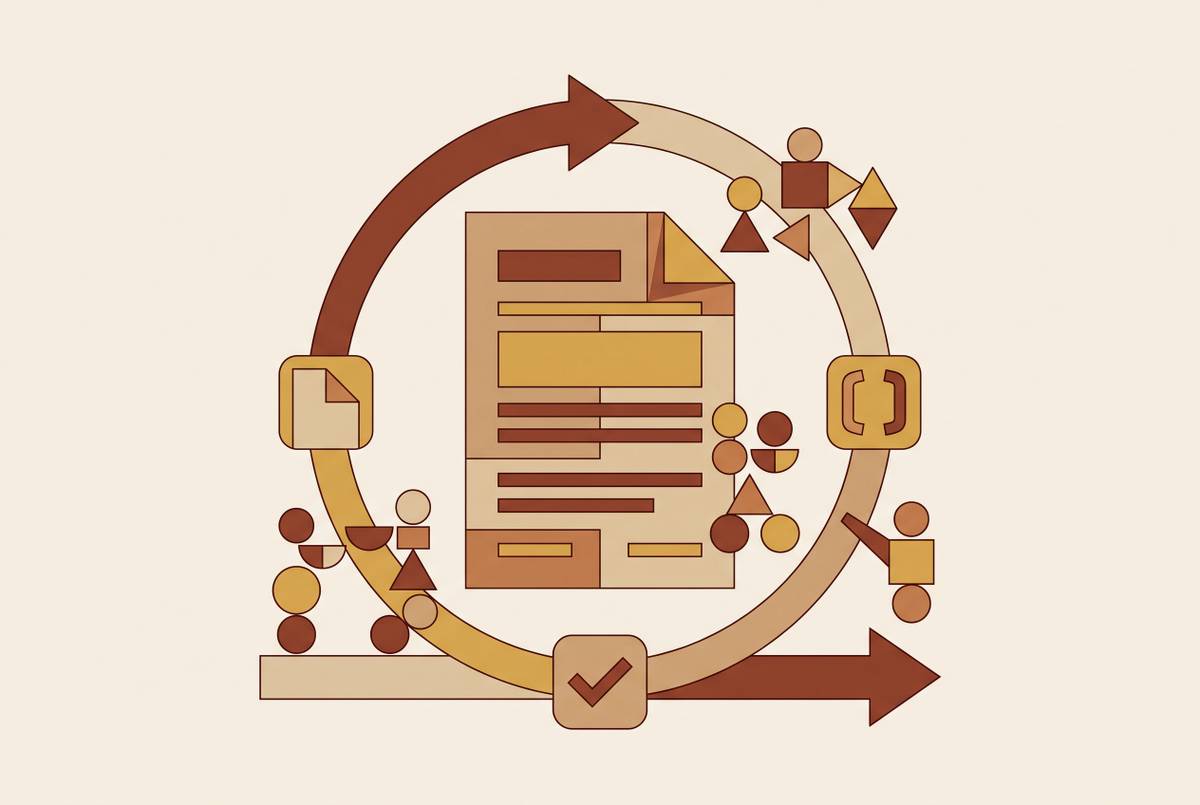
E-signature API integration can bring signing into an enterprise agreement lifecycle or interrupt that lifecycle. The strongest approach combines patterns around the workflow, then treats security, evidence, reliability, and downstream data as architectural requirements from the outset. A successful integration does more than capture a signature. It preserves the agreement’s continuity from creation through ongoing obligation management.
Why e-signature API integration is an architectural decision, not a feature toggle
Teams often scope e-signature work as “just an API call,” but production systems must manage a sensitive, legally binding agreement across people, systems, and time. A signer may respond in minutes or weeks, so the application cannot wait for completion as though signing were an ordinary request. It must keep track of state while the agreement is still in progress. That work includes handling errors, keeping notifications in sync, and making sure the experience makes sense for all parties.
The user experience adds another constraint because redirecting someone to an unfamiliar, differently branded site creates friction and can lower completion rates. Keeping signing inside the application addresses that friction, but it does not remove the underlying workflow responsibilities. Instead, the product becomes closely coupled to the signing platform’s behavior. As volume and regulatory exposure grow, weaknesses in that relationship become harder to contain. The initial architecture therefore determines how much complexity the application can absorb without compromising trust.
The three foundational integration patterns and what each one optimizes for
Nearly all integrations reduce to three foundational patterns, namely polling, webhook-driven processing, and embedded signing. Polling asks the API for document status at set intervals after a signature request begins. Its simplicity suits low-volume or batch workflows that do not need immediate feedback. But status stays stale between checks, and those requests use more resources as volume grows.
Webhook-driven integration lets the platform notify a registered endpoint when a document is viewed, signed, declined, or expired. It optimizes for timely feedback without continuous status requests. Anvil’s Etch API illustrates this pattern with HTTPS POSTs configured at the organization level or per object, carrying an action name, a verification token, and optionally encrypted data. DocuSign’s Connect webhook system supports XML and JSON delivery.
Embedded signing addresses a different concern by rendering the signing ceremony inside an iframe or web component in the host application. It preserves context and brand consistency independently of how backend status travels. DocuSign exposes this through the createRecipientView endpoint. The session needs short-lived, scoped tokens so that keeping the signer inside the product does not give them broader access.
Why production systems converge on a hybrid architecture
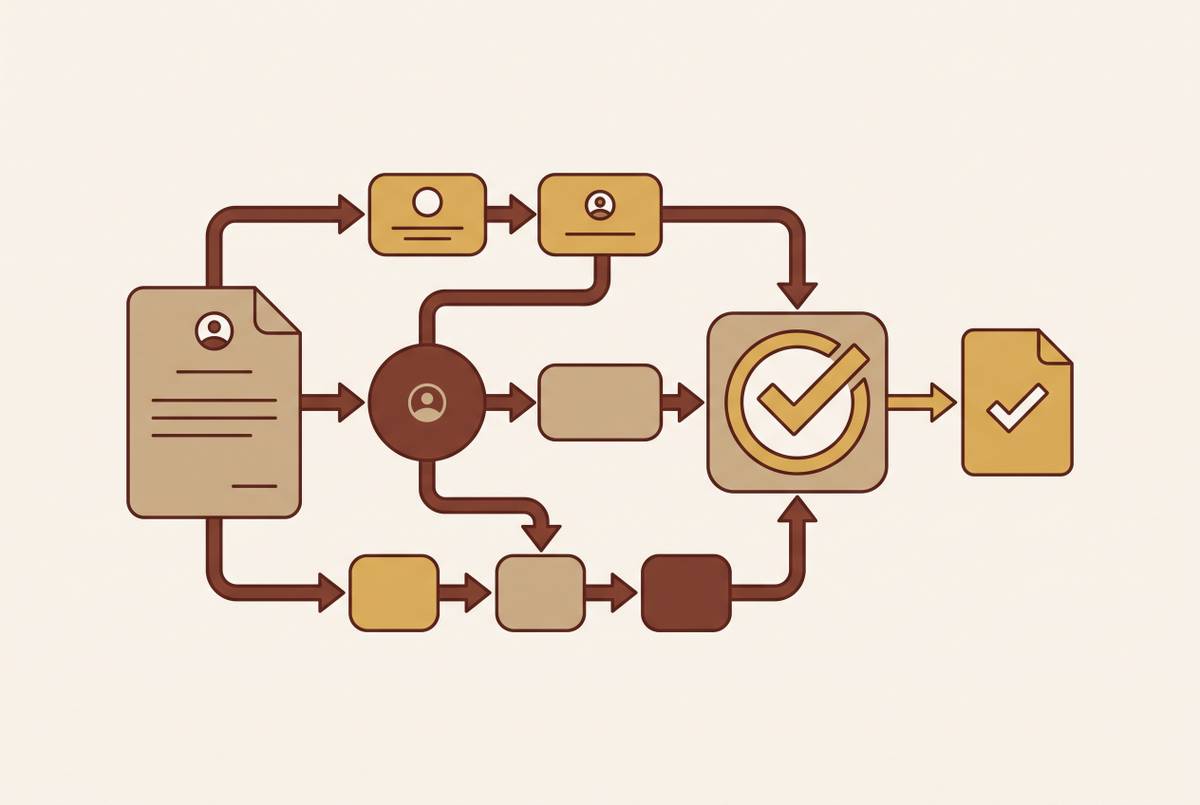
In the standard hybrid, embedded signing handles the frontend ceremony while a backend webhook supplies the authoritative completion event. Polling then serves as a reconciliation fallback when webhook delivery is missed or delayed.
With this setup, the user interface is separate from event processing, which is separate from downstream business logic. A completed signing session can therefore remain distinct from the work that completion triggers. That separation matters during a provider outage or latency spike because synchronous confirmation can stall the workflow. Durable queues and retry logic let processing pick up again when the dependency is available.
The hybrid’s production readiness depends on boundaries between all three patterns that enforce security and preserve reliable state. Authentication is the first test of those boundaries.
Authentication and token management as the first production-readiness gate
The choice of authentication brings security duties that last, especially when credentials sit deep in the application code. OAuth 2.0 with JWT assertion is the enterprise standard for server-to-server integrations because it supports scoped, time-limited access without long-lived credentials in the code. Embedded sessions need a narrower boundary, with a short-lived token scoped to a single signing session. Reusing a long-lived token for an iframe is a vulnerability.
Provider evaluation must therefore examine the actual authentication scheme, including standard OAuth Bearer support versus custom approaches. SDK weight and compatibility with edge runtime environments also matter because they can constrain implementation midway through development. Internal enterprise users bring additional requirements for SSO, SAML, and OpenID Connect. These access requirements are separate from proving a counterparty’s identity.
Incoming webhooks require authentication of their own because receiving an event does not establish its origin. Endpoints must validate that the signing platform sent the notification. HMAC signature verification checks who sent it, while a shared-secret header on its own gives less protection.
Signer identity verification and matching authentication strength to transaction risk
System authentication establishes which application may act, but signer verification establishes who is entering the agreement. The required assurance depends on the transaction. Email-based authentication is easy to use but gives little assurance. Stronger methods include SMS OTP, knowledge-based authentication, government ID checks, biometric verification, and qualified signatures backed by certified identity providers.
The eIDAS framework distinguishes QES, AES, and SES, with only a Qualified Electronic Signature legally equivalent to a handwritten signature under that framework. Certain administrative filings and high-value financial instruments require QES specifically. Qualified-signature workflows may therefore need identity providers such as itsme® or Evrotrust. Even a better-built standard email-signing flow cannot meet a QES requirement on its own.
A loan application workflow illustrates the risk of relying on general compliance statements while implementing only email authentication. The resulting record may not meet the identity assurance required by the applicable regulation. Map each document type to its assurance requirement before choosing verification methods. Then check whether the API lets the method be chosen dynamically for each envelope.
Building an audit trail that survives a legal challenge
Identity verification contributes to legal evidence, but it is not the whole record. The ESIGN Act provides the U.S. federal legal framework, while UETA addresses electronic transactions through state-level law. A defensible record must establish intent to sign, consent to transact electronically, each party’s identity, and the document’s integrity. A completion timestamp on its own cannot prove all of this.
The audit trail must capture the document hash at initiation and each view event with its timestamp and IP. It must also record signature events with the authentication method used, any decline or reassignment, and the final sealed document hash.
The record must also be documented and exportable. If access depends entirely on an active provider subscription, termination or migration can put historical evidence at risk. Retrieve and archive the signed document and full audit package at completion instead of treating the provider portal as the system of record. Docusign’s listAuditEvents endpoint supports structured, per-envelope retrieval, while Connect supplies the separate real-time notification.
Compliance requirements that the integration pattern itself must accommodate
Compliance varies by jurisdiction, industry, and document type, so one deployment may need several regulatory configurations. The architecture must accommodate those differences without requiring a new integration for every document category. Runtime selection of QES, AES, or SES is one expression of that flexibility. Provider selection must also account for the environments in which the agreements will operate.
GDPR creates a design tension between personal-data erasure rights and a tamper-evident evidence record. Separating signer personal data from cryptographic evidence addresses that tension more directly than combining both in an indivisible record. The distinction must shape the data model before records accumulate. It cannot be reduced to a retention setting added after launch.
SOC 2 Type II certification, HIPAA BAA availability, and FedRAMP authorization are provider-level prerequisites in specific regulated contexts. Check the requirements that apply before integration, without waiting for a security review after launch. Docusign’s compliance infrastructure supports its position in government contracts, financial agreements, and healthcare, where the provider’s own posture forms part of the integration’s risk profile.
Scalability and reliability design for high-volume enterprise workflows
Legal correctness does not guarantee operational reliability under load. Annual HR re-enrollment, mass customer onboarding, and procurement renewal cycles can reveal rate limits and synchronous bottlenecks that tests at low volume miss. Queuing and batching must keep requests within API limits without sacrificing throughput. With asynchronous processing, the application can acknowledge receipt, and webhook events can drive state transitions later.
The webhook endpoint should be a lightweight, dedicated service whose job is to receive, validate, and enqueue the event. A durable queue decouples ingestion from processing and lets downstream services subscribe independently. Idempotency must cover both event handling and write operations because retries could otherwise create the same envelopes, contract records, notifications, or payments more than once. Every write operation in a high-volume integration should be idempotent by design.
A sandbox that differs from production in rate limits, webhook delivery, or authentication can conceal defects until launch. Evaluation should therefore include sandbox fidelity, webhook reliability, and event granularity. Pricing must also fit how volume changes in practice, since the system must both handle delivery and keep costs predictable.
Connecting the signing event to the broader agreement lifecycle through CLM integration
Once completion is reliable, its value depends on what it triggers. Signing should initiate the next lifecycle steps, including archiving, CRM or ERP updates, onboarding, renewal alerts, and CLM obligation management. Treating it as the terminal event leaves agreement data disconnected from the systems that need it. Parties, effective dates, payment terms, and obligations become useful when structured workflows can use them.
A CRM integration demonstrates this continuity. The CRM triggers contract generation from a pre-populated template, routes the document for signature, and receives the completed record with the CLM system. In procurement, the signing webhook can connect to CLM renewal alerts, while contracts can be dispatched for signature directly from CLM. In healthcare, a signed consent form can trigger a real-time EHR update, replacing manual chart entry.
Docusign’s IAM platform addresses this continuity by combining e-signature, Agreement Manager, Workflow Builder, and AI tools, with CLM available as a separate Docusign product. Its pre-built integration ecosystem connects systems where agreements originate with those where agreement data must land.
AI readiness and the data structure decisions that determine what the integration can do later
That connected lifecycle produces a corpus of agreement data whose structure determines what automation can do next. Consistent metadata and clause taxonomy support reliable AI outputs, while inconsistent records and ad hoc naming undermine them. The integration establishes the quality of the material that later systems receive.
Capture structured metadata at envelope creation, including document type, counterparty, effective date, expiration date, and key clause flags. Upstream metadata is more reliable than approximate OCR extraction from a sealed PDF. Feeding that record into CLM at completion supports clause extraction, risk flagging, content-based routing, and obligation tracking. Those capabilities remain dependent on the data they process.
For example, routing an agreement to legal review only when payment terms or indemnity language fall outside policy requires a machine-readable record. When signing, CLM, and AI tools on one platform share a common data model, there is no need for a translation layer between those stages. The lasting advantage comes from preserving meaning in the data from the outset.
A decision framework for selecting and evaluating an e-signature API integration approach
Selection begins with four intersecting questions about workflow shape, user experience, regulatory context, and downstream connectivity. Volume and the need to coordinate multiple parties shape how processing must work, while the need for embedded signing shapes the frontend. Required signature tiers constrain identity options. The actions that must follow completion determine how much lifecycle connectivity the architecture needs.
Evaluate developer experience through documentation, language-specific SDK coverage, sandbox fidelity, and the ability to test a two-signer, multi-document packet without manual dashboard steps. Assess security by verifying broad compliance claims through exportable evidence and verifiable controls. Judge operational fit against delivery behavior, branding requirements, and actual usage patterns. Finally, examine whether the data model connects signing to CLM, CRM, and AI workflows or leaves permanent translation work to the integration team.
Keeping generation, prefilling, signing, and archiving within a single API surface reduces failure points and data-mapping work. Docusign’s REST API, Connect webhooks, createRecipientView endpoint, IAM platform, and connector ecosystem bring these evaluation axes together. For enterprise and regulated workflows, they provide a reference implementation against which to evaluate legal defensibility and lifecycle connectivity.