Contract Approval Workflow Design for Complex Organizations
How broken approval processes cost organizations weeks of delays, lost revenue, and compliance risk.
Sales asks where the contract is. Someone checks their inbox, finds nothing, and forwards the question to legal. Finance says they never received it. By the time the document turns up, buried in a reply-all chain under a subject line that no longer matches what's inside it, the deal has lost a week it didn't need to lose. This happens when a contract approval process that worked fine at a smaller scale meets the complexity of a larger one, and nobody redesigned it to survive the transition.
The instinct, when this happens, is to treat it as a checklist problem: who signs, in what order, and did someone forget a step. That diagnosis is wrong, or at least incomplete. The real failure sits in the architecture that governs how a contract actually moves from one person to the next, who owns it at each stage, and what happens when a handoff goes quiet, and the checklist is only its visible surface. Those rules were built for a simpler version of the organization, and they do not scale on their own.
Several forces multiply the pressure on that architecture at once. The pipeline takes on more contract types. The pipeline also expands across more geographies, each adding its own regulatory regime layered onto the same approval chain. More stakeholders hold overlapping authority over the same category of deal. More regulatory requirements attach themselves to categories of agreement that used to move through without much scrutiny. Each of these pressures, on its own, might be manageable. Together, they strain a workflow that was never engineered to carry that much weight.
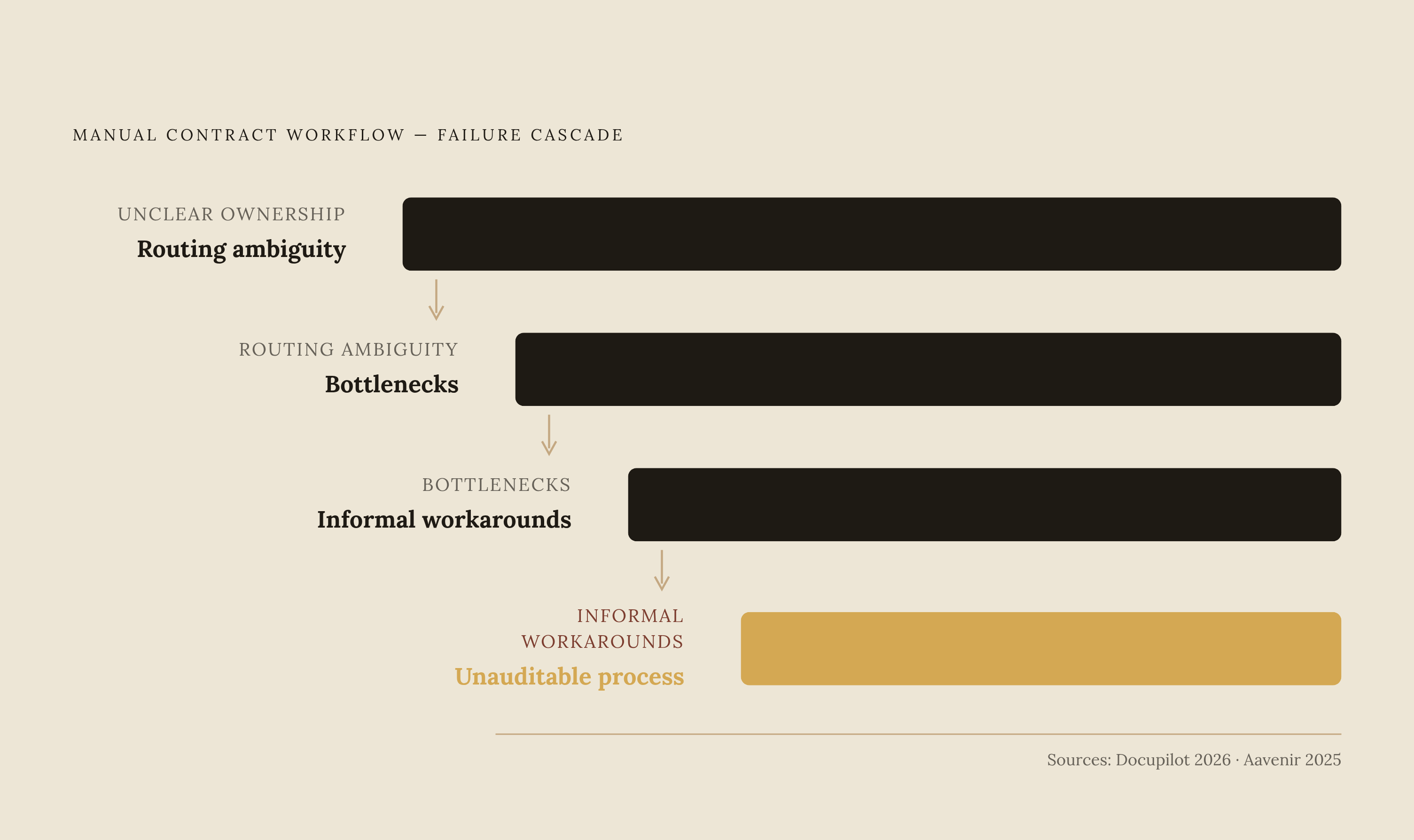
What results is not a single point of failure but a cascade. Unclear ownership creates routing ambiguity, because nobody can say with confidence whose job it is to review a given contract next. Routing ambiguity creates bottlenecks, since contracts default to whoever last touched them rather than whoever should act on them. Bottlenecks drive people toward informal workarounds, the personal follow-up email, the direct message, the favor called in with someone in legal. Those workarounds might rescue an individual deal, but they leave the process as a whole invisible and unauditable, because nothing about an informal fix enters any system of record.
Aavenir's 2025 guide catalogs the breakdown modes that occur most often in manual workflows: no visibility into where a contract currently sits, version control failures when drafts get emailed back and forth among reviewers, undefined approval paths that send contracts to people who were never the right approver, and no escalation mechanism when a deadline passes unmet. Docupilot's 2026 guide identifies routing and escalation as the steps where most contract approval workflows tend to fail. That specificity matters: it tells you where the structural weight concentrates, and it tells you where a redesign has to start.
Quixy's June 2026 enterprise workflow guide describes the organizational version of this same stress. As companies grow, approval chains lengthen and requests pass through more stakeholders, and employees increasingly spend their time chasing a status update rather than doing the work the approval was supposed to clear the way for. Informal coordination, the kind that depends on knowing who to call or remembering to follow up, functions reasonably well in a small organization where everyone can track a handful of deals in their head. It stops functioning once headcount, contract volume, and deal complexity grow past the point where any one person holds the whole picture, and most organizations never replace that informal coordination with anything formal enough to take its place.
What structural failure costs (in cycle time, revenue, and compliance exposure)
The costs of a broken approval structure are not abstract. They appear in cycle time, in revenue left on the table, in hours consumed by legal review that didn't need to happen the way it did, and in compliance records that cannot answer a basic question: who approved this, and on what authority.
Start with speed. Concord's agreement workflow analysis cites research putting the average contract approval timeline at 3.4 weeks, start to signature. Rather than a negotiation delay with a counterparty on the other side of the table, it is time lost inside the organization's own walls, while a deal sits waiting for someone to notice it needs attention. A strategic initiative that depends on a signed contract does not wait patiently for 3.4 weeks to pass; it stalls, and the cost of that stall compounds the longer the contract sits unresolved.
The bottleneck driving that delay is rarely legal complexity itself. It is the absence of structured routing, the absence of parallel review where parallel review would work, and the absence of an escalation path that activates automatically once a deadline slips. Each of those is a design problem, and each one is correctable.
Revenue leakage follows the same logic. Concord cites World Commerce and Contracting research showing that businesses lose a meaningful share of annual revenue to poor contract management, with approval delays accounting for a significant portion of that loss. It is deferred revenue, a customer who had a window of urgency that closed, or a vendor discount that expired while the paperwork sat in someone's inbox.
Legal teams absorb a disproportionate share of this cost directly. Concord's analysis notes that manual review of a 20 to 30 page contract consumes four to six hours of in-house legal time, and when that pattern repeats across every contract regardless of its actual risk profile, the opportunity cost compounds quickly. Workflow design routes every contract through the same sequential human review, high-risk and low-risk alike, instead of reserving that scrutiny for the agreements that actually warrant it.
Compliance exposure is the least visible cost and often the most serious one. Without defined routing and a documented escalation trail, an organization cannot reliably answer who approved a given contract, when they approved it, or under what delegated authority they were acting. In a regulated industry, that gap is not a paperwork inconvenience; it is a material risk that a regulator or an auditor will eventually surface on their own terms rather than the organization's. Quixy's enterprise guide names compliance risk directly as a consequence of inefficient approval workflows, alongside slower project execution and reduced operational efficiency.
Version control adds a quieter, compounding layer to all of this. When contracts move back and forth by email, mismatched drafts and disputed terms become common, and that confusion does not just slow the approval down, it generates rework on top of the delay already incurred. Aavenir lists version control breakdown and unauthorized-term risk among the six most common challenges organizations face in manual contract approval processes. None of these costs are surprising once the structural diagnosis is taken seriously. They are the predictable output of unclear ownership and undefined routing, and that predictability is itself the useful fact: a cost that follows directly from a structural flaw can be removed by fixing the structure.
The six structural decisions that determine whether an approval workflow scales
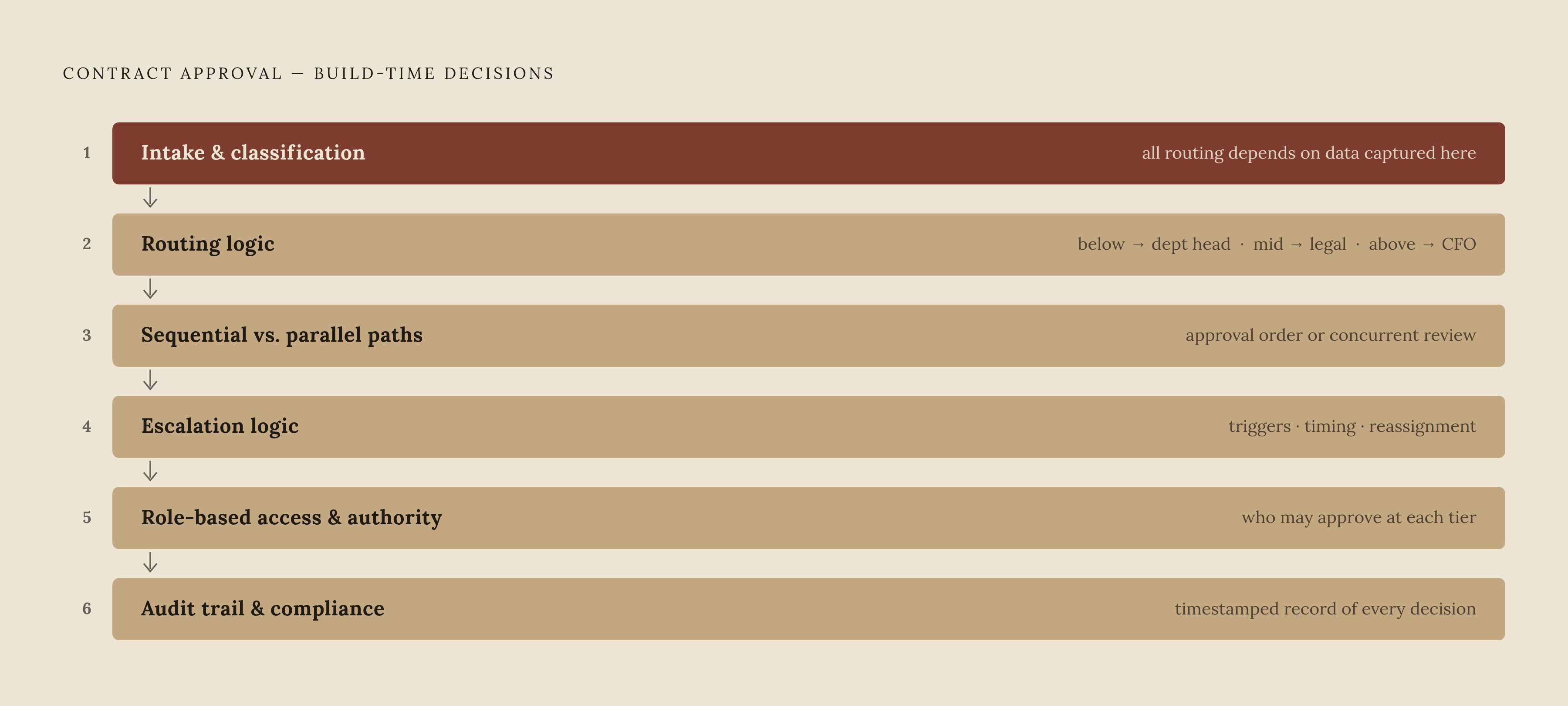
A contract approval workflow built to hold up under organizational complexity rests on six structural decisions. These decisions have to be made deliberately, at design time, rather than discovered through trial and error after the workflow is already live and failing in production.
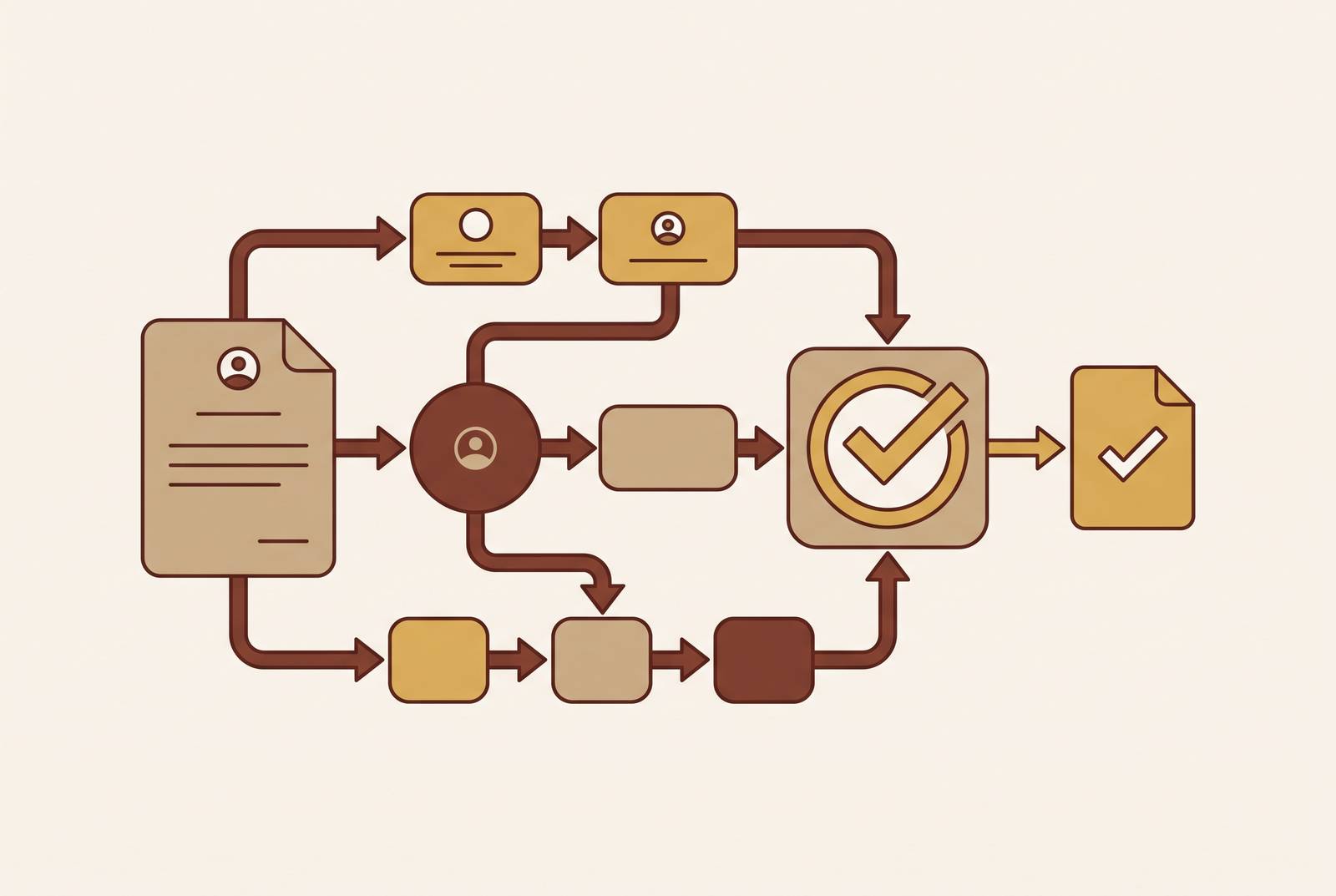
Decision 1 concerns intake and classification discipline. Docupilot's 2026 guide places contract intake and classification as the first step in the process, and for good reason: the classification data captured at intake, including contract type, value, risk level, and counterparty status, is what every downstream routing decision depends on. Without a structured intake that records whether an agreement is an NDA, a vendor contract, an employment contract, or a custom MSA, whether its terms are standard or negotiated, and whether the counterparty is new or already known to the organization, the routing logic that follows has no reliable input to act on. Organizations that automate this step by triggering intake the moment a CRM deal reaches a defined stage remove a manual handoff entirely, and they ensure the classification data is complete before routing even begins.
Decision 2 is routing logic itself, built around value thresholds, contract type, and risk profile. Routing is the decision layer of the whole process: it determines which approvers see which contracts, in what sequence, and under which conditions. Docupilot describes a value-threshold model that has proven durable in practice: contracts below a lower dollar threshold route to a department head, contracts in a mid-range add a legal review step, and contracts above a higher threshold require CFO or executive sign-off. That structure ensures a contract receives scrutiny proportionate to its stakes, rather than either rubber-stamping something consequential or burying something routine under unnecessary layers of approval. Value thresholds alone cannot handle every case, though. A low-value contract with custom terms and an unfamiliar counterparty may warrant a legal review that an equivalent-value renewal with a known counterparty does not. Risk-profile and contract-type routing has to operate alongside the value threshold, not instead of it. Aavenir identifies version control breakdown and unauthorized-term risk as two of the six most common challenges in manual contract approval processes.
Decision 3 addresses whether an approval path should run sequentially or in parallel. Sequential routing, where legal reviews first and finance follows, makes sense when each stage genuinely depends on the output of the one before it. Parallel routing, where legal and finance review at the same time, makes sense when the two reviews are independent of each other and the delay comes from waiting rather than from any real dependency. Concord and Quixy's enterprise guide both point to parallel approval as a central mechanism for cutting cycle time, since it collapses what would otherwise be sequential weeks into simultaneous days. Fit depends on which approach matches a given contract type and risk tier, so a workflow built for a complex organization needs both options available, triggered automatically by the classification rules established at intake.
Decision 4 is escalation logic: what triggers it, on what timing, and who the contract reassigns to. Escalation logic needs to specify what triggers it, whether that is elapsed time or simple non-response, who the contract escalates to, whether the original approver is notified or bypassed, and whether the escalation event itself is logged into the audit trail. A workflow without predefined escalation rules has no recovery path when an approval stalls. It depends entirely on someone noticing and stepping in manually, and that dependence on manual intervention is the exact behavior that fails once an organization grows past the size where one person can track every contract in flight.
Decision 5 covers role-based access and clearly defined approver authority. Aavenir's guide and Spendflo's 2026 approval workflow guide both treat this as foundational: without clearly defined roles, contracts get routed to the wrong people, unauthorized changes slip through, and accountability for any given decision disappears. Role-based design also has to account for what happens when a named approver is simply unavailable, building in delegation and backup-approver rules so the workflow has a defined fallback instead of stalling on someone's vacation. Permission controls extend beyond who approves, too, governing who can view, redline, or comment on a given contract, which protects sensitive commercial terms while still allowing the right people to collaborate on them.
Decision 6 is the audit trail and the compliance documentation the workflow produces. Aavenir lists a comprehensive audit trail, capturing who did what and when, as a core component of any workflow built to hold up under scrutiny. Quixy's enterprise guide frames audit readiness as a governance outcome that a well-designed workflow produces as a natural by-product of how it operates. In regulated industries, healthcare, financial services, government contracting, a complete audit trail is a compliance requirement. It is a compliance requirement that the workflow has to satisfy by default, without anyone having to assemble the record after the fact.
Conditional logic and automation replace the informal coordination that breaks at scale
Automation's role in an approval workflow is not to add judgment the humans lacked. It enforces the six structural decisions already made at design time, so the workflow no longer depends on anyone's memory, diligence, or willingness to send a follow-up email.
The core automation layer is rule-based routing: a system reads the classification data captured at intake and directs the contract to the correct approver without anyone manually deciding where it should go next. Quixy's enterprise guide describes what an effectively automated workflow looks like in practice: requests reach the correct approvers automatically through rule-based routing, stakeholders can check request status in real time without asking anyone for an update, and a missed deadline triggers a predefined escalation procedure rather than waiting for someone to notice. The follow-up burden that Quixy identifies as one of the largest sources of wasted employee time in manual approval environments disappears once notifications fire automatically instead of depending on a person remembering to chase a reviewer.
Conditional logic is what lets a single workflow absorb the diversity of contract types a complex organization actually generates. A contract can branch based on its value, its type, the counterparty's status, and the jurisdiction it's executed in, all within one workflow, instead of requiring a separate manual process built from scratch for every combination of those variables. Docupilot's guide describes exactly this kind of template-level conditional logic connected to eSignature tools, and the result it produced for Morristown Beard School is concrete: the school automated more than 160 employment contracts per year and sent seven contracts out for signature in 30 minutes. That result did not come from automation alone. It required conditional rules structured correctly at the intake and routing stage first, with the automation simply executing rules that had already been designed with care.
Real-time visibility into contract status is a direct output of automated routing. When routing runs automatically, every stakeholder, sales, legal, finance, can see exactly where a contract sits without asking anyone, which eliminates the failure mode where sales believes a contract is with legal while legal believes finance already has it. That particular confusion, common enough in manual workflows to earn its own description in the research, simply has nowhere to occur once status is tracked centrally and updated automatically.
Pre-approved templates and clause libraries work alongside conditional routing rather than as a separate system. Standard contracts that meet defined criteria can be generated directly from approved language and routed automatically, which frees legal review time for the contracts that genuinely require a lawyer's attention. Aavenir treats pre-approved templates and clauses as a core workflow component because they move the compliance check earlier, from the approval stage, where a problem causes delay, to the drafting stage, where non-compliant terms never enter the workflow.
The scalability argument underlying all of this is straightforward. Automation does not just make today's workflow faster. It keeps the workflow stable as contract volume and organizational complexity continue to grow, because rule-based routing scales linearly with the number of contracts moving through it, while manual coordination scales with headcount, and headcount growth never keeps pace with contract volume growth in a healthy organization. Quixy's guide frames scalable approval workflows in exactly these terms: workflows built to support organizational growth without a corresponding increase in operational complexity.
Where AI fits into the approval workflow (and where human judgment must stay)
AI has a genuine role in a modern approval workflow, and that role is narrower than the marketing around it often suggests. AI accelerates the review and analysis work inside the workflow. It does not replace the governance structure that decides who holds the authority to approve a given contract, and in a complex or regulated organization, role-based authority and escalation logic have to remain in human hands at the points where the stakes are highest.
What AI contributes concretely starts with first-pass review of standard agreements: flagging non-standard clauses, identifying missing required terms, and surfacing risk indicators before a contract ever reaches a human approver's desk. That first pass reduces the time a legal reviewer spends on a low-risk, largely standard agreement, freeing that reviewer's attention for the contracts where judgment actually matters. The 2026 State of Contracting Report found that 44% of respondents now use AI for contract review.
Beyond first-pass review, conversational interaction with a contract lets a user ask natural-language questions about its terms, its obligations, and its liability exposure, compressing the time it takes to understand a complex agreement well enough to act on it. AI-assisted drafting pulled from pre-approved clause libraries extends the same logic from Decision 6 into the drafting stage itself, helping ensure that a contract generated for routing already meets the compliance standard the workflow expects, before it ever reaches an approver's queue.
None of this changes who holds the authority to say yes. The role-based access and defined approver authority established in Decision 5, and the audit trail required by Decision 6, exist because an approval is an act of accountability. AI can narrow down what a human reviewer needs to look at and how quickly they can understand it. It cannot be the party of record when a regulator asks who approved a contract and under what authority they were acting. The organizations that build approval workflows well treat AI as an accelerant applied inside a structure that humans still govern.