CLM Adoption Strategies for Corporate Legal Teams
Phased rollout and stakeholder buy-in determine whether legal tech actually cuts through volume.

Corporate legal departments are managing more contracts with roughly the same staff, and the mismatch is no longer a minor irritant. It's a structural problem that's forcing a rethink of how contracts move through the business from request to signature to renewal. Legal departments report rising contract volumes at a rate far outpacing headcount growth: 79% see more contracts coming through, while only a third have added the staff to match. That gap doesn't close on its own, and it isn't closing anytime soon.
The role legal plays inside a company has shifted underneath that volume increase. Legal teams used to review risk after a deal was already shaped by sales or procurement, catching problems late and often too late to change course cheaply. Now they're expected to shape the commercial strategy itself, moving fast enough to keep deals on schedule rather than slowing them down. Operational efficiency has become a top priority for close to three-quarters of legal departments, because the hours spent on repetitive contract administration are hours legal teams could spend on the advisory work that actually needs a lawyer's judgment.
Poor contract management costs companies enough revenue to matter to a CFO, not just to legal ops. Poor contract management costs companies a meaningful share of annual revenue, and separate research on legal inefficiency puts a significant share of revenue at risk from contracts that get delayed or lost in the shuffle. Those numbers alone justify the attention CLM (contract lifecycle management) software has gotten. It's become the most widely adopted legal technology tool in corporate departments, and for good reason: it addresses volume, visibility, and speed at the same time, at the level where the work actually happens.
Adoption, though, is not the same as success. A platform can be purchased, configured, and still fail to change how contracts actually move through a company. The tool is broadly recognized as the right answer, and a large share of the organizations that buy one still don't get the value they paid for, and how a legal team adopts CLM matters just as much as the decision to adopt it at all.
Why so many CLM implementations stall before delivering value
Gartner's research found that half of all initial CLM implementations fail to deliver on their promise. That failure rate has little to do with the software itself. The dominant cause is organizational: missing governance structures, no executive sponsor willing to push adoption past the legal department's own walls, and resistance from teams asked to give up whatever workaround they built years ago.
Fragmented rollout is the clearest version of this failure. One department adopts the platform, another keeps working out of email and shared drives, and the result is a patchwork that reproduces the exact visibility and consistency problems the CLM platform was bought to solve. A company running three different versions of "how we handle contracts" hasn't modernized anything. It's just added a fourth system to the pile.
A related mistake is treating CLM purely as a software purchase rather than a change in how people work. Successful implementations require clear processes, defined ownership of each contract type, and users who actually adopt the new workflow instead of tolerating it. Without that groundwork, the platform becomes what Summize's research calls "another separate tool," layered on top of existing habits instead of replacing them. Users respond by routing around it, falling back on email threads and spreadsheets, and the money spent on the platform produces nothing.
A third failure mode appears later, usually after a team has already limped through a rocky rollout. Once contract work is under pressure and the sanctioned platform feels slow or incomplete, employees start reaching for unapproved AI tools and point solutions to fill the gap. That shadow AI use introduces security and compliance exposure that legal departments spend years trying to eliminate elsewhere in the business. CobbleStone's research names ungoverned tools lacking basic security and transparency controls as a major 2026 risk. More organizations are steering deliberately toward private, enterprise-grade AI models instead of letting each team pick its own. Ungoverned adoption, in other words, doesn't just fail to deliver value. It actively creates new risk on top of the risk the platform was supposed to reduce.
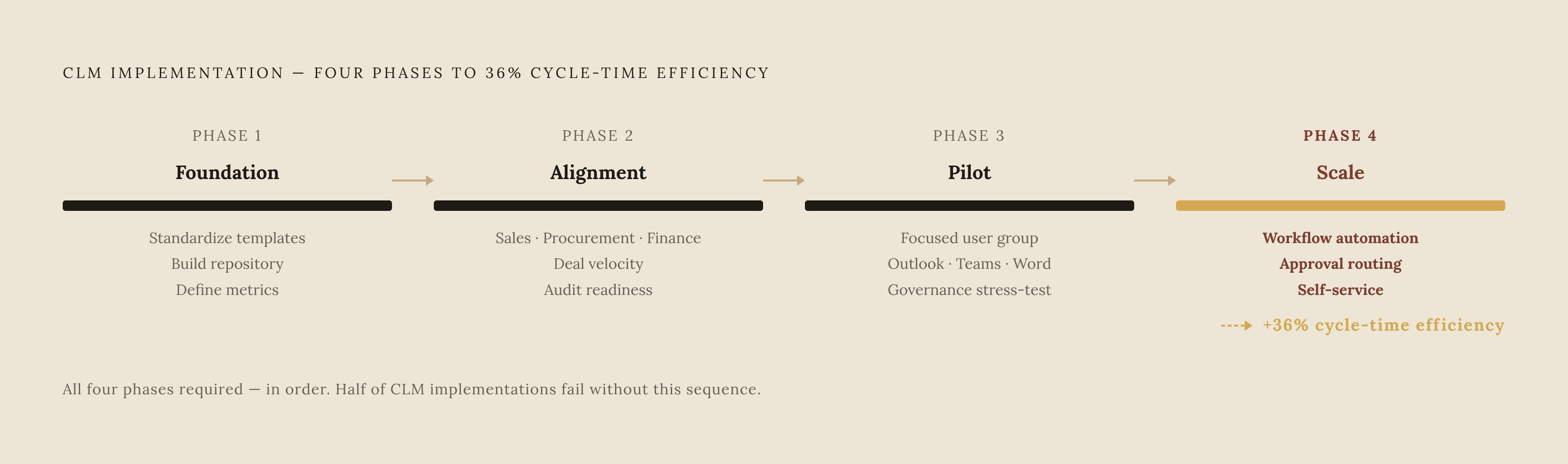
A phased approach exists precisely to close each of these gaps before the next one has a chance to open.
Phase one: mapping processes and building the foundation before touching software
The first phase of a durable CLM rollout has nothing to do with software selection. It's process discovery: figuring out what contracts the organization actually produces, where they get stuck, and what a good outcome looks like for each contract type before anyone configures a workflow around it. Skipping this step is how a legal team ends up automating a broken process, and automation doesn't fix a broken process. It just runs it faster, at greater scale, with the flaws baked in from day one.
Summize's guidance on this point is specific: map the current process, name the inefficiencies, and agree on what success looks like before any implementation begins. In practice, this phase should produce a handful of concrete deliverables. A legal ops lead should walk out of phase one with a map of contract types sorted by volume and complexity, a list of the specific bottlenecks slowing each type down, named ownership for each contract category, and metrics the team has agreed to track once the new process is live. Without that map, there's no way to know later whether the CLM platform actually improved anything or just moved the same bottleneck to a different screen.
Standardizing how contracts get drafted, templates, playbooks, an approved clause library, has to happen in this same phase, and it comes before automation rather than after it. Every contract negotiated from scratch is a one-off negotiation, and no workflow tool can systematize an agreement that was never standardized in the first place. Legal teams should start with high-volume, lower-risk work: NDAs, MSAs, supplier agreements. Standardizing these frees up legal capacity immediately, and it does so without forcing the team to solve every complex negotiation playbook before the platform even goes live. Complex, high-stakes contracts can wait for a later phase. The volume work can't.
A central, searchable contract repository belongs in this phase too, and the reasoning is less about convenience than about data integrity. Every capability that gets built in later phases depends on clean, complete contract data sitting in one place. If the repository is incomplete or inconsistent, the AI-powered review tools introduced later will have nothing reliable to learn from. Garbage in, garbage out applies to contract intelligence the same way it applies to any other data system, and there's no fixing that problem downstream once the platform is live and contracts are already flowing through it.
Phase two: getting stakeholder alignment and securing executive sponsorship
Legal doesn't own the contract process by itself. Sales generates the deal terms, procurement negotiates supplier agreements, and finance cares about payment terms and revenue recognition, all before legal ever gets involved. A CLM platform that reflects only legal's priorities, without accounting for what those other functions actually need from the process, produces conflict rather than efficiency once it goes live. Sirion's research on digitization confirms the mechanism: without strong leadership support pulling departments in the same direction, each function pursues its own approach, and enterprise-wide adoption becomes structurally impossible.
Getting this right takes more than a single kickoff meeting where legal announces the new platform. It requires structured, recurring check-ins with sales, procurement, and finance, built specifically to surface what each department needs from the contract process and to catch friction points before they turn into resistance once the platform is live. A legal team that skips this step usually discovers the resistance the hard way, months into rollout, when sales quietly reverts to email because the intake process doesn't match how deals actually get done.
Executive sponsorship turns alignment from a conversation into an enforceable expectation. Without a senior champion outside the legal department, CLM stays a legal initiative that other functions can treat as optional, adopting it when convenient and ignoring it otherwise. Getting that sponsorship means translating CLM outcomes into the language each executive already uses to judge performance: deal velocity for the CEO, cost avoidance for the CFO, audit readiness for the board. Legal leaders don't need to invent this argument from scratch. Global research from Deloitte and Docusign found that AI-powered agreement management produces an average time savings of 37% across agreement management activities, along with measurable cycle-time gains and cost avoidance through earlier risk detection. Those are numbers a CFO already tracks, not numbers legal ops made up for the occasion.
Structured intake is where this alignment work becomes visible day to day. Replacing ad hoc email requests with defined intake forms, and eventually self-service portals, is the practical output of getting sales, procurement, and finance aligned on the process. It gives legal visibility into what's coming before it turns into an urgent request landing in someone's inbox. Self-service portals let non-legal users initiate contracts directly without overloading legal, provided the templates and approval rules are already established, which is the work of phase one. But that only works because the templates and approval rules behind the portal were already built in phase one. A self-service portal with no standardized template behind it just moves the chaos earlier in the process instead of removing it.
Phase three: piloting with a focused user group to surface adoption barriers early
A pilot with a small, focused group of real users, working on real contracts, surfaces problems that process maps and stakeholder meetings can't. Sirion's guidance is specific about the mechanism: running a pilot before enterprise-wide rollout lets a team identify adoption barriers, collect direct feedback, and fix training materials while the stakes are still low.
The value of a pilot comes from watching what users actually do, not what they say they'll do in a survey. Some features get adopted immediately, without anyone having to explain them twice. Others get quietly avoided, and that avoidance is diagnostic: it tells legal ops exactly where more training or reconfiguration is needed before the rollout reaches the rest of the company. A pilot also generates the first real data against the metrics defined back in phase one, time-to-sign, intake performance, SLA compliance, giving legal ops an actual baseline instead of a guess before the full rollout begins.
Integration is the single biggest factor in whether a pilot succeeds or quietly fails. If using the CLM platform means switching to a separate tool to handle a routine approval, users will revert to email and the pilot won't tell legal ops anything useful about adoption, only about avoidance. Summize's research on this point is direct: contract tasks need to live inside the tools people already use, Outlook, Teams, Slack, HubSpot, Word, because that's where the friction that kills adoption actually gets removed. Sirion's buying guidance treats integrations with e-signature, CRM, ERP, and communications tools the same way, as a core requirement rather than an add-on, because they keep contract work in a single flow and maintain a single source of truth. The industry has started calling this "invisible CLM," meaning governance and automation built into the tools people already use rather than a new destination they have to remember to visit. The less a platform feels like new software to learn, the more consistently people actually use it.
The pilot is also where governance features get tested under real pressure rather than in a demo. Concurrent editing with tracked changes, field-level security, exportable audit logs, and full approval lineage all need to hold up during an actual negotiation with real data. For legal teams in regulated industries, being able to show who changed a clause and when is a compliance requirement auditors will eventually ask about. It's a compliance requirement that auditors will eventually ask about, and the pilot is the place to find out whether the platform can actually answer that question under real conditions.
Phase four: scaling automation and workflow across the full contract lifecycle
Once the pilot has proven out the templates, the integrations, and how real users actually behave, the work shifts to extending automation across the entire contract lifecycle, from intake and drafting through approval routing, execution, and obligation tracking after signature. Automation is one of the most consequential practices in a mature CLM rollout: it cuts manual work, keeps output consistent across teams, and lets non-legal users self-serve on the lower-risk agreements that don't need a lawyer's direct attention.
Workflow automation, multi-step approvals, escalation rules that fire when a deadline is close, automatic reminders before a renewal date passes, takes legal out of the approval path for contracts that were already standardized and pre-approved back in phase one. A template built and approved in phase one doesn't need a lawyer to re-review it every time it's used later in the rollout. The Deloitte 2026 study found that companies following this structured, phased approach saw a 36% efficiency gain in cycle times.
None of this scales, though, without the foundation laid in the first three phases. Automation applied to a process that was never standardized just runs the old chaos faster. Workflow rules layered onto a platform nobody trusts, because the pilot skipped the integration work, get ignored the same way the original email process got ignored. Scaling is the payoff phase, but it's a payoff that depends entirely on the discipline of the phases that came before it: process mapping that defined what "good" looks like, stakeholder alignment that got sales and finance actually using the intake process, and a pilot that stress-tested the platform under real negotiation conditions rather than a demo.
Legal's function changes at this point, from a team that reviews and approves each contract by hand to a team that governs the system doing that work automatically. That's a meaningful shift in what a legal department is actually for, and it's the shift that the volume pressures, the regulatory complexity, and the flat headcount described at the outset of this piece were always pushing legal teams toward. The tool matters less than the sequence used to get there.
Sources
- Creating Effective In-House Legal Teams in 2026 | Summize
- 2026 CLM Buying Guide: Secure Collaboration for Small Legal Teams Inside Large Enterprises
- 10 Contract Lifecycle Management Best Practices for 2026 | Summize
- The 2026 Legal Operations Playbook: Selecting the Right CLM Solution
- AI Contract Lifecycle Management: The 2026 Survey on Trends & ROI | Deloitte US
- 4 Contract Lifecycle Management Trends for 2026