AI Contract Drafting Tools Compared to Traditional Templates
AI drafting tools produce reliable contracts three times faster than human lawyers using templates.
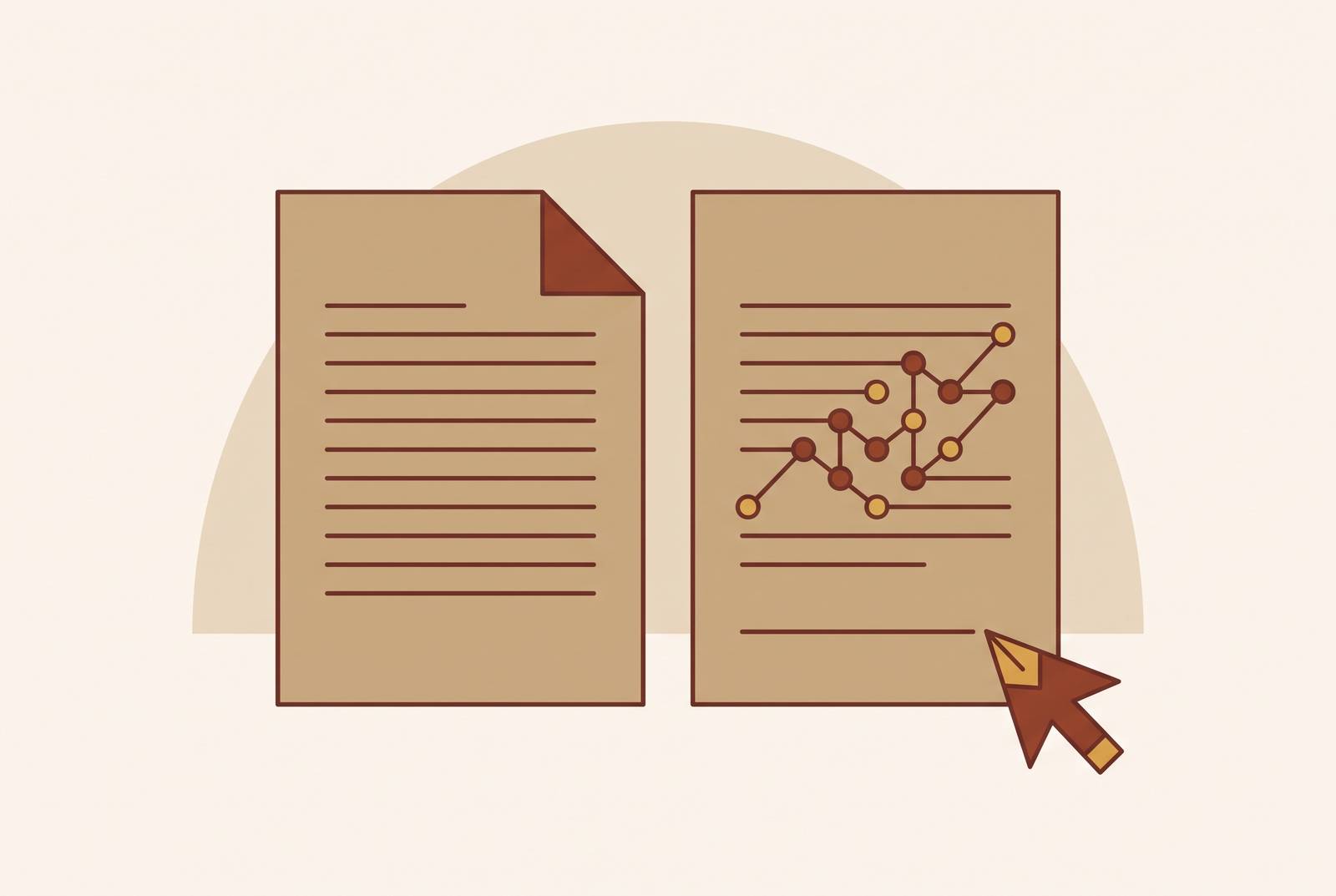
Contract templates solve one problem: inconsistency. AI drafting tools solve a harder set of problems: adaptability, risk visibility, speed. The two operate at different stages of the contract lifecycle, and most legal teams make the same mistake, treating a faster template as though it were an intelligent one. A template that fills in blanks quickly is still a template; it has no memory of the last twenty deals, no sense of a counterparty's risk profile, and no way to flag a clause that contradicts another clause three pages later. Templates are losing ground everywhere except the narrow band of work they were actually built for, and that narrow band is smaller than most legal departments admit.
Templates gave legal teams standard language and a predictable shape to start from, and for a thin slice of agreements, that is still enough. A template is static, though: it cannot adjust to a new jurisdiction or deal-specific terms without a human rewriting it by hand, and that is where the trouble starts. Human error does not disappear in a template-based process; it just moves. Someone pulls the wrong version off a shared drive, someone pastes in a clause meant for a different contract type, or someone leaves a placeholder field blank and nobody catches it until the counterparty does. Add email-based routing on top of that and version sprawl follows almost automatically: five people holding five different "final" drafts, no single source of truth, and a dispute later over which one actually got signed.
The World Commerce and Contracting organization has put a number on what this costs: companies lose an average of 9.2% of annual revenue to poor contract management, driven by missed renewals, unfavorable terms nobody flagged, and compliance failures that surface too late to fix. Templates did not cause all of that, but they created a share of it simply by staying fixed while the business moved around them.
What the drafting stage actually looks like under each approach
A template-based workflow runs in a fixed sequence: find the right template, fill in the placeholders, hand-adjust the boilerplate so it actually fits the deal, send it around for comments. Every link in that chain is a place something breaks, and the break is rarely dramatic. A wrong field, an unread paragraph of boilerplate, a version pulled from the wrong folder — that is usually all it takes.
AI drafting tools follow a shorter sequence. A lawyer or business user fills out an intake form or writes a prompt, and the system generates a draft pulled from a clause library trained on the organization's own approved language and past deals. The clauses reflect the company's actual standards, assembled automatically instead of copied by hand, one contract at a time, by whoever drew the short straw that afternoon.
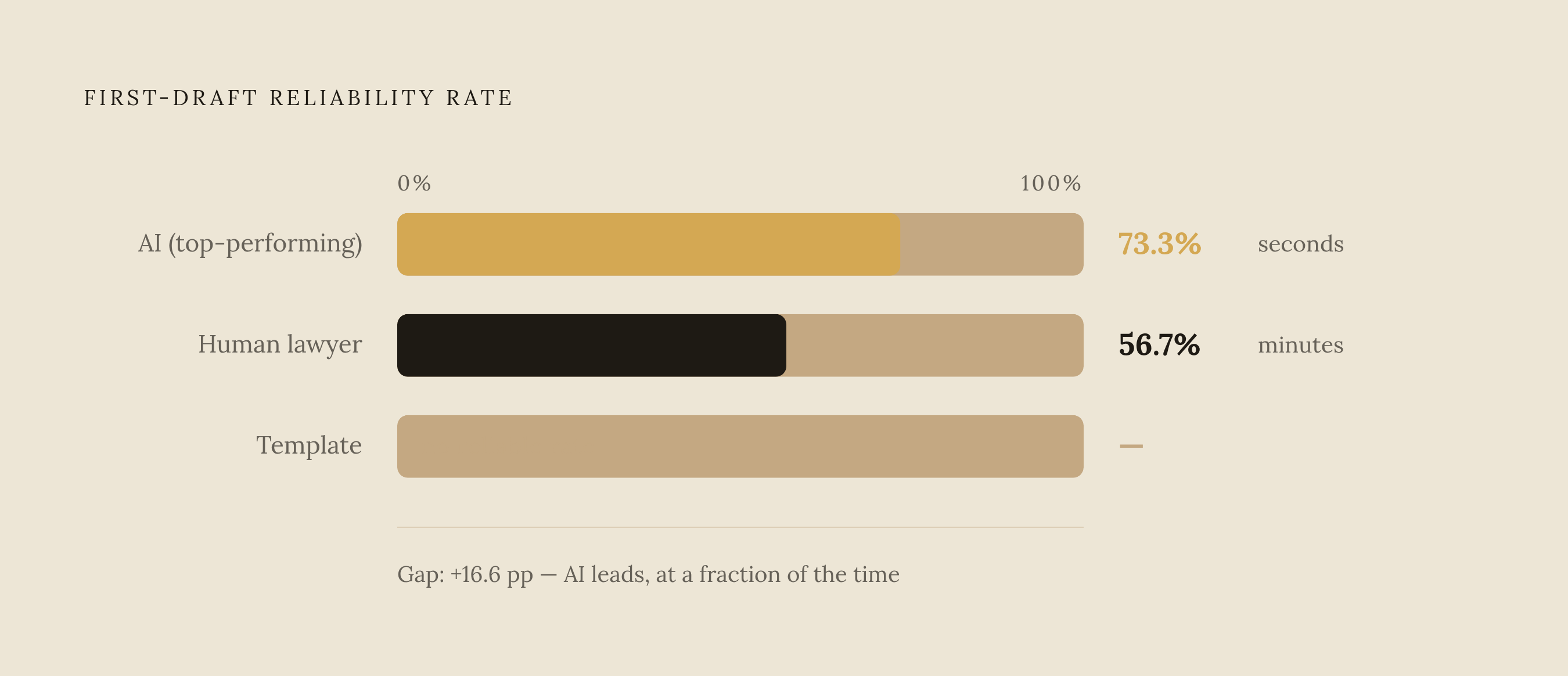
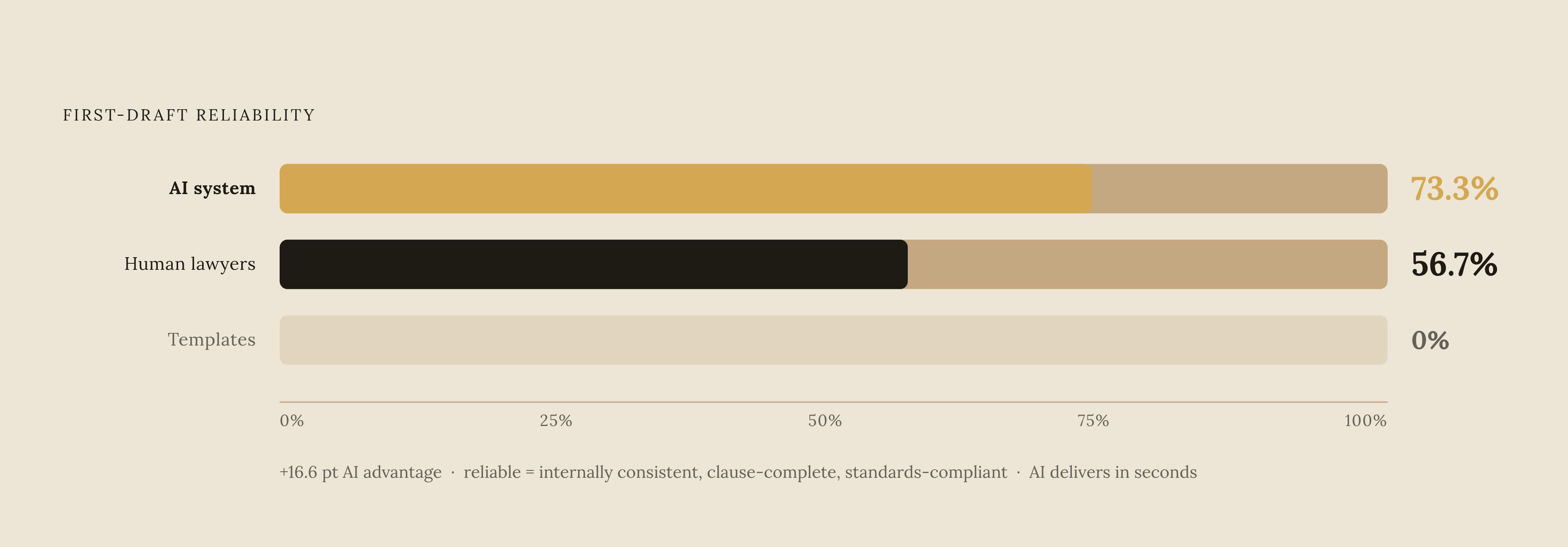
The gap here is not marginal. A 2025 Thomson Reuters survey found lawyers using AI drafting tools finished first drafts 67% faster on average than those working from templates and manual editing. Speed is not the same as quality, though, so the more telling figure comes from a 2025 LegalBenchmarks evaluation: human lawyers produced reliable first drafts about 56.7% of the time, while the top-performing AI system hit 73.3%, in seconds rather than minutes. "Reliable" there means internally consistent, clause-complete, and compliant with pre-approved standards. That is the fair comparison, and templates do not clear either bar.
None of this makes an AI draft a finished product. The review that follows still has to catch what a model cannot know: negotiation strategy, the client's actual intent, the texture of the specific deal. The American Bar Association has flagged a real limit here (over-reliance on AI can miss client-specific needs), and models trained on data before 2023 can miss recent case law or statutory changes entirely, unless the tool connects to a live legal database. So that ceiling is real for pure language-model tools used without that integration, and it deserves to be taken seriously rather than waved off.
The honest comparison is an AI-assisted lawyer against a template-dependent one, not an AI-assisted lawyer against some idealized human draft. Measured that way, the productivity gap compounds every time a new draft goes out the door.
How AI changes the review and redline stage, and where templates leave teams exposed
Template review depends almost entirely on whoever happens to be reading it that day, and there is no systematic way to catch a missing clause: it surfaces, or it does not, based on the reviewer's memory and attention span at 6 p.m. on a Friday. None of this is a knock on any individual lawyer, just a fact about what manual review looks like when no second system checks behind it.
AI review tools work differently, and the difference is structural, not incremental. They cross-reference every clause against the organization's playbook and against relevant regulatory standards automatically, flag missing or non-standard provisions before the contract ever reaches a negotiation table, and surface problematic language directly, instead of requiring the reviewer to already know what a red flag looks like.
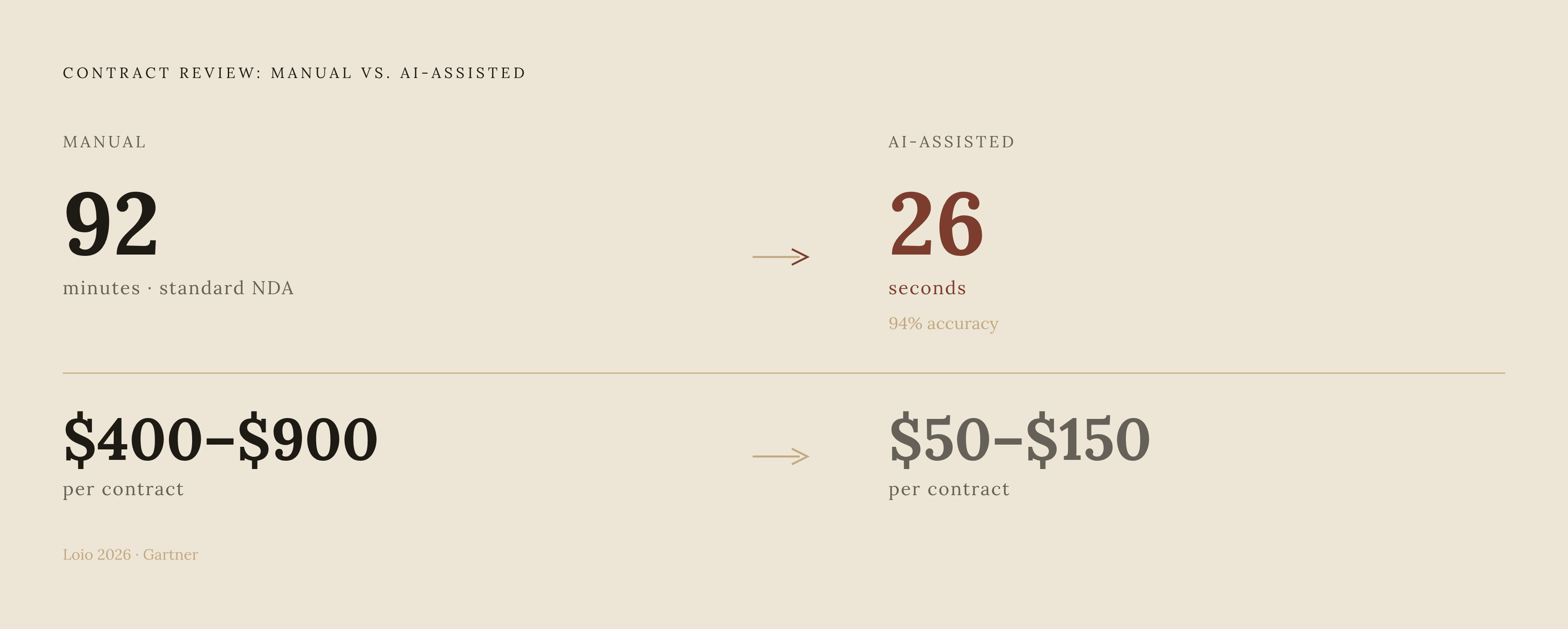
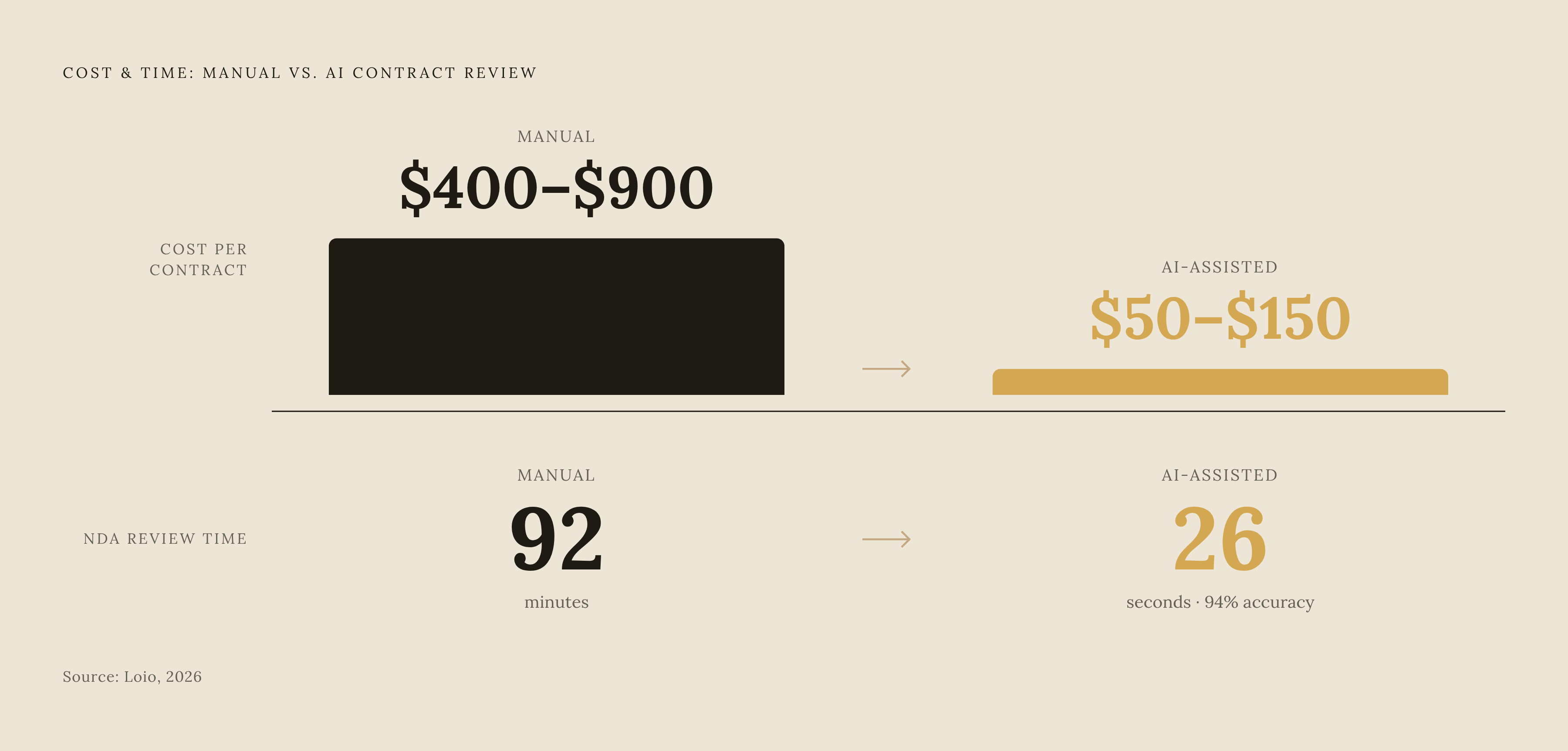
Loio's 2026 statistics report found AI can review a standard NDA in 26 seconds at 94% accuracy, against 92 minutes for a human lawyer doing the same review by hand. Gartner's cost estimates track the same gap: manual review of a standard commercial contract runs $400 to $900, while AI-assisted review on dedicated platforms brings that down to $50 to $150 per contract. That remaining 6% still matters, and it is worth naming what it covers: complex regulatory interactions, novel deal structures, judgment calls about leverage and strategy. Human expertise does the real work there, and no accuracy benchmark changes that.
Redlining is where the gap widens further, and this is the piece templates cannot replicate at any price. AI systems generate suggested redlines pulled from the organization's preferred positions in prior negotiations. A template carries no memory of how the last twenty deals were fought over; every deviation from it has to be tracked by hand, and version control ends up resting on one person's discipline instead of anything built into the tool. A system that learns from precedent behaves fundamentally differently from one that repeats the same blank language regardless of what happened last time.
The risk intelligence gap: what templates cannot see in a contract
Templates lock in a risk standard the moment they are written, then stay frozen there, even as regulatory environments shift and a company's own risk appetite changes after a bad quarter or a new compliance mandate. The template knows none of it. That gap sits at the center of the format's limitations, not at its margins.
AI drafting tools operate on a different premise. They catch clause combinations that look fine individually but create exposure read together, score a contract against the organization's own risk thresholds instead of a generic checklist, and flag when a counterparty's draft language drifts from market standard, something no human reviewer catches reliably at scale, no matter how sharp.
Deloitte's research on this is blunt: the average contract loses 8.6% of its value over its lifespan, while the best-performing organizations hold that loss to around 3%. The difference comes down to post-execution visibility, obligation tracking that keeps running after signature, which a template was never built to provide.
Templates are point-in-time instruments, full stop. Risk accumulates and shifts across the life of a contract, which means it needs continuous monitoring, not a one-time audit at signing. It has to surface the moment a clause gets drafted and get tracked all the way through execution, not caught in a periodic review months later when the exposure is already locked in. AI tools tied into contract lifecycle management address this directly: they surface risk in-workflow, while there is still time to fix it.
Where the comparison goes beyond legal: workflow automation across the agreement lifecycle
Template-based processes tend to run on email, where someone routes a draft for approval, someone else sits on it for four days, and there is no audit trail showing where the bottleneck happened. Visibility into whether a contract is stuck with Legal, stuck with Finance, or just sitting in an inbox, unread, simply does not exist.
AI-enabled contract lifecycle management platforms route work automatically based on contract type, dollar value, or risk level, and every handoff gets logged. Industry benchmarks consistently show CLM solutions can cut contract drafting and review time dramatically. That is a shift in operating model, not a marginal efficiency gain, and treating it as the latter is how legal departments talk themselves out of adopting it.
The scale of the underlying problem points to a missing capability: intelligent triage. Without it, routine contracts consume executive attention that should be reserved for decisions that actually require senior judgment, and the volume only grows as a business scales.
Templates also end the moment the ink dries. AI-powered platforms keep tracking obligations after signature, trigger renewal alerts before a deadline slips, and monitor compliance for the life of the contract. ContractSPAN's 2025 analysis found that for every euro invested in CLM tools, businesses recovered between 85 and 170 euros through better renewal tracking and compliance alone. The operational case for AI drafting stands on its own, apart from whatever quality gains show up earlier at the drafting stage.
How to evaluate AI drafting tools against each other, and against your current process
Not every AI drafting tool sits at the same layer of the process, and treating them as interchangeable is the wrong move. General-purpose language models applied to legal work behave differently than platforms built specifically for contracts, and tools that stop at generating a draft behave differently than ones that manage the agreement through its entire post-signature life. The depth of a tool's clause library and playbook integration matters more than how fluent its output sounds on the page; teams that shop on fluency alone tend to regret it six months in.
Harvey AI sits in the general-purpose category: a legal AI platform built on models fine-tuned for legal work, covering drafting, document analysis, research, and summarization across practice areas. Pricing runs an estimated $400 to $600 per lawyer per year for core features. The company raised $160 million in a December 2025 Series F at an $8 billion valuation, and a 2025 partnership with LexisNexis gave it access to a proprietary legal database, which addresses the ABA's concern about models missing recent case law directly.
Luminance takes a narrower, contract-specific approach. A January 2026 platform update introduced what the company calls institutional memory, and Luminance claims the tool returns 30% of legal team time back to other work. The company doubled its global revenue in 2025 for the second year running, which reads less like early hype and more like real enterprise traction.
Docusign IAM covers the widest span of the three: drafting, AI-powered clause analysis through its Iris engine, negotiation, execution, and post-signature obligation tracking, all in one system. It connects with more than a thousand third-party applications, and its CLM and Workflow Builder tools handle routing and approvals without needing IT to build anything custom. That model attacks a template's core weakness directly: AI embedded across the whole lifecycle, not bolted onto one stage of it.
A handful of questions cut through the marketing regardless of which tool sits on the table. Does it enforce the organization's own playbook, or just generic legal norms? Does it cover what happens after signature, or stop at drafting? Can Sales, Procurement, or HR use it inside guardrails without looping in Legal for every routine request, and what does the audit trail look like for compliance and version control? How does it handle a counterparty's redlines coming back, not just the outbound draft? A tool that only speeds up drafting, without touching review, routing, or lifecycle tracking, reproduces the same fragmentation templates create, only faster (the same problem wearing a better interface).
Deciding where templates still belong and where AI drafting is the practical answer
Templates still make sense in a few clear situations, and it is worth being precise about which ones, rather than leaving the door open to every use case out of politeness. High-volume, low-risk, genuinely standardized agreements, standard NDAs with known counterparties, routine clickwrap terms, are exactly the cases templates were built for. Variation there is rare enough that a template's rigidity is not a liability. Organizations with low contract volume may not generate enough activity for AI tooling to pay for itself yet, either, and inside AI platforms themselves, pre-approved clause libraries function as a smarter form of templating. The two categories overlap more than they compete.
Past that narrow band, the case for templates collapses, and it is worth saying so plainly instead of hedging. AI drafting earns its cost once volume is high enough that the per-contract savings compound: $400 to $900 for manual review against $50 to $150 with AI assistance adds up fast past a certain number of contracts a month. It is the stronger choice whenever deals involve real negotiation and counterparty redlines, whenever the industry is regulated or the contracts cross borders and the risk exposure justifies clause-level intelligence, and whenever the organization needs to track obligations and renewals after signature instead of filing the contract away and hoping someone remembers the expiration date. Most legal teams still default to templates out of habit rather than fit, and that habit is what is actually costing them money, not the technology gap.
The Forbes Landmark Study from 2025 found U.S. legal professionals using AI produced higher-quality work in roughly half the time, with quality gains of 10% to 28% on certain tasks. The productivity case is settled at this point; what is left to work out is lifecycle integration.
The ABA's caution still stands: human oversight remains essential for negotiation strategy, complex transactions, and questions of enforceability, and no tool on the market changes that. Judge these platforms by how well they support that oversight. A tool's ability to replace human judgment is the wrong test, and chasing it will lead teams to the wrong tool every time.
For a team deciding where to start, the practical move is to audit the process first: where contracts stall, where errors keep showing up, where cost per contract runs highest. Those are the stages where AI tooling pays back fastest. The larger shift underneath all of this reaches beyond speed alone. Organizations moving from templates to real agreement platforms turn contracts from paperwork that sits in a drawer into a live source of operational and strategic intelligence, and that shift is worth more than any single time-saved statistic can capture.