Natural Language Querying of Contract Repositories
AI turns contract filing cabinets into searchable databases anyone can query in plain English.

Most contract repositories work like a filing cabinet nobody opens twice. Natural language querying (NLQ) is what changes that: instead of a place where signed agreements go to be forgotten, the repository becomes something anyone in the business can ask directly, in plain phrasing, and get an answer tied to real contract text in seconds. The shift matters because it moves the repository from storage to something closer to a colleague who actually read every file. Most companies still treat NLQ as a search upgrade. It is closer to a change in who gets to know what inside a legal department, and that difference is the one to argue over.
What natural language querying does to a contract repository
Ask it directly: which NDAs expire next quarter? Which contracts with a given supplier allow termination for convenience? Show every agreement with an indemnity cap under some threshold. What's the notice period on a specific MSA? NLQ lets someone put questions like these to a contract repository and get a precise answer back, tied to the source document, without opening a single PDF by hand.
The mechanism is retrieval-augmented generation, RAG for short. A semantic search layer, built on vector embeddings, finds relevant documents by meaning instead of exact word match. A large language model then drafts an answer grounded in the specific text that search step surfaced, and the system cites its source: not a summary floating free of the document, but a link to the actual clause the answer came from.
That citation step matters more in contract work than almost anywhere else, because legal drafting is never standardized. A clause capping "consequential damages" in one template appears as "indirect losses" in another and "special damages" in a third, depending on which law firm drafted it. Keyword search treats those as three unrelated clauses. Semantic search recognizes they're the same idea in different clothes, and that's the whole reason this technology earns its keep in legal work specifically, rather than as a generic feature borrowed from customer support chatbots.
None of it works, though, until the repository has done the unglamorous groundwork: ingesting PDFs, scanned images, and Word files, pulling structured data out of them, classifying each clause by type. Search finds documents. Answering a question about what's inside those documents is a harder, separate problem, and vendors that blur the two together deserve a second look before signing.
Research out of MITRE, published through Springer at CSER 2025 on a tool called Oraculo, tested a related idea in a different field: using large language models with in-context learning to turn plain queries into the structured query language of an enterprise architecture repository. The system converted natural language into structured queries and returned results a non-technical user could read without translation. Contract repositories are running that same play, just aimed at legal text instead of architecture diagrams.
AI extraction of the structured data that makes NLQ possible
Before a system can answer "what's our termination notice period," it has to already know what a termination clause looks like, and it has to have found and tagged one inside the document. That happens through a pipeline: ingestion, information extraction, clause analysis, risk flagging, compliance checks, roughly in that order.
At minimum, extraction pulls party names, effective dates, payment terms, renewal windows, termination rights, indemnification language, liability caps, assignment clauses, governing law, and SLA commitments. Vendor studies put extraction accuracy on standard fields, in common contract types, above 90%. That number drops fast once the language turns non-standard or heavily negotiated, or once a counterparty's outside counsel drafted it instead of pulling from a shared template. Anyone buying on the headline accuracy figure alone is buying the easy case, and the easy case was never where the risk lived.
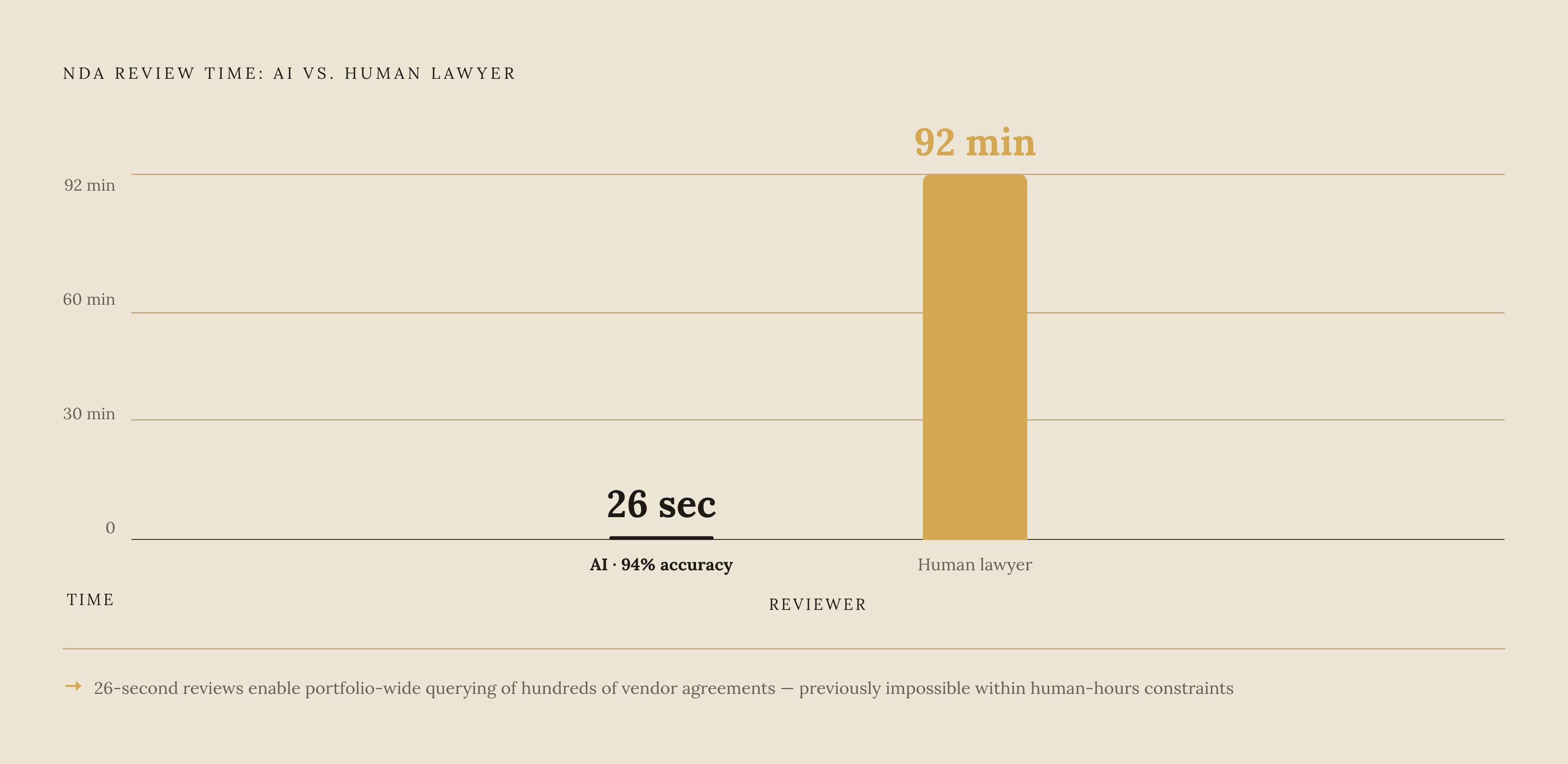
Speed is where drafting attorneys and their clients see the real economics. According to Loio, AI reviews an NDA in 26 seconds against 92 minutes for a human lawyer doing the same review, at 94% accuracy. That gap is what makes querying an entire portfolio, rather than one contract at a time, worth doing. Nobody ran a manual audit across hundreds of vendor agreements before a quarterly close, because nobody had the hours. A system reviewing at that speed can, and does.
What comes out the other end is structured metadata: searchable, reportable, exportable into whatever finance or procurement already runs. Playbooks do the calibration work here. AI checks an extracted clause against the organization's own standard language and flags where it deviates, so extraction is never a neutral technical act, it's tuned to how much risk a given legal department is willing to carry. Two companies running the same tool can get different flags on the identical contract, and that's by design, not a bug.
Research into contract management errors consistently finds that the majority trace back to human handling rather than software failures. AI extraction doesn't erase that number, it just moves where the error lives. Instead of a paralegal missing a clause on page 40, the risk becomes a model misreading unusual phrasing it hasn't seen before. That argues for keeping a person reviewing anything high-stakes, not for pulling them out of the loop.
Evisort's Document X-Ray, launched January 2024, marks how far extraction has moved past simple field-tagging. It's built to surface deeper contract insight through AI-driven analytics, aimed at enterprises of any size, and it points at where the extraction layer is heading: past what a clause says and into what it means for the business reading it.
What NLQ unlocks across legal, procurement, sales, and finance
Legal gets the most obvious win: portfolio-wide risk scanning. One query surfaces every contract with non-standard indemnification language or a liability cap under whatever number the general counsel cares about this week. In M&A due diligence, the same mechanic compresses weeks of associate hours into a single pass, querying a target's whole repository for change-of-control clauses instead of assigning a team to read every agreement line by line.
Procurement gets visibility it rarely had before. Querying vendor contracts for SLA terms, audit rights, or price-adjustment clauses without opening a single file is the front end of real savings work. One pharmaceutical company built an AI-driven invoice-to-contract reconciliation tool and found more than $10 million in leaked value inside a four-week proof of concept, a number that only exists because someone could compare contract terms against actual invoices at scale, fast. Separately, one organization automated 46% of its procurement contracts and cut lead time to 6.8 days. Calls like that only get made once someone has clear sight into what the contracts actually say, and most procurement teams never had that sight before.
Sales and revenue teams stop waiting on legal for routine answers. Renewal dates, pricing tiers, exclusivity terms, termination-for-convenience rights: a rep or a revenue ops analyst pulls these directly instead of filing a ticket and waiting two days for someone else to open the file. Revenue ops specifically uses NLQ to flag contracts approaching auto-renewal or accounts sitting on unused volume discounts, the kind of detail that used to become visible only after the renewal deadline had already passed.
Finance runs the same query pattern against payment terms: every contract with net-60-or-longer terms, every agreement with variable pricing, every milestone-based schedule that affects revenue recognition. None of this is new information. It sat in the contracts the whole time. It just wasn't reachable without someone who knew exactly where to look and how the files were named, which in practice meant it mostly went unreached.
The same structural shift drives all four functions: nobody has to go through legal to get an answer grounded in an actual contract anymore. That's a redistribution of who gets to know what, and when, and legal departments that treat NLQ as a nice-to-have are underrating how much that redistribution changes their own workload once procurement and sales stop routing every question through them.
Platforms that deliver NLQ in production today
DocuSign Navigator describes itself, in the company's FY2026 10-K, as a unified AI-powered repository covering agreements stored in DocuSign and in third-party systems, surfacing insights and contract detail through AI. It ships bundled with DocuSign's Core, Sales, and CX editions, alongside the no-code Workflow Builder (formerly Maestro) and Agreement Desk. DocuSign's Iris AI engine shipped in 2025, with AI agents for review, intake, redlining, and obligation tracking following in 2026. Navigator was named a Leader in the Gartner Magic Quadrant for Contract Life Cycle Management in 2024.
Sirion built its platform natively around AI, with particular depth in analytics and conversational querying: users can ask about obligations, liabilities, risks, and contractual commitments across a whole portfolio in plain language. It was named a Leader in both the Forrester Wave for Contract Lifecycle Management Platforms, Q1 2025, and the Gartner Magic Quadrant for CLM 2024.
Evisort covers the contract lifecycle from drafting through renewal, with search built to locate specific clauses across large repositories, and it's used at enterprise scale for its reporting and scalability. Document X-Ray extends that further into AI-powered insight extraction.
Comparison data from linksquares.com shows LinkSquares scored strongest across a seven-platform review on clause detection, payment term extraction, governing law extraction, and workflow automation. Built specifically for in-house legal, procurement, and revenue teams, it folds contract intelligence, CLM, workflow automation, and repository management into one platform, and it runs autonomous agents directly over email.
PwC's AIDA, built on AWS, supports natural language Q&A across documents and returns answers with linked citations back to source material. It integrates with existing contract management systems and repositories, and PwC has scaled it across multiple enterprise functions and industries.
Summize unveiled its next-generation CLM platform in April 2025, built around agentic AI through Summize Intelligent Agents. Review Pro automates redlines directly inside Microsoft Word, and Ask SIA handles AI summaries and contract Q&A across the platform. It connects into Outlook, Gmail, Teams, Slack, Salesforce, and Jira.
Traits that separate reliable NLQ from systems that demo well but disappoint in production
A clean demo and a reliable production system are not the same claim, and treating them as interchangeable is the single biggest mistake buyers make in this category. NLQ reliability comes down to three things: how good the upstream extraction is, how much and how varied the training data is, and whether the system actually grounds its answer in real contract text instead of drifting into a clause that sounds plausible but isn't there.
Citation is the test that matters most. A trustworthy system links every answer back to the source document and the exact clause, so a user can check the response against the original text in under a minute. A system that hands back a clean summary with no citation is a liability sitting quietly inside a legal department's workflow, and it should get priced and evaluated like one, not treated as a feature that happens to be missing.
Extraction accuracy above 90% holds up fine on standard contract types. Where systems actually diverge from each other is the counterparty-drafted, multi-jurisdictional, heavily negotiated agreements, and that's exactly where the stakes run highest, since those are usually the contracts carrying the most unusual and consequential terms. Playbook calibration matters just as much: an AI tuned to generic legal norms instead of an organization's own risk tolerance produces noisy flags, and noisy flags are how legal teams stop trusting the tool inside of a few months.
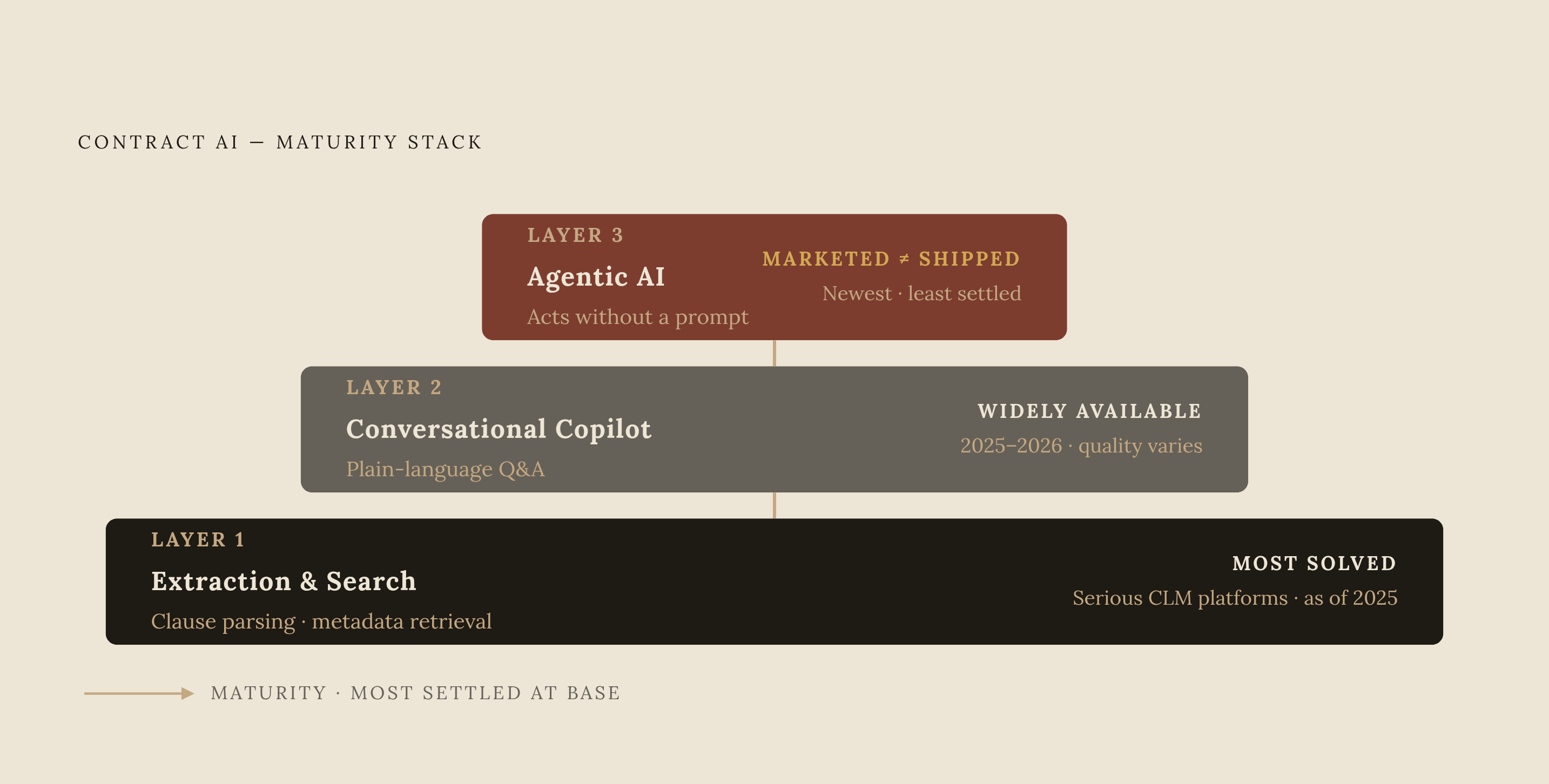
Maturity here breaks into three layers, an approach contractsafe.com laid out in its CLM analysis. Extraction and search, the first layer, is the most solved of the three, and most serious CLM platforms handle it well by now. The conversational copilot answering questions in plain language, layer two, is widely available as of 2025 and 2026, though quality still swings hard on complex, multi-document questions. Agentic AI that takes action on its own without a prompt, layer three, is the newest and least settled: some of it works today, plenty of it is still a roadmap slide dressed up as a shipped feature.
Pricing is its own reliability signal. Several vendors meter the number of extractions allowed, cap user seats, or sell the AI layer as a bolt-on priced separately from the core platform. contractsafe.com's analysis put it bluntly: the headline price often excludes the exact feature a buyer is purchasing the software for. Ask about that before signing anything, not after the invoice arrives.
Integration depth is the quiet dealbreaker nobody raises in the sales call. A repository that answers questions beautifully but can't push a payment term into the ERP or a renewal date into the CRM has just built a nicer-looking silo. The value was always in what happens to that answer next, and a platform that stops at the chat window hasn't finished the job it was sold to do.
Oversight doesn't disappear just because the system got faster. AI-driven CLM tools show a 30 to 40% improvement in obligation-tracking accuracy, which is real and worth having. But the right posture still keeps a person reviewing anything high-stakes, rather than pulling them out because the model tested well in a demo. Security follows the same logic: role-based access, audit trails, and real data protection aren't optional extras for regulated industries handling sensitive legal documents. They're the baseline, and any vendor treating them as a premium tier is telling you something to pay attention to.
Adoption and market momentum reflecting the shift from passive storage to active intelligence
This isn't a passing trend. 78% of organizations made CLM investments within the past five years, and 41.9% of those investments landed within just the last year as of 2025, a pace that points to acceleration rather than a market settling in.
Procurement has moved even faster on the AI side specifically. 94% of procurement executives report using generative AI at least once a week, and McKinsey's survey of procurement functions found 40% had already implemented or piloted generative AI in some form. 81% of organizations say they want to adopt contract automation, and two-thirds have already set aside dedicated budget for contract technology, a different and more serious signal than intent alone.
The CLM AI market was valued at $2.8 billion in 2025, with projections putting it at $12.5 billion by 2033, an 18.3% compound annual growth rate. BFSI stands out as the largest end-user segment, and that tracks: regulatory complexity in banking and insurance rewards exactly the kind of portfolio-wide, plain-language querying NLQ was built to deliver. A bank running thousands of vendor agreements under shifting compliance rules doesn't get to read them all by hand and call it a strategy. This is less a hype cycle than a category settling into how contracts get managed from here on.