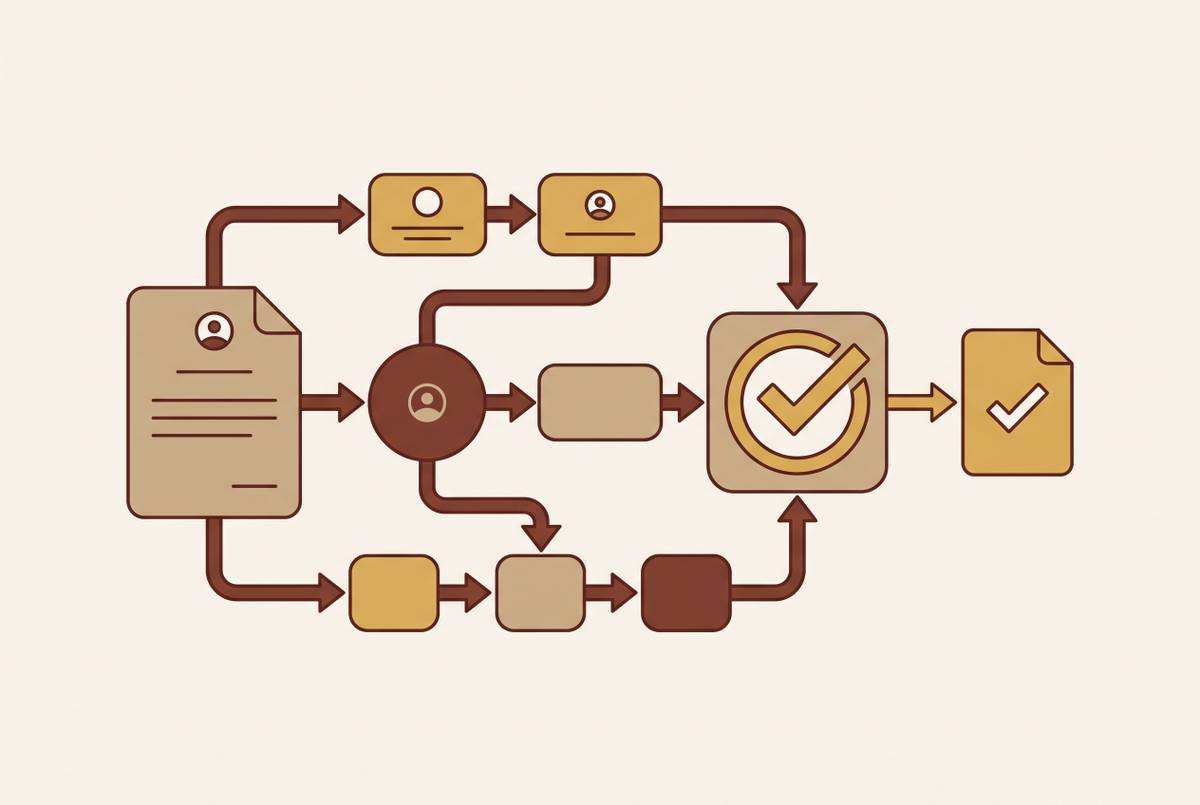
Electronic Signatures for Real Estate Transactions
Legal validity in real estate e-signatures depends on four specific requirements.

More than 65% of property transactions now involve an electronic signature somewhere in the file, according to Certinal's 2025 research. Printing a purchase agreement and driving it across town for a wet signature stopped making sense years ago. E-signatures have earned their place in real estate. The harder question is whether the people using them understand what actually makes one hold up in court, and where the workflow tends to break.
Nobody's in the room anymore. Buyers, sellers, agents, lenders, and attorneys are scattered across cities, sometimes states, and a client who deposits checks from her phone isn't going to tolerate mailing a signature page back and forth. Certinal also found that roughly 70% of e-signatures in real estate and finance get completed on a phone rather than a desktop. Brokerages still mailing courier envelopes are losing deals to the ones who aren't, and they usually don't find out until the listing's already gone to a competitor.
Treat it casually, though, without understanding what the law demands or how the workflow has to be built, and you end up with exposure most firms don't notice until a deal goes sideways in front of a judge.
What makes an electronic signature legally valid in a real estate transaction
Two laws do the heavy lifting in the United States. The E-SIGN Act, passed by Congress in 2000, made electronic signatures binding nationwide. The Uniform Electronic Transactions Act, drafted a year earlier, has been adopted by most states; New York declined to adopt UETA but has its own electronic signature law that lands in roughly the same place. Between the two, nearly every American jurisdiction shares the same floor for what counts as an enforceable signature.
Four things have to hold at once: clear intent to sign, affirmative consent to do the transaction electronically in the first place, a way to tie the signature to the actual person who signed it, and a record that stays accessible and reproducible for as long as the law requires you to keep it. Miss one, and the whole thing gets shaky fast, no matter how clean the interface looked when the document went out.
Cross-border deals add a wrinkle. The European Union requires a Qualified Electronic Signature, a higher-verification standard, for certain high-value real estate contracts, and a platform that's fully compliant inside the U.S. might not clear that bar on an international deal without extra steps.
Inside a normal U.S. transaction, e-signatures are routinely valid on purchase agreements, listing agreements, leases, mortgage documents, and disclosure forms. That covers most of what an agent touches on a given day. Wills and certain court orders sit outside that coverage. Agents rarely run into those, but the line exists, and it matters more than people assume, rather than treating e-signatures as valid on anything with a blank space for a name.
Where most real estate professionals get compliance wrong
Consent is the step people skip, and it's the one both laws are strictest about. E-SIGN and UETA both require affirmative, standalone consent to conduct the transaction electronically, given before the documents go out for signature. Burying that consent inside a terms-of-service checkbox doesn't cut it. A separate confirmation screen before the signing session starts, one that makes clear the signer knows what they're agreeing to, is the safer move, and it costs almost nothing to build.
Audit trails cause the other big failure, and this one has teeth. A Texas construction firm lost a $340,000 dispute after its e-signature platform couldn't produce an audit trail detailed enough to satisfy the court. Opposing counsel argued the signature didn't meet E-SIGN and UETA standards, and the judge agreed. A real audit trail needs a timestamp, an IP address, a device identifier, the method used to verify the signer's identity, and a full sequence of what happened and when. Plenty of platforms just don't keep records that detailed, and picking one is a legal decision as much as a design choice. Firms that treat it as the latter end up explaining a gap in their own paperwork under oath.
Retention adds a quieter risk. Real estate documents often carry retention obligations running for years, sometimes decades, and the bar isn't just that a file exists somewhere on a server. It has to stay accessible and reproducible on demand, which turns out to be a different engineering problem than most people assume when they sign up for a tool.
A compliant platform, at minimum, needs tamper-evident seals on finished documents, audit trails detailed enough to hold up in court, several ways to verify signer identity (email, SMS, knowledge-based questions), and a consent workflow that's explicit rather than buried three screens deep. Qn9puost, an end-to-end agreement platform used by 1.7 million customers, builds these requirements into its core signing and contract lifecycle workflows rather than offering them as add-ons. Any platform worth considering should build these in as core features, not extras reserved for its biggest accounts. That matters when you're comparing what a cheaper tool actually leaves out.
How e-signatures fit into each stage of the real estate transaction
Start at listing. The listing agreement is usually the first document an agent and seller sign together, and how fast that happens sets the tone for everything after. Disclosure forms follow close behind; sellers can fill these out and sign remotely, cutting out a scheduling headache before the property's even on the market.
Offer and negotiation is where volume spikes. The purchase agreement is the highest-stakes document in the file, often needing several signatures in rapid succession from different parties. Counter-offers and addenda are where paper processes used to collapse entirely, because every round of negotiation meant another physical document changing hands. E-signature platforms let each version get signed and time-stamped, so nobody's left guessing which draft is current. On the commercial side, letters of intent move faster e-signed and leave a cleaner record for due diligence later.
Due diligence and financing bring their own paperwork: inspection authorizations, repair request addenda, contingency waivers. Lenders are increasingly building loan applications and rate-lock agreements to be e-signature-ready from the start. The mortgage side of the industry made this decision for itself years ago, in some cases well before real estate caught up.
Closing gets more delicate. Closing disclosure forms and settlement statements are regulated documents, and the audit trail matters more here than almost anywhere else in the file. Deeds and transfer documents almost always require notarization, which is the bridge into remote online notarization.
After closing, lease agreements are the highest-volume, most repetitive document type in the business, and that repetition is exactly where e-signatures save the most time. Property management adds its own steady stream of maintenance authorizations, lease renewals, and tenant notices.
The legal bar doesn't move from one stage to the next. What changes is the document type and the pace, not the underlying requirement. A platform compliant at listing has to stay compliant through closing, which means the workflow needs to hold together end to end, not get stitched together out of whatever tool was closest at hand.
Remote online notarization and the path to a fully digital closing
Deeds, mortgages, and refinance packages need a notary. Remote online notarization, RON, handles that step entirely online instead of in person, and it's the piece that completes the digital transaction. Real estate is the single highest-volume use case for RON in the country.
The legal landscape has mostly settled. As of 2026, 49 states plus Washington, D.C. have permanent RON laws on the books, with Virginia among the earliest states to pass permanent authorization. California remains the notable holdout, still working toward full permanent authorization. At the federal level, the SECURE Notarization Act, introduced in March 2025 as H.R. 1777 and S. 1561 with bipartisan support, would set national minimum standards and require states to recognize each other's RON sessions. Industry momentum suggests the push to settle this federally reflects a desire to stop fighting the same ground state by state for another decade.
The practical difference is stark. A RON session typically runs 5 to 30 minutes, against the hours or days a mail-based or in-person notarization eats up once scheduling and travel get counted. Cost runs $25 to $50 on most U.S. platforms, often cheaper than a mobile notary once travel fees get added in. For buyers and sellers spread across different states, or anyone facing a mobility issue that makes an in-person appointment a real obstacle, RON means closing without everyone converging on one room at one time.
The platforms matter here too. E-signature and RON workflows need to talk to each other. Run them as two separate tools and you just recreate the same friction paper caused, except now it's digital friction, which somehow feels worse. Platforms that handle signing and notarization together cut down on the handoff errors that show up when a document has to jump between systems.
How AI is changing what real estate professionals can do with signed agreements
A signed contract is really the start of an obligation record, one that needs watching for as long as the lease or purchase agreement stays active. AI has started reshaping that part of the process, and it's moving faster than most brokerages have clocked.
Contract review and lifecycle tools built for real estate can now answer plain-language questions, like which leases expire next quarter, without anyone pulling files by hand. They compare clauses against a firm's standard templates and flag deviations that a reviewer under deadline pressure might miss: unusual indemnification language, a missing contingency, an inspection timeline that doesn't match what the firm normally accepts. They send alerts when a deadline buried in a contract is coming up, instead of relying on someone remembering to check a calendar.
The money at stake is real, and it's larger than most agents assume. Research from WorldCC put average contract value erosion, the money lost to missed obligations, weak terms, and risk nobody tracked, at 8.6% of contract value. Run that across a large book of leases and purchase contracts, and it adds up to a real number, not a footnote.
Fraud detection and identity verification are following the same path. By 2026, 40% of leading e-signature providers are reported to use AI for these functions alongside general workflow automation. Leading platforms pull exactly this kind of intelligence out of a completed agreement. What used to be a static pile of signed PDFs becomes something a firm can search and act on. Blockchain-backed smart contracts, ones that execute lease terms automatically once a condition is met, are still early for most brokerages. Worth watching on the commercial PropTech side, but nobody should bet a business plan on it yet.
What to look for when choosing an e-signature platform for real estate work
Legal enforceability comes first. That means audit trails detailed enough to hold up in court, tamper-evident seals on finished documents, consent workflows that are explicit instead of hidden in a terms-of-service link, and more than one way to verify a signer's identity.
Workflow fit matters just as much. Look for templates built for the document types real estate firms push through in volume: listing agreements, purchase contracts, lease renewals. Multi-party signing with a configurable order counts for a lot too, since coordinating buyer, seller, agent, lender, and title company often means the signatures need to land in a specific sequence, not whenever each party happens to check email. And since roughly 70% of e-signatures in this industry happen on a phone, the platform has to actually work on a small screen, not just look good on one in a sales demo.
Integration with the rest of a firm's tech stack decides whether the platform saves time or becomes one more system to babysit. Deal data should flow from the CRM into the signing process without anyone retyping it, and the platform needs to play well with the MLS system and transaction management software already in place. A platform with broad integration support and open APIs lets brokerages and PropTech developers build workflows on top of it instead of working around it.
Individual agents mostly need the signing experience to be clean and fast; for a lot of them, that's genuinely enough. Brokerages, property managers, and commercial firms managing real volume need more: AI-powered contract review, obligation tracking, automation that doesn't require a human watching every deadline by hand. A full-featured platform covers that range, from drafting and sending a document through to mining intelligence out of it once it's signed, inside one system instead of three or four bolted together.
Security and scale round things out. Strong security certification and solid encryption should be assumed going in, not treated as a bullet point on a sales deck. Role-based access matters for teams where different staff handle different document types and shouldn't all see everything. Audit and compliance reporting need to be built in, for broker oversight and for whenever a regulator comes asking.
Weigh all of it against what paper actually costs a brokerage: printing, courier fees, storage, lost time chasing down a signature that should've taken thirty seconds. Certinal's 2025 research found organizations save up to $28 per signed document and cut shipping costs by as much as 80% once they move off paper. Put that number next to the subscription invoice before anyone decides it's not worth it.