Third-Party Contract Risk in Supply Chain Agreements
Contracts are where organizations actually control supply chain risk or quietly lose it.
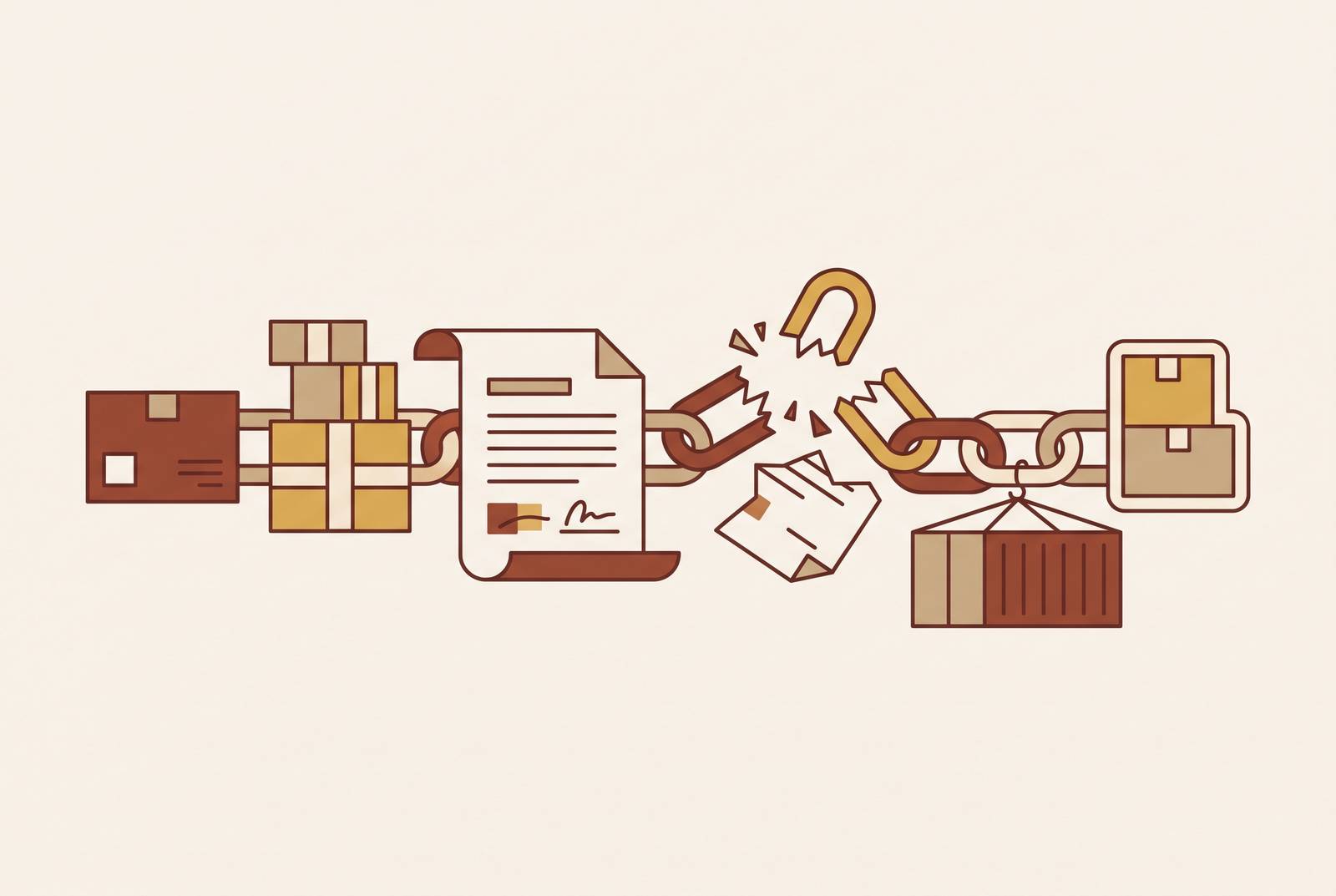
Third-party and supply chain risk now ranks as the second-highest near-term risk facing executives worldwide, a signal that external dependencies have worked their way into the core of how organizations operate. The 2026 Executive Perspectives on Top Risks and Opportunities Report, produced by NC State's ERM Initiative with Protiviti, traces this to several forces moving together: heavy reliance on AI-enabled and cloud-based vendor platforms, cybersecurity threats that originate at third-party access points, poor visibility into multi-tier supplier networks, geopolitical instability, and regulatory expectations that keep climbing. In late April 2025, attackers brought Marks & Spencer to a standstill not by breaching M&S's own systems but by impersonating a contractor user and social-engineering the third-party contractor's help desk, a pattern that shows the perimeter has shifted to the contract relationship itself. Large supply-chain and third-party compromises have nearly quadrupled since 2020, and Conagra Brands told investors in its FY2026 10-K that disruptions to its supply chain have had, and could continue to have, an adverse impact on its business, financial condition, and results of operations. When a packaged food company puts that sentence in a public filing, vendor risk has stopped being a procurement line item and become a board-level exposure. The response to it has to start where the relationship is actually defined: the contract.
How risk travels beyond the vendor you contracted with
Standard vendor risk assessments check financial soundness, compliance certifications, and contractual reliability, and all three checks stop at the edge of the relationship the organization can see. They say nothing about the tier below it. Fourth-party risk is the exposure created by the vendors that an organization's own vendors rely on, and as responsibility gets delegated downstream, oversight weakens with each additional link because every one of those links carries its own processes, standards, and blind spots. Equipment like conveyors, forklifts, and Automated Storage and Retrieval Systems is built from components sourced several tiers deep, so a facility's actual risk exposure runs through that physical bill of materials rather than through whatever vendor contract sits in a file cabinet or a document repository. A full supply chain risk assessment has to account for third parties, fourth parties, supplier interdependencies, supply chain integrity, and systemic risk, which makes vendor due diligence a small piece of a much larger structure. An organization can vet an OEM thoroughly as a company and still have no idea who manufactures the motor inside that OEM's equipment, who supplies the bearings, or whether a proprietary drive component comes from a single plant with no backup. If the standard vendor scorecard cannot see that far, something else in the relationship has to carry the obligation to look. That something is the contract.
Where most organizations lose control
No contract eliminates risk outright; a vendor can still fail, a subcontractor can still cut corners, a component can still come from a single, unreplaceable plant. What a contract can do is define, before any of that happens, who bears the consequence, who has the right to look, and how fast the organization finds out. The contract is the one instrument an organization fully controls before a problem occurs, and most organizations quietly lose control of the risk they thought they had managed right there. Most enterprises, especially in regulated industries, run on fragmented systems and manual processes that leave contractual obligations unmanaged: critical terms go unmonitored, renewals get missed, and commercial opportunities are never captured. Contract management tools have historically focused on storing documents and routing them for signature rather than interpreting what the language actually requires, so the provisions negotiated at signing often go unwatched the moment the ink dries. The clauses meant to catch multi-tier risk, subcontractor approval rights, audit provisions, flow-down compliance terms, are frequently missing or written so loosely that no one could enforce them if they tried. Deploying an AI system, a cloud platform, or a piece of industrial equipment without the right protections already written into the contract means the organization inherits liability for AI failures, vendor lock-in, and weak security recourse that is expensive, and often impossible, to fix after the fact. The EU Data Act makes the same point from the regulatory side: any agreement covering connected equipment, smart devices, or industrial IoT infrastructure now needs data-access terms specifying who can access the data that equipment generates, a clause type that standard procurement contracts routinely miss and that costs far more to add after signature than before it.
The regulatory environment that is making weak supply chain contracts increasingly costly
Several distinct regulatory regimes are entering active enforcement in the same period, and all of them reach directly into contract language. AI governance, data access, operational resilience, public contracting transparency, and ESG disclosure are converging in 2026, stacking compliance obligations on top of each other inside the same vendor agreements. The EU AI Act's general application date arrived on 2 August 2026, triggering Article 50 transparency requirements and the broader enforcement framework; the Digital Omnibus pushed the Annex III high-risk classification and documentation requirements to 2 December 2027, but those requirements will eventually determine how AI-enabled vendor systems must be documented and overseen. That obligation only reaches a vendor relationship if the contract is written to carry it. The UK Procurement Act 2023 is now in a critical implementation phase, with payment and performance transparency rules rolling out through 2026, creating new contractual reporting duties for any organization with UK public-sector supply chain exposure. In the US, the SEC, the OCC, and the Federal Reserve Board are prioritizing third-party risk management in 2026, joined by the FDIC and NCUA, and their tightened oversight is making contractual evidence of vendor risk management a material factor in examinations. Regulators across sectors are also watching the threat landscape directly, including a nation-state-linked group's attack on a medical device maker and a ransomware disruption at an aerospace supplier in September 2025, and they are translating those incidents into stricter vendor oversight expectations. Put together, an organization whose vendor contracts lack breach-notification timelines, audit rights, and AI-specific governance terms faces two separate failures at once: exposure to the vendor failure itself, and exposure to regulatory sanction for failing to show it managed that vendor properly.
The contract provisions that determine actual exposure in supply chain agreements
Whether a supply chain agreement actually transfers and controls risk, rather than just containing language about it, comes down to whether specific provisions exist, are written precisely, and are monitored after signing. The following clause categories are where that exposure is decided, and qualified counsel should review the final language in any given deal.
Subcontractor and flow-down clauses require the vendor to get approval before handing off material obligations to a subcontractor, giving the organization visibility into fourth-party risk that would otherwise stay hidden. Flow-down language goes further, requiring the vendor to impose the organization's same compliance, security, and data-handling standards on its own suppliers, extending governance below the first tier. Without that language, whatever was negotiated with the vendor ends at the vendor's door, and everything happening downstream runs on the vendor's own standards alone.
Audit rights and inspection clauses enforce every other provision in the contract. A right to audit a vendor's security controls, data practices, and subcontractor relationships is only useful if it specifies who can conduct the audit, how much notice is required, what systems and records are in scope, and what happens once a deficiency is found. In regulated industries, failing to show that an audit right exists, and has actually been used, is itself a compliance problem under the frameworks US financial regulators are enforcing in 2026.
Breach notification and incident response obligations need real numbers attached to them. The Health Sector Coordinating Council's 2026 guidance finds that standard vendor contracts fall short on fail-safe requirements and incident response cooperation terms for AI-enabled systems, because those systems fail in ways conventional software does not. Language like "without undue delay" or "as soon as practicable" is close to unenforceable; a notification clause needs to state hours, not sentiment.
Data access and ownership terms now carry legal weight under the EU Data Act, which requires agreements covering connected equipment, smart devices, or industrial IoT infrastructure to specify who may access the data that equipment generates, a bar that most standard procurement templates do not clear. These terms should state who holds the data, who can use it for model training or analytics, what happens to it when the contract ends, and whether the vendor can share it with its own subcontractors or affiliates. For AI vendors specifically, the HSCC's 2026 guide flags synthetic data misuse and training data leakage as risks that ordinary data clauses don't touch, which calls for purpose-limitation language built around how the AI system actually behaves.
AI-specific governance provisions exist because AI systems change after deployment in ways conventional software does not: models update, and data drifts as the distributions underneath them shift, so a contract written at the moment of deployment may not govern the system actually running a year later. Good AI vendor contracts include model change notification requirements, explainability thresholds defining what the vendor must be able to show about how the model reached a given output, performance benchmarks tied to the buyer's own data rather than the vendor's test set, and the right to terminate if drift pushes risk past an acceptable threshold. The HSCC names vendor security attestations, model explainability thresholds, and fail-safe requirements as the critical control areas for AI-enabled clinical and operational systems, and the same logic holds in supply chain and procurement contracts.
Termination for convenience and transition assistance address vendor lock-in directly. If you can't exit a vendor relationship without losing operational capability, that is a supply chain risk on its own, and a contract without termination-for-convenience rights and data portability obligations hands that entire risk to the buyer. Transition assistance clauses should require the vendor to support migration of data and workflows for a defined period after notice of termination, so the organization is never held hostage to a relationship it needs to leave.
How Poor Contract Visibility Turns Negotiated Protections Into Unmonitored Paperwork
A contract with every one of those provisions in place offers no more protection than a contract with none of them if nobody is watching for when they activate. Most organizations have no reliable way to surface obligations across a full vendor portfolio: renewal dates, audit windows, notification deadlines, and compliance checkpoints sit scattered across disconnected systems or buried in documents nobody can query. The cost of that gap is measurable. Industry analysts note that a meaningful share of negotiated contract savings is lost to poor compliance tracking: the work done at the negotiating table gets undone quietly, months later, by nobody noticing a deadline. Legal, procurement, finance, and IT each hold a piece of a given vendor relationship, and because no single function has end-to-end visibility into what the contract actually requires at any given moment, obligations fall into the gaps between departments. The Navarino case shows what closing that gap looks like in practice: after the company set up an integration so signed contracts sync automatically to SharePoint and finance gets instant access to contract data, Efficiency Manager Nikos Anthopoulos said the change "made it much easier for the finance team to access contract information," eliminating the manual handoffs that had previously delayed oversight after signing. That is a small, specific fix, but it points at the larger problem: protections negotiated into an agreement only function as risk controls if something in the organization is actively checking for them.
AI-Enabled Contract Management and Supply Chain Risk Oversight
Closing that visibility gap is what AI-enabled contract management is built to do. Contract management is shifting from a system of record, storing and routing documents, into a system of intelligence that extracts, monitors, and acts on the obligations buried inside an organization's contracts. In supply chain freight specifically, AI clause analysis has already turned contract review from a weeks-long legal bottleneck into a scan that takes minutes, flagging risk, highlighting deviations from standard terms, and benchmarking pricing against market data. That progression runs through three stages: first, consolidating and structuring the contract repository so obligations can be queried at all; second, using AI to classify documents, extract key metadata, and surface gaps, duplicates, and inconsistencies; and third, at the leading edge, using agentic AI under human supervision to support risk assessments, workflow orchestration, negotiation preparation, and ongoing obligation management. For supply chain risk, that means the audit windows, notification timelines, subcontractor approval requirements, and AI model change notifications negotiated into a vendor agreement get surfaced automatically when they become relevant, instead of being rediscovered in the middle of an incident, when it's too late to act on them calmly.
That shift requires caution: AI extraction accuracy figures published by vendors are typically benchmarked against the vendor's own document corpus, and those numbers may not hold up against a buyer's actual mix of contracts. In regulated industries, an inability to explain why an AI system flagged or extracted a particular term is itself a compliance problem, and it is becoming a hard gate in procurement policy at some organizations. Docusign's Intelligent Agreement Management platform answers that caution by building transparency and lifecycle coverage directly into the platform. Through a suite including its AI engine, along with agreement management, CLM, workflow builder, and web forms tools, the platform embeds AI throughout the agreement process instead of bolting it on at the end, letting organizations create, negotiate, sign, and monitor vendor agreements inside one environment that connects to more than 1,100 third-party applications. The design matches the argument this piece has been building: well-drafted provisions are necessary but not sufficient, and what closes the loop is active, explainable monitoring across the full life of the agreement.
Building a contract governance framework that treats vendor agreements as live risk controls
Everything above points toward one operating model: vendor agreements function as live risk controls when an organization treats them that way continuously, monitoring them for as long as they remain in effect. Segmentation by criticality is the starting point. Not every supplier needs the same depth of protection, but an organization needs a clear framework for deciding which relationships require flow-down clauses, AI governance terms, and actively managed audit rights, and which can run on standard terms. The NC State ERM Initiative's 2026 guidance recommends building a centralized third-party risk management framework with defined ownership and escalation paths, folding third-party risk into enterprise-level dashboards and scenario planning, and segmenting vendors by criticality so the highest-risk partnerships get the deepest review. None of that works without cross-functional ownership. ERM, procurement, IT, legal, and compliance each hold a different piece of a vendor relationship, and the contract is the only instrument capable of binding all five to one shared set of obligations and monitoring duties. Electronic signatures and digital workflows at vendor onboarding, NDA execution, and compliance attestation shrink the lag between negotiating a term and that term actually taking effect, while paper-based onboarding stretches timelines by weeks and leaves gaps in the audit trail that the whole governance framework depends on.
The risk described throughout this piece, fourth-party exposure, AI drift, regulatory enforcement reaching into contract language, does not originate in the vendor relationship itself. It originates in the gap between what an organization negotiates and what it actually watches. When an organization closes that gap, a vendor agreement becomes what it was always meant to be: a working control it can rely on before the next incident, not after it.