SOX Compliance Requirements for Contract Management Processes
Contracts are core to SOX compliance, not peripheral to it.

The Sarbanes-Oxley Act turns 24 in 2026, but its requirements for contract management remain among the least understood compliance obligations in public companies. Contracts are the originating documents for revenue recognition, vendor obligations, and financial commitments. That makes contract processes not peripheral to SOX, but embedded in its core requirements. This article walks through what each section demands and what those demands mean in practice for the teams responsible for agreements.
What SOX actually requires of public companies, and why contract management sits at the center of it
SOX compliance is a legal obligation for all U.S.-listed public companies, their wholly-owned subsidiaries as part of the parent's consolidated scope, and foreign companies listed on U.S. exchanges. It is not a voluntary best practice or a framework an organization can opt into selectively. The statute, named after Senator Paul Sarbanes and Representative Michael G. Oxley, was enacted as the Sarbanes-Oxley Act of 2002, and is known in the Senate as the Public Company Accounting Reform and Investor Protection Act. Compliance is enforced by the SEC and the PCAOB, the latter created by SOX itself to oversee the public accounting firms that audit covered companies.
The enforcement structure matters for contract teams because it means the controls governing agreements face scrutiny from two directions at once. Management certifies the control environment, and independent auditors then test that certification against what the systems and processes actually demonstrate. Private companies preparing for an IPO or positioned for a merger or acquisition also need to review their internal controls before entering this environment, which makes the requirements relevant well beyond public-company legal departments.
The connection to contracts follows directly from what those documents do. Every customer agreement, vendor contract, and amendment that touches financial reporting falls inside the SOX control environment. A contract management process that is informal, undocumented, or fragmented is therefore not a workflow problem. It is a compliance exposure that CEOs and CFOs certify personally, under penalty of fines and imprisonment.
What Section 302 demands from the executives who sign financial certifications
Section 302 makes CEOs and CFOs personally and criminally liable for the accuracy of financial reports and the effectiveness of internal controls. Signing officers must review and certify the accuracy of financial statements, establish and maintain internal controls, and disclose all significant deficiencies, fraud, and significant changes in internal controls. The penalty structure reflects the seriousness: executives who willfully certify false financial reports face fines up to $5 million and imprisonment for up to 20 years under Section 906, while knowingly but not willfully certifying a noncompliant report carries penalties of up to $1 million and 10 years.
What this means for contract operations is that every approval on a material agreement functions as evidence the executives are certifying to the SEC. A CFO certifying quarterly results is attesting that the control environment, including every approval process for contracts affecting financial reporting, operated as described during the period. The practical implication is that anyone in Legal, Sales, or Procurement who routes contracts for approval is operating inside the Section 302 control environment, whether or not they know it. Each approval requires clear evidence: signatures, timestamps, or system audit trails that demonstrate the control existed and functioned.
What Section 404 requires in terms of documented, tested internal controls over contract processes
Section 404 is the most operationally demanding part of SOX for contract teams. It requires not only that controls exist, but that management assesses their effectiveness and that independent auditors attest to that assessment. Annual reports must include an internal control report stating management's responsibility to maintain an adequate internal control structure, an assessment of its effectiveness, and any material weaknesses identified. Smaller, non-accelerated filers are exempt from this attestation requirement.
The operational requirements for contract processes are specific. Access to draft contracts must be restricted to authorized individuals. Auditors look for a formal contract review checklist, clear segregation between sales and accounting, and system workflows that flag new contracts or amendments before revenue is recognized. The external audit must be performed by independent auditors exercising professional skepticism, separate from any consulting relationship with the company.
The enforcement climate has tightened. On March 19, 2026, the SEC announced a dedicated SOX enforcement group targeting audit firm misconduct, which signals materially heightened scrutiny of firm-level quality controls. Practitioners should expect tighter penalties and lower tolerance for internal control over financial reporting, or ICFR, failures in upcoming audit cycles.
A common objection deserves a direct answer. Revenue recognition flows directly from contract terms and is a financial reporting line item. Any control weakness in how contracts are created, approved, or amended is by definition a weakness in internal controls over financial reporting, which makes it a Section 404 matter regardless of which department owns the contract process.
What Sections 409 and 802 add: real-time disclosure and the seven-year retention floor
Two additional SOX provisions set enforceable minimum standards that contract management systems must be built to satisfy. Section 409 requires real-time disclosure of material financial changes. Contracts that constitute material financial events trigger an obligation to disclose promptly, which means the internal process for identifying and escalating material contract terms must be fast and reliable, not deferred to the next reporting cycle. Section 802 sets strict record retention rules: all financial records, audit trails, and related communications must be retained for a minimum of seven years.
The retention requirement is not just about duration. It specifies the character of the records: tamper-evident, indexed, searchable, and readily retrievable on demand. Write-once-read-many, or WORM, storage formats that prevent edits or deletions are a recognized technical approach to satisfying the tamper-proof standard. Contracts signed today must remain retrievable, unaltered, and accompanied by their full audit trail through multiple audit cycles and potential regulatory inquiries. The stakes are criminal: penalties for document destruction under Section 802 run up to 20 years imprisonment. Record retention is not a records management inconvenience. It carries direct criminal exposure.
What a SOX-compliant electronic signature audit trail must be able to prove
Auditors examining electronic signatures on contracts under SOX look for four specific things that an audit trail must answer without manual reconstruction. The system must establish who signed, through unique user identity rather than shared credentials or role-based logins that multiple individuals could access. It must establish what they signed, through a document hash or fingerprint proving the version signed is the version on file rather than a later revision. It must establish when they signed, through a system-controlled timestamp rather than a self-reported or manually entered date. And it must establish how the record was protected from alteration, through evidence of tamper-evident storage rather than an editable file format in a general-purpose folder.
The standard has risen because informal practices consistently fail it. SOX-compliant electronic signature records must be retained for seven years and remain tamper-evident throughout, and the e-signature system itself, not a downstream file management practice, must enforce that. Docusign's audit trail architecture, consisting of timestamped signer identity, document fingerprint, chain of custody, and tamper-evident storage, is designed to answer exactly these four questions as a matter of system record, satisfying the evidentiary standard auditors apply.
How revenue recognition controls extend SOX obligations from the contract into the quote-to-cash workflow
Revenue recognition is a direct financial reporting line item, which means the contract management controls governing what terms are agreed to, and how they are captured, are inseparable from SOX financial reporting controls. Controls must ensure every customer agreement is valid, approved, and captured in the system before revenue hits the books. Amendments and non-standard terms that alter revenue timing or amount must flow through the same controlled process as original contracts. A side agreement or informal modification that changes payment terms but bypasses the approval workflow is a control failure. The compliance challenges that surface in sales and revenue operations include inconsistent quote and contract workflows, excessive or unapproved discounting, weak pricing governance, missing or incomplete deal documentation, manual data transfers between core systems, non-standard contract terms affecting revenue recognition, and overlapping roles that break segregation of duties.
Segregation of duties between sales, which negotiates terms, and accounting, which recognizes revenue, is a specific control requirement rather than an organizational preference. A workflow where the same individual who negotiates the deal also enters the contract terms into the revenue system, without a review checkpoint, creates a segregation of duties failure that auditors will flag. System workflows that flag new contracts or amendments before revenue is recognized are the operational mechanism for enforcing this segregation. Docusign's Workflow Builder and CLM capabilities support structured, role-enforced routing that builds review checkpoints into the process rather than leaving them dependent on individual discipline.
How third-party and vendor contracts expand the SOX control perimeter
Organizations that rely on third-party vendors for operations touching financial reporting are responsible for the control environment in those vendor relationships. Outsourcing a function does not outsource the SOX obligation. The control environment boundary is defined by where financial data flows, not by where employees sit, which means SOX compliance extends to cloud data centers and third-party systems that store or process financial information. In 2026, third-party and SaaS systems are part of the SOX control environment, not external to it.
The 2026 compliance standard for vendor contracts requires that SOX obligations be embedded in the contract itself rather than assumed or managed informally after the fact. Procurement, legal, IT, security, and finance each see part of the vendor risk picture, but when those functions are siloed, no one sees the complete control environment in real time. A unified contract management platform that gives all stakeholders visibility into vendor agreement terms, obligations, and audit rights across the vendor portfolio directly addresses this visibility gap.
What AI and automation change about SOX contract controls — and the new risks they introduce
AI-enabled contract management shifts SOX controls from periodic, sample-based review toward continuous monitoring across the full contract population. AI-enabled CLM changes the arithmetic: it can summarize agreements, identify risky clauses, extract renewal dates, compare contract language against playbooks, surface missing obligations, and assist with contract search, at scale, across the full portfolio, not just sampled documents. SOX requires organizations to maintain comprehensive logs of system activities and monitor access to critical systems, and AI-driven platforms that continuously test controls across every contract align with this monitoring standard more completely than manual processes ever could.
The other side of that ledger is that AI agents capable of executing approvals, modifying data, or bypassing manual checks are themselves a new category of SOX risk. When automated workflows or AI agents can approve transactions, change vendor master data, or execute journal postings, least-privilege controls and segregation of duties must apply to those non-human identities just as strictly as to human ones. Segregation of duties enforced across AI-assisted workflows prevents the same conflict-of-interest failures that Section 404 was designed to prevent in manual processes.
The ongoing monitoring obligations SOX places on contract processes after the annual audit closes
SOX compliance is a continuous operational obligation, not an annual audit event. The controls auditors examine once a year must function correctly every day of that year to be certifiable. SOX requires organizations to test internal controls regularly to ensure effectiveness and compliance, not merely to document that controls exist at audit time. Internal audit findings support external auditors in their annual SOX compliance assessments, which means the internal monitoring process throughout the year is what makes the annual external audit defensible. Section 409's real-time disclosure requirement adds another continuous dimension: when a contract event constitutes a material financial change, the obligation to disclose is not deferred to the next annual report.
Continuous monitoring also reduces the cost and disruption of audit preparation. Whistleblower protections under SOX require companies to maintain secure reporting mechanisms, and the contract management environment should be designed so that employees can escalate concerns about contract irregularities without fear of retaliation. Building for continuity from the start is what makes the annual audit a verification exercise rather than an evidence assembly project.
Building a contract management process that satisfies SOX requirements across all four sections
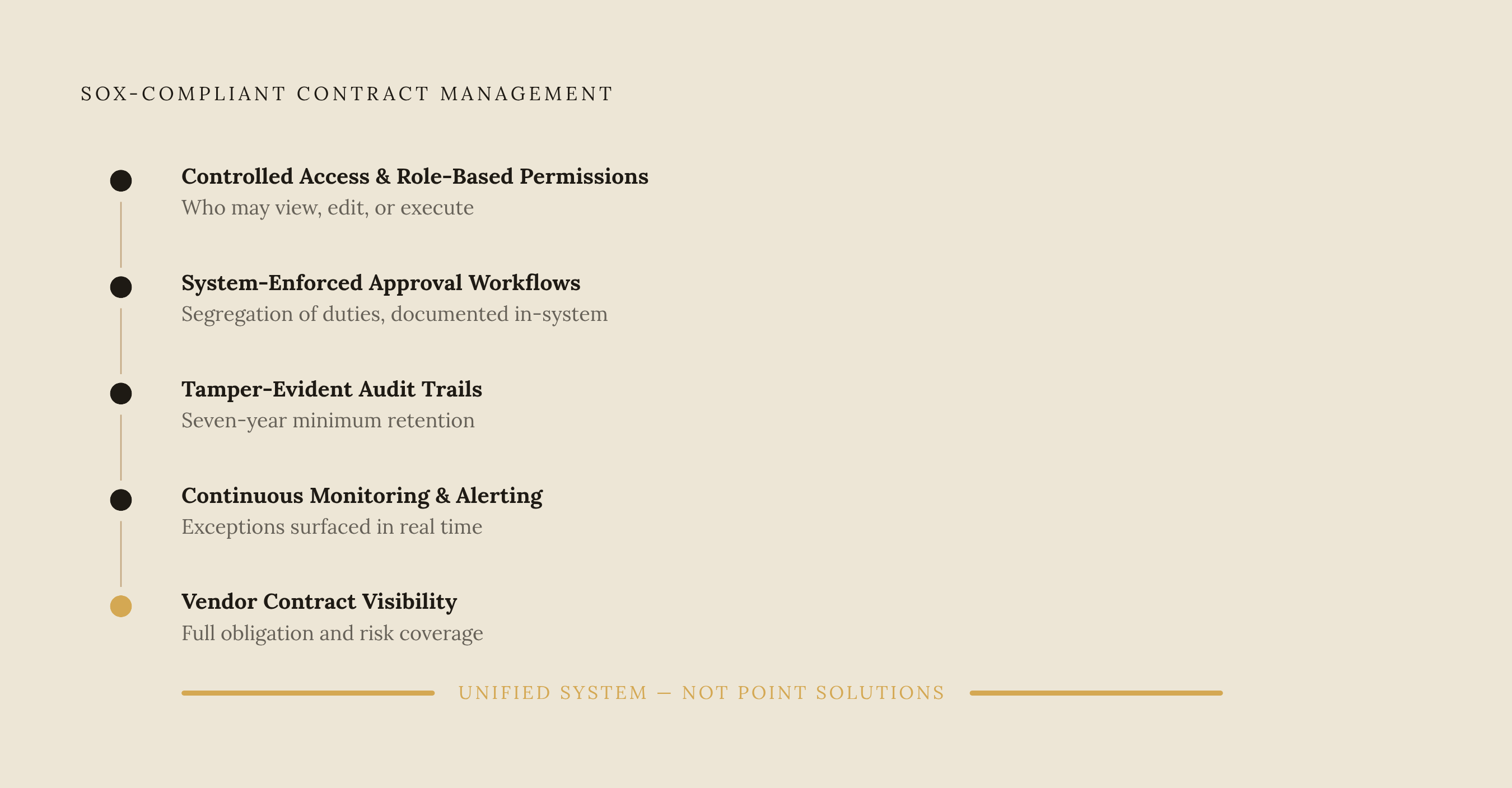
A contract management process that satisfies SOX across Sections 302, 404, 409, and 802 requires five interconnected capabilities operating as a unified system rather than separate point solutions. The first is controlled access and role-based permissions, so that only authorized individuals can create, review, approve, or amend contracts at each stage, enforced by the system rather than by convention. The second is documented, system-enforced approval workflows with segregation of duties, where the approval chain exists as a process the platform enforces and produces a log as a byproduct, rather than a policy individuals are expected to follow voluntarily. The third is tamper-evident, seven-year-minimum audit trails, with every signature, approval, access event, and modification recorded with a system-controlled timestamp and protected from alteration, retrievable on demand. The fourth is continuous monitoring and alerting, with controls tested across the full contract population on an ongoing basis and real-time flagging of anomalies, missing approvals, non-standard terms, and expiring obligations. The fifth is vendor contract visibility, so that all third-party agreements touching financial reporting are managed within the same controlled environment, with audit rights and control reporting obligations embedded in the contract terms themselves.
Docusign's Intelligent Agreement Management platform is built to provide all five capabilities within a single environment, supporting the full SOX compliance obligation across contract creation, negotiation, signature, and post-execution management. Agreement Manager and CLM provide the workflow enforcement, role-based access controls, and obligation tracking that Section 404 controls demand across the contract lifecycle. Workflow Builder, also known as Maestro, enables no-code automation of approval routing and escalation, making segregation-of-duties enforcement accessible to Legal, Finance, and Operations teams without requiring IT development resources. Integration with more than 1,000 third-party applications, including ERP and revenue systems, means the contract management control environment connects to the financial reporting systems auditors examine, closing the gap between contract approval and revenue recognition. Each of these capabilities maps to a specific requirement the statute imposes, which is the standard a SOX-compliant process must meet.