Contract Workflow Automation for Regulated Industries
Compliance controls must be built into every step, not added after speed improves.

Contract workflow automation in regulated industries is a compliance infrastructure decision. For it to succeed, the system must enforce sector-specific requirements and show evidence of compliance at each step of creation, approval, signature, and storage. For those who make decisions in legal, compliance, and operations, faster contracting has value only if the controls stay in place.
Why regulated industries cannot treat contract automation as a pure efficiency upgrade
Faster routing, fewer clicks, and quicker signatures make an obvious business case for automation. Contracts in regulated sectors are evidence artifacts that must demonstrate to regulators, auditors, and courts that the right people approved the right terms at the right time, with the required identity verification. Decision-makers therefore have to evaluate process speed and evidentiary strength together, rather than assume that improvements in one will deliver the other.
That tension shapes the design of a contract lifecycle management system from the outset. Removing an approval step may shorten a workflow, but it can also remove a control that the regulatory environment requires. The shift from document-centric to data-centric management adds another layer of responsibility. When AI extracts obligations, routes approvals, and flags risks, the decisions it makes become part of the compliance record. The first question for a regulated-industry project is therefore what the system must prove.
How sector-specific regulatory regimes translate into concrete system requirements
In financial services, signature capture must go hand in hand with identity assurance. Under AML and KYC requirements, electronic signature flows must include identity verification as well as collect a signature. Audit logs must also be court-admissible, with timestamps, tamper-evident records, and attribution to a verified individual. DORA, the EU Digital Operational Resilience Act, adds a vendor contract compliance dimension by requiring ICT vendor agreements to be reviewable for regulatory alignment. A major European bank used an AI compliance agent to review contracts and generate audit-ready reports ahead of the DORA deadline, reducing review cycles from weeks to minutes.
HIPAA sets the baseline for workflows that touch protected health information, which must operate in a compliant environment. For electronic signatures subject to FDA 21 CFR Part 11, the requirements reach into the signature implementation itself. The regulation requires two distinct identification components and linkage between signatures and their electronic records to prevent falsification.
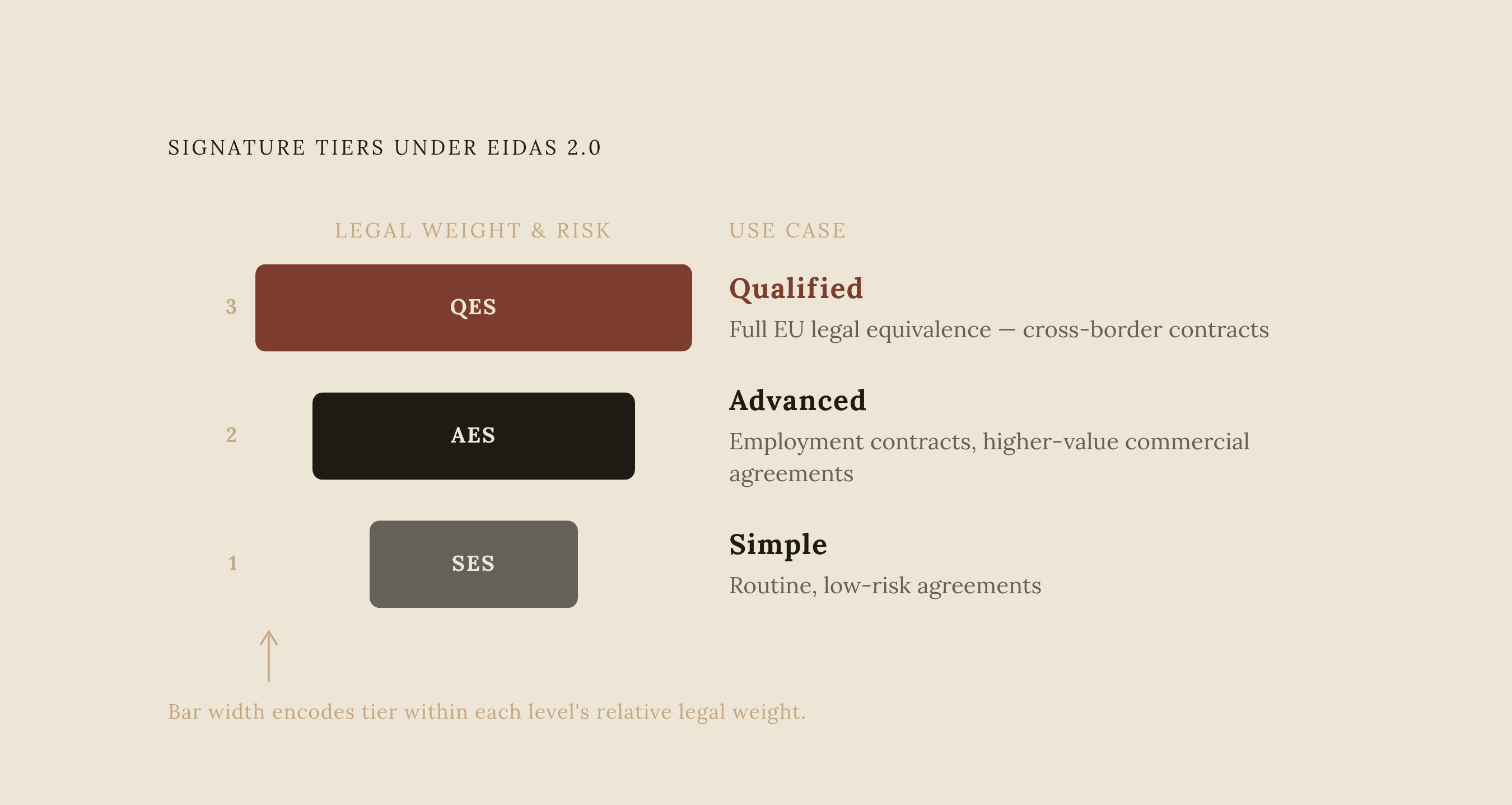
For work across borders and in the EU, eIDAS 2.0 sets out tiers of signatures. Simple Electronic Signatures (SES) form one tier, while Advanced Electronic Signatures (AES) require unique identity linkage to the signatory, sole control over signing data, and tamper-detectable document binding. Qualified Electronic Signatures (QES) have full legal equivalence to handwritten signatures across EU member states. Authentication requirements also have a defined timetable. Every EU member state must make at least one compliant EU Digital Identity Wallet available to citizens and residents by December 24, 2026, and regulated private-sector organizations in banking, healthcare, and telecoms must accept the wallet as an authentication method by 24 December 2027. Platforms deployed across EU jurisdictions therefore need to accommodate wallet-based authentication on their near-term roadmap.
The US legal foundation remains stable under the ESIGN Act and UETA. ESIGN applies nationwide, while the vast majority of states have adopted UETA and New York uses its own equivalent, ESRA. Together, these frameworks give electronic signatures legal equivalence to handwritten signatures across every state, subject to statutory carve-outs for certain document types. Legal recognition is only the starting point. Regulated-sector vendor evaluations add requirements such as HIPAA compliance where applicable, SOC 2 certification, and detailed audit trails.
Where fragmented and manual contract processes create the most acute compliance exposure
Before automation, 15% of renewals are missed or identified too late. In regulated environments, a lapsed vendor contract or expired data processing agreement is not simply an inconvenience and can trigger regulatory inquiry. Manual review creates a related problem when regulations change, because identifying every affected agreement in a large portfolio can take months. During that interval, the organization may be operating under non-compliant terms without knowing it.
Fragmented evidence compounds the problem when an audit begins. Without a centralized, automated audit trail, staff must assemble documentation under pressure, with the risk that records are incomplete or inconsistently formatted. Manual approval routing leaves a different gap in accountability. The wrong person may approve a contract, or the organization may lack a record of who reviewed which terms and when.
As the business grows, it gets harder to keep those weaknesses in check. Agristo, a food manufacturer in Belgium, had a backlog of supplier contracts across multiple jurisdictions as it grew quickly. Lengthy reviews made compliance checks a bottleneck that slowed supplier onboarding. AI-assisted review cut that review workload by a great deal. The case illustrates how a process that depends on manual checks can struggle when contract volume and jurisdictional complexity increase together.
The compliance-first automation framework and its requirements at each lifecycle stage
A compliance-first framework requires teams to enforce regulatory requirements at each lifecycle stage through system controls. At creation, AI-assisted drafting should use a pre-approved clause library based on the organization’s legal playbook and the regulatory requirements now in force. Generic templates are not an adequate substitute here. The authoring environment should flag deviations before a draft moves into review, because correcting non-compliant language at creation is cheaper than correcting it later. For healthcare and financial services teams, maintaining the library against regulatory updates is part of that control, since a static library becomes a liability as rules evolve.
Approval routing should then translate the contract’s characteristics into the appropriate review path. AI-assessed risk can guide routing by contract type, value, counterparty risk, and regulatory classification, allowing the system to dispatch agreements to the right approvers automatically. Each decision must include a timestamp, user identity, and the reasoning or rule that triggered it. That record connects the approval path to the governance requirement it was intended to enforce.
As a default, teams can require human review of AI recommendations for contracts above a set value threshold and audit lower-risk contracts in batches. Teams should establish those boundaries before allowing the system to approve high-risk agreements autonomously. A narrow, lower-risk pilot provides a way to test accuracy and assess limitations before expanding scope.
At signature, teams should select the signature tier according to the agreement’s compliance needs rather than the convenience of the signing experience. SES is suited to routine low-risk agreements, AES to employment contracts and higher-value commercial agreements, and QES to contracts requiring full legal equivalence to a handwritten signature in EU member states. Identity checks form a separate control layer. Multi-factor authentication, biometric identity checks, and government-issued ID verification are becoming expected baseline capabilities for regulated deployments. Where Part 11 applies, teams must check that the way signatures are set up meets its rules for identification and record-linkage.
After execution, monitoring should track obligations, vendor performance metrics, and regulatory deadlines continuously, with alerts to the relevant team when a milestone is at risk. Signature does not close the compliance obligation. Notifications for approaching renewal windows, SLA breaches, and regulatory changes give teams a way to act before an unmanaged obligation becomes a compliance gap. AI-powered systems are more than 90% accurate at finding critical contract events and potential violations, which helps them give these early warnings.
Storage must preserve the evidence needed to explain the agreement’s lifecycle. Audit-ready reporting should be available on demand. This requirement belongs in the data architecture itself. If a repository holds signed documents but cannot produce the required reports, some of the compliance work stays outside the automated workflow. Creation, approval, signature, and monitoring must all add to a record that teams can still use after execution.
How Docusign's IAM platform is built to meet these requirements
Docusign's Intelligent Agreement Management (IAM) platform provides a concrete example of a connected lifecycle architecture. Its AI-assisted drafting capabilities, clause libraries, and Agreement Desk support the use of pre-approved, compliant language from the authoring stage. Workflow Builder extends those controls into conditional approval routing. Legal and compliance teams can build routes based on value, type, and geography without help from IT. That ownership supports teams that need to update workflows as their requirements change.
The platform’s electronic signature tools support tiered authentication, with multi-factor authentication and identity verification options that fit the needs of regulated use cases. Its legal foundations include ESIGN, UETA, and eIDAS. The audit trail captures actions, routing decisions, approvals, and versions with timestamps and user identities. Evidence remains connected to the workflow that produced it. These capabilities map to the framework’s authentication and recordkeeping requirements, while the implementation still needs to be evaluated against the organization’s applicable regulatory constraints.
Post-execution monitoring through IAM tracks obligations and proactively surfaces alerts for renewals, milestones, and regulatory deadlines. Integration with third-party applications, including CRM, ERP, and identity management systems, extends workflow controls into the broader enterprise environment rather than leaving them isolated inside the contract platform. Negotiation adds another point for risk detection. Docusign’s investment in agentic AI includes automated redlining for in-house legal teams and proactive detection of exclusivity conflicts and high-risk clauses in non-standard agreements. These capabilities extend the compliance-first approach into negotiation, where deviations can be addressed before execution.
Practical implementation sequence for regulated-sector teams moving from pilot to full deployment
Teams should begin by mapping applicable regulatory requirements before selecting or configuring a platform. HIPAA, Part 11, DORA, AML/KYC, and eIDAS tier requirements must translate into specific system criteria, including signature tier, audit trail depth, identity verification method, and data residency. The mapping establishes a common basis for evaluation. It becomes both the platform selection scorecard and the acceptance criteria for implementation, connecting purchasing decisions to what the organization needs the system to prove.
The next step is a lower-risk, high-volume pilot using confidentiality agreements, standard vendor agreements, or routine procurement contracts. These categories provide enough activity to generate useful accuracy data while keeping errors recoverable. The pilot should test AI clause extraction and risk flagging, check how well users accept the system, and find gaps in human review. Accuracy is not the only acceptance test. The team also needs to understand how people use the workflow before it reaches high-stakes agreements.
Before they expand the pilot, teams should set the contract types and value thresholds that call for human review of AI recommendations. Human involvement is essential for contract exceptions, non-standard clauses, negotiation positions or concessions, complex risk assessments, and model exceptions. These boundaries need to be explicit in advance. They give reviewers a defined role in the process and allow the pilot’s findings to inform the wider deployment.
The audit trail architecture should be established before the system takes on contracts likely to face regulatory examination. Teams should confirm that every routing decision, approval, version, and notification is captured with timestamp, user identity, and structured reasoning. On-demand reporting belongs at this stage as well. Configuring it before expansion allows documentation to be produced in minutes rather than assembled over weeks, making audit readiness part of normal operation.
Finally, teams should extend the deployment into post-execution monitoring and connect it to CRM, ERP, and identity management systems. Real-time alerts should cover renewal windows, SLA milestones, and regulatory obligation deadlines to keep controls in place after signature and across the enterprise stack. Time to Sign (TTS) reduction and compliance metrics together establish the case for continued investment.